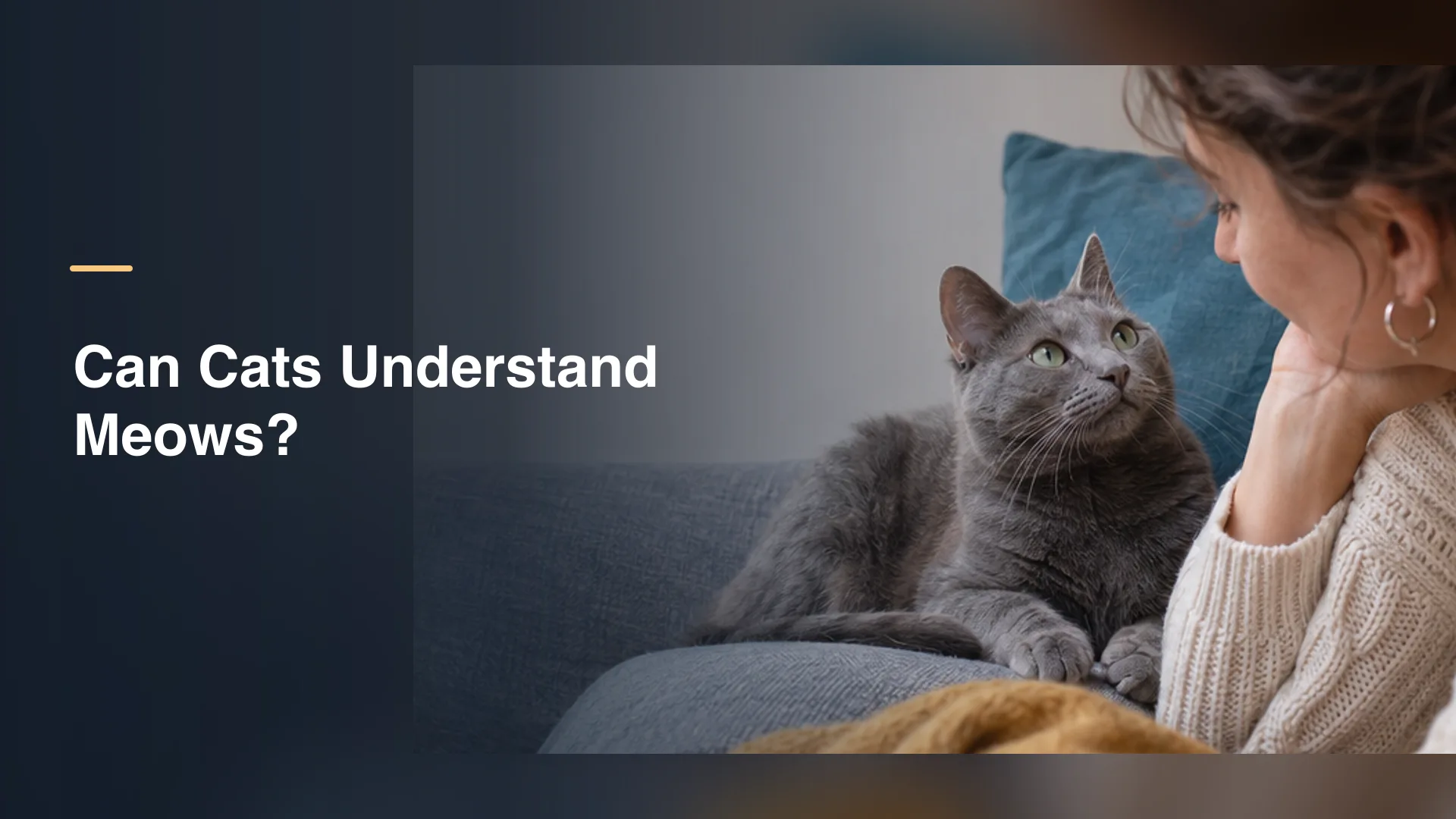
Cats may turn, approach, or vocalize when a person imitates a meow. These responses show that the cat noticed or reacted to something in that situation. Studies of familiar human speech give clues about why that happens. They leave open whether a human imitation carries a specific meaning for the cat. The person’s familiar voice, the timing, and what usually happens next can also help explain the response.
Cats also make sounds to other cats, particularly in interactions like those between a mother and kittens. Adult cats have other ways to communicate with one another, including posture and scent. The meow you make at home is one sound in a larger interaction. You will usually learn more by watching how the cat responds than by trying to pick the right syllable.
What a Cat’s Reaction Can Tell You
If you imitate a meow and your cat swivels an ear, you have seen them orient toward a sound. If they walk over, you can see they chose to come closer. If they meow back, you heard a response. None of these observations tells you which feature of your sound caught their attention. Pitch, novelty, your familiar voice, and the expectation of an interaction are all possible explanations.
What you see | What you can describe | What remains open |
|---|---|---|
One ear turns toward you | The cat oriented toward the sound | Whether they noticed your voice, pitch, or a novel noise |
The cat comes closer | The cat approached in that situation | Whether they expected attention, food, or simply wanted to look |
The cat makes a sound back | A vocal response followed your sound | Whether their call relates to you or something nearby |
The cat turns away or leaves | The cat increased distance or shifted attention | How much of the response was about the sound |
Imagine you walk into the kitchen just before dinner and imitate a meow. Your cat answers and moves toward the cupboard. You were in a familiar place at a familiar time, and the sound came from a person the cat knows. “They walked to the cupboard when I came in” is an observation you can check another day. “My meow told them dinner was ready” adds an explanation that the scene alone cannot settle.
A different result can be just as informative. Suppose the cat turns toward you, then relaxes again without getting up. They noticed something and decided to stay where they were. That is a complete observation. There is no need to keep making the sound louder or repeating it until they do something else.
If your cat responds to a familiar person but ignores the same noise from a visitor, note who made it and when. The visitor’s position, voice, and the cat’s comfort around that person all differ. You can compare those two scenes without deciding which part mattered most.
What Cats Have Recognized in Experiments
In a playback experiment, Atsuko Saito and Kazutaka Shinozuka had domestic cats hear their owners’ voices and unfamiliar voices while the speakers were out of sight. Cats distinguished their owners, often showing small movements of the ears or head. The researchers measured the cats’ reaction to a familiar person’s recorded voice. The study did not ask the cats to interpret human imitations of meows. Saito and Shinozuka’s original study
Charlotte de Mouzon and colleagues studied whether cats respond differently when people speak as they do to a cat or as they do to another adult. The participating cats showed a difference when their owner used the two styles, while the unfamiliar speaker did not produce the same distinction. This tells us that who is speaking can matter alongside the way the sound is made. De Mouzon and colleagues’ cat-directed speech experiment
A separate experiment found that cats could distinguish their own name from other words under the tested conditions. That finding supports a narrower idea: a familiar sound can stand out. It gives you a reason to try the cue your cat hears regularly when you want their attention. It gives no basis for assigning a shared feline meaning to a person’s “meow.” Saito and colleagues’ cat-name study
Do Cats Meow to One Another?
Young kittens call to their mother, and cats can vocalize around other cats. In the home, adult cats commonly meow around people. A cat around another cat can also use whisker and ear position, body orientation, scent marks, distance, and other calls. You need the whole interaction to decide how to read one sound. A kitten calling near its mother and an adult cat calling at a person’s bedroom door are two different scenes.
If one household cat calls and the other looks over, you can say the second cat noticed the call. Watch for what happens next. A familiar cat may approach, keep a distance, or continue what they were doing. When the cats have just seen movement through the window, they may both be tracking the same thing. The sound may be part of the interaction without being its only cause.
A recording played from a phone also changes the situation. The speaker is in one place, the person holding it may be in another, and the sound has no visible animal attached to it. If your cat checks the speaker or leaves, let that be the end of the observation. Playback cannot recreate a whole exchange between animals.
If you’re trying a tool that plays or labels a call, check what a cat translator app can actually do before reading anything into the response.
How to Get Your Cat’s Attention Without Guessing at a Meow
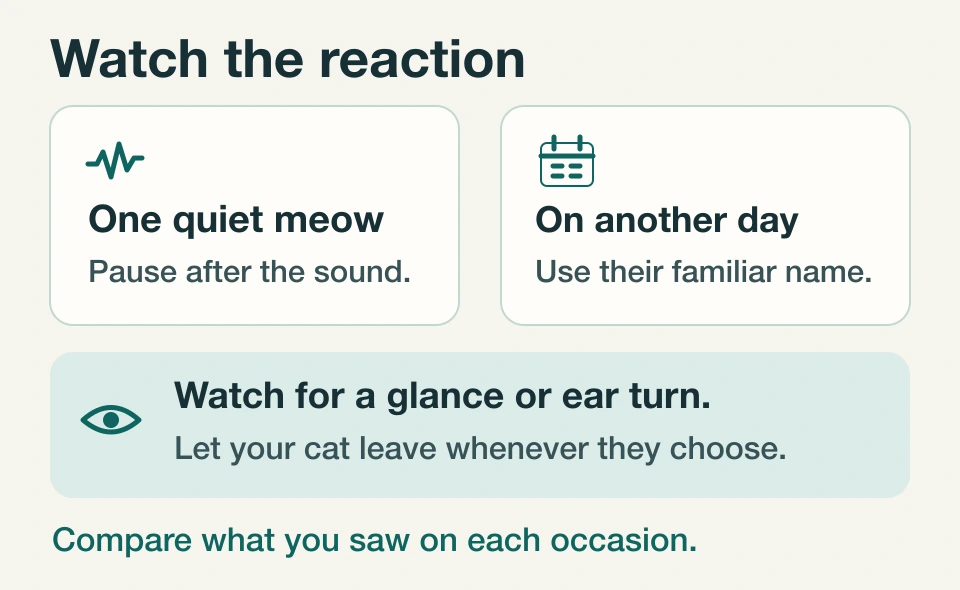
Choose a moment when your cat is awake and relaxed. Use your usual voice and a familiar cue, then give them a chance to look your way. You are looking for a small response such as an ear turn or a glance. If they look away or choose to leave, pause. Keeping the interaction optional helps you notice a genuine response.
Watch the first reaction When your cat hears you, look for a glance, ear movement or a pause instead of waiting for a dramatic answer. Those quiet changes are often the only thing you can confidently describe.
If you imitate a meow for fun, use a comfortable volume and make it once. Notice what the cat was doing before the sound, then what changed. Compare it with an ordinary moment when you use their name on another day. If they turn away or move off, let the interaction end. Even a familiar cue can get little response when your cat is interested in something elsewhere.
When you want a practical response, make the surroundings help. Speak from where the cat can see you, keep the words familiar, and give them room to choose. You may find that your usual voice at a predictable moment does everything you needed from the interaction. You can still play with a meow as a sound without deciding that it carries a particular request.
If your cat is making the call, see how to interpret a familiar pet cat's meow.
Takeaway
Cats can notice a human meow and may respond to it. Familiar voices, ordinary routines, and the rest of the scene can help explain what you see. Use a familiar cue when you want their attention and give them room to respond in their own way.
PetMira for iPhone
Record your cat’s natural calls
If your cat meows during an ordinary interaction, record their call on iPhone and compare the AI interpretation with what was happening.
 Capture a call your cat makes on their own
- Compare the suggestion with where your cat looked or moved
The recording helps you look back at your cat’s call. Their response to your voice is something you observe in the moment.
Download iOS App