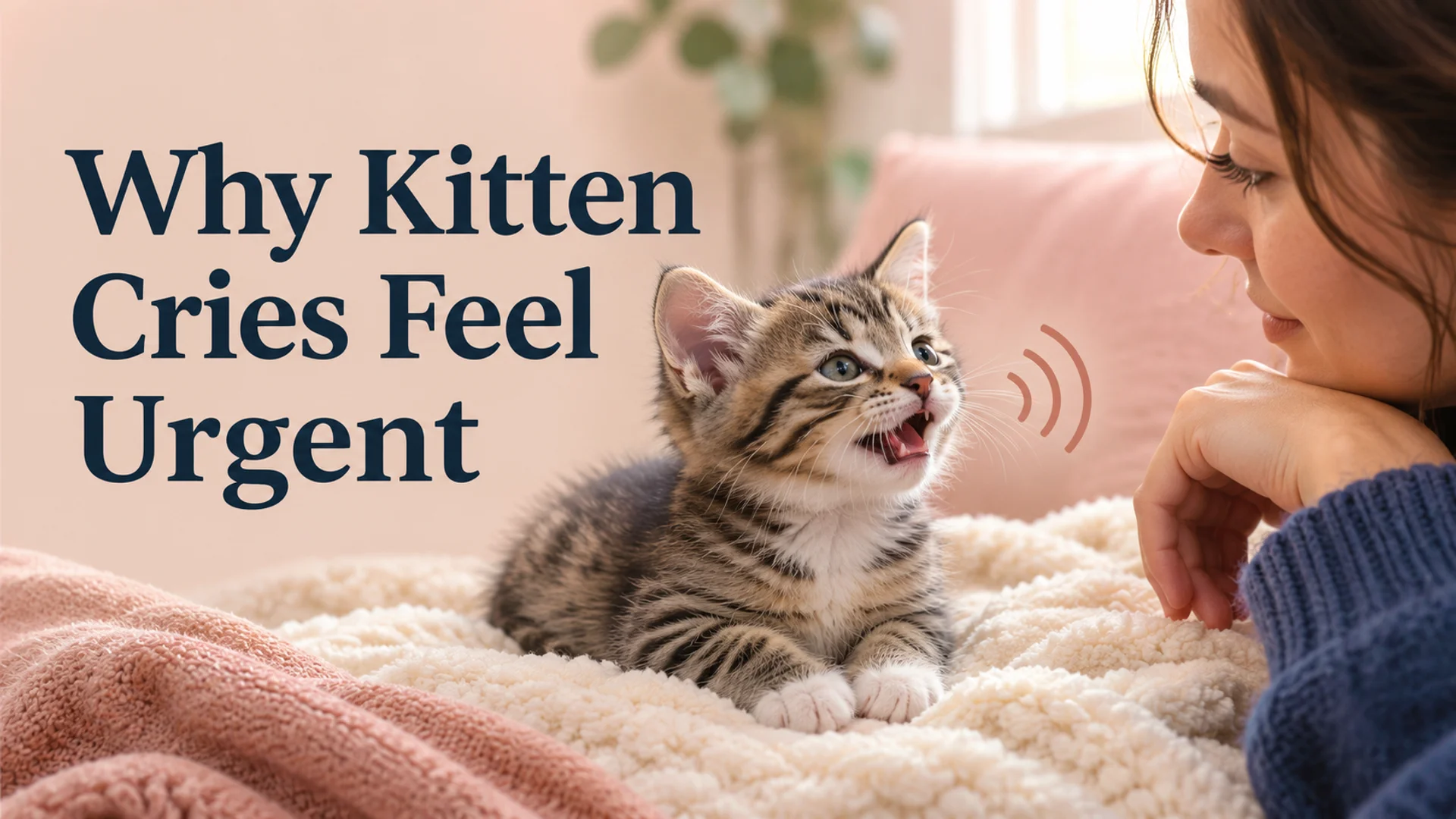
Kitten cries can feel urgent because they are noticeable calls from a dependent animal. Listening studies also associate cat ownership with more negative ratings of recorded cat meows. Research supports a role for the sound itself and the listener's background. It also leaves a gap between feeling a strong reaction and knowing what a particular kitten needs. The useful response is to pay attention, look at the kitten and use the surrounding situation to decide what to do.
A brief call from a comfortable kitten beside its caregiver and repeated cries from a kitten that cannot feed may both make you want to help. Your reaction tells you that the sound caught your attention. What happens around the call gives you the information needed for the next step. Seek veterinary advice promptly for a kitten that is weak, cannot nurse or seems unwell, and get emergency help for difficulty breathing. Recording the sound can wait.
Evidence | What was measured | Boundary to keep |
|---|---|---|
Human ratings of dog and cat sounds | How negative or sad recorded sounds seemed to listeners | A strong rating does not reveal a kitten’s need |
Food-solicitation purr experiment | Urgency and pleasantness ratings, including a modified recording | Adult-cat purr evidence is distinct from kitten meowing |
Kitten isolation-call studies | Call acoustics or responses by adult female cats | A measured call feature or feline response is not proof about a human brain |
Human meow-context task | Ability to match a meow with its recording situation | Hearing emotional significance does not guarantee the right context |
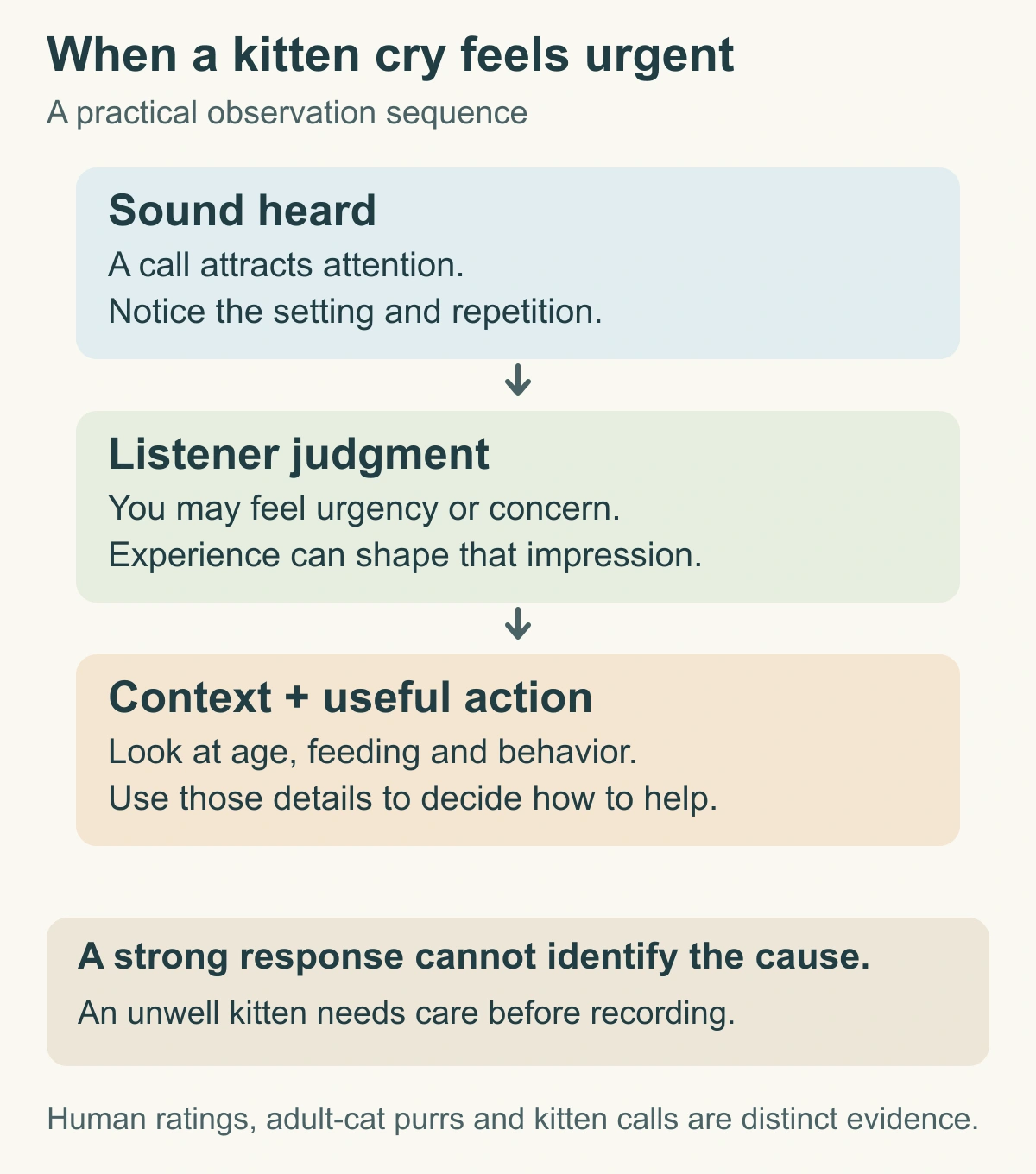
Sound and context both shape the feeling of urgency
A kitten has limited ways to obtain a caregiver's attention. Its call can be heard when it is out of view, and repeated vocalizations can keep drawing your attention back to the same location. You may already associate that particular kitten's voice with feeding, a brief separation or a familiar approach. The sound arrives with those expectations, even if you cannot immediately see the caller. This makes it worth distinguishing the sound you heard from the story you first attach to it.
Suppose you hear a small cry while preparing food. You may immediately assume the kitten is hungry because that explanation fits the familiar setting. When you turn around, the kitten may walk toward the bowl, or it may be trying to follow another cat through a closed door. Those observations lead to different questions. Check what the kitten actually does and whether normal care has happened before settling on an explanation.
Acoustic researchers can measure how calls vary in pitch, duration and other features. Studies of kitten isolation calls have found differences between calls recorded in different arousal conditions. Those recordings establish that a kitten's vocal output can change with the situation. They do not give an owner a reliable sound-only dictionary. The age, individual and recording conditions matter when anyone tries to move from a measured feature to a claim about need.
What studies of human listeners actually found
In a 2019 study, researchers asked 561 young adults to rate animal distress sounds. People who owned pets generally rated the sounds as sadder than people without pets, and cat owners gave especially negative ratings to cat meows. This was a listening task using recorded sounds. It shows an association between pet experience and the way people judged the recordings. It does not establish that each recording came from a kitten or identify a specific medical problem behind a call.
That study of human listeners also illustrates why a familiar headline can oversimplify a result. The paper reported that dog whines received negative ratings comparable with human baby cries. That comparison concerns dog sounds. It gives no basis for telling a reader that a kitten cry produces an identical emotional or brain response to a crying human infant. When evaluating a claim, keep the tested sound and the measured response in the same sentence.
A second study, published online in 2024, asked 237 participants about dog and cat distress vocalizations, empathy and pet care. Current pet owners rated the animal sounds as sadder than nonowners. Sensitivity to the recordings was not a strong indicator of the care people reported giving their pets. The researchers also noted that the animals' ages and the true causes of the original sounds were unknown. A strong response can encourage attention, while useful care still depends on what you do next.
Why the famous purr finding needs its own label
You may have heard that cats use a baby-like cry inside a purr to make humans respond. A 2009 experiment did find that people rated purrs recorded during food solicitation as more urgent and less pleasant than other purrs. Removing an embedded voiced component reduced the urgency ratings. This was research on a particular kind of cat purr, with people judging the recordings. It helps explain how an acoustic component can affect perception.
A kitten meowing from its bed is a different event from that experiment's food-solicitation purr. You can discuss the purr finding as related evidence without treating it as a complete explanation for every young cat's call. The same care applies to research in which adult female cats responded more quickly to higher-arousal kitten calls. The listeners in that study were cats. Their responses answer a question about feline care and communication, while the question here concerns a human listener.
Feeling that a call is meaningful does not tell you its cause
Write the observation before the interpretation Start with “called after the carrier door closed, then settled in a quiet room.” Add a possible emotion separately, and revise that interpretation when new details appear.
In another study of human interpretation, participants heard meows recorded while cats were waiting for food, isolated or being brushed. Matching the recording to its context proved difficult overall. The finding supports a practical distinction. You may readily hear a sound as engaging, pleasant or upsetting and still struggle to identify what happened before it. This is one reason a short clip becomes more informative when it is paired with an observation from the same moment.
Write “called from the carrier after the door closed, then settled when the room became quiet” before you write “scared.” Keep the first statement even if you later change your interpretation. If another household member heard the sound from a different room, ask what they saw immediately afterward. They may have a detail that changes the explanation, such as the kitten following the food bowl instead of continuing to hide.
Our guide to why kittens meow helps you apply feeding stage and behavior to that separate care question. If the birth date is unknown, our kitten appearance guide explains visible developmental clues without assigning an exact birthday. For a broader view of posture and the choice to approach or move away, read cat language and signals. These observations can help you respond to the individual kitten after the sound has done its job of attracting attention.
Use a recording to remember a moment, then follow the kitten
If a healthy, settled kitten makes a familiar call naturally, you can save a brief recording to revisit the sound. On iPhone, PetMira can record a pet vocalization and provide an AI interpretation. Keep your own note of the location and what happened before and afterward. Compare the suggestion with those observations. The app can offer another interpretation to consider, while a clinician can assess health concerns directly.
Avoid replaying distress calls to see how you or the kitten reacts. You already have the ordinary observation in front of you, and an experiment that prompts more crying adds little to the immediate care decision. If the kitten moves away from a phone or seems unsettled, stop and let it return to a comfortable setting. A reassuring response can be quiet and practical, even when the sound initially feels very urgent.
What to take from that strong response
Let the cry direct your attention to the kitten, then check the stage, setting and accompanying behavior. Research explains some differences in how listeners perceive animal sounds, while the individual situation determines the useful next step. For a familiar, comfortable call you choose to save in PetMira, keep the context alongside your interpretation.
PetMira for iPhone
Compare a familiar call with its context
PetMira can record a pet vocalization and offer an AI interpretation. Use a naturally occurring, comfortable moment, then compare the suggestion with what you observed before and after.
 Record a familiar vocalization when the kitten is comfortable
- Consider an AI interpretation alongside your own observations
AI interpretation cannot diagnose illness or replace veterinary advice. Care comes before recording.
Download iOS App