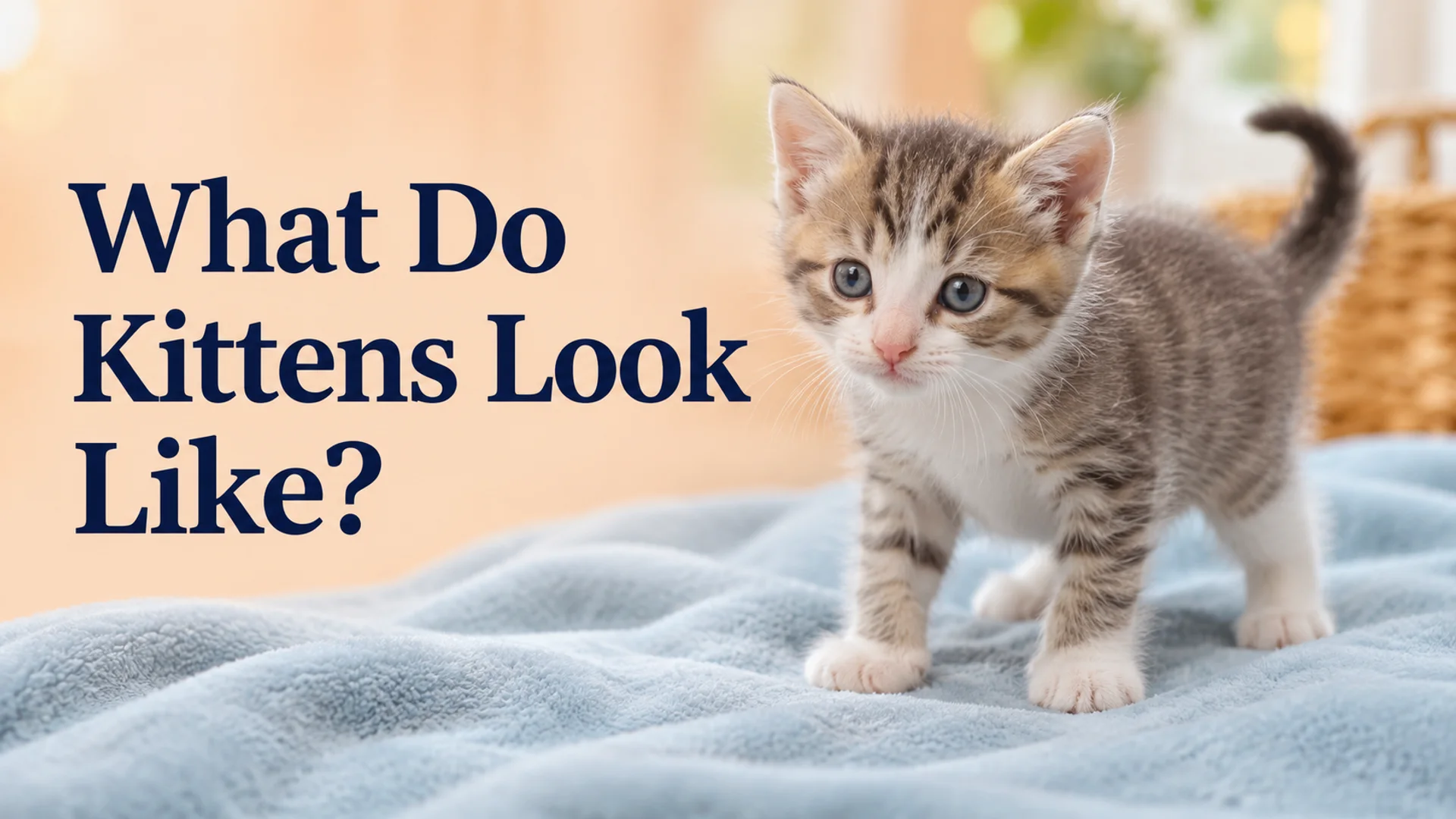
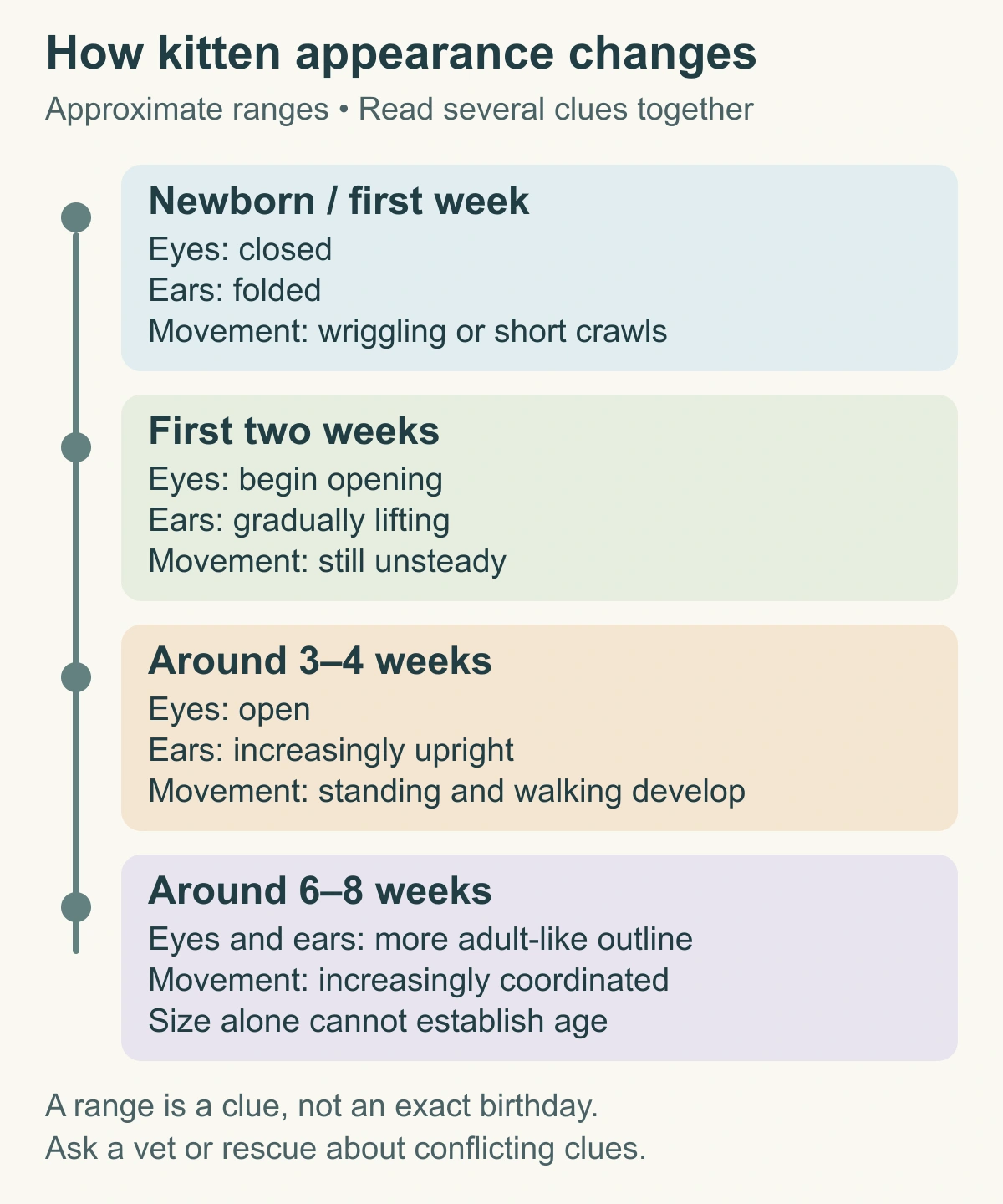
Newborn kittens have closed eyes, folded ears and limited movement. Over the following weeks, their eyes open, their ears become upright and crawling develops into increasingly coordinated walking and play. By around six to eight weeks, many kittens look like small versions of adult cats. Those visible changes can suggest an age range, while a known birth date or a veterinarian's assessment gives you firmer information.
If you are looking at a kitten you found outdoors, first consider whether it is safe and whether its mother could be nearby. A kitten that looks cold, injured, weak or unwell needs prompt advice from a veterinarian or experienced rescue. A photograph can wait. For a comfortable kitten with a caregiver present, watch from a short distance and use several visible clues together instead of trying to assign an exact birthday.
Approximate stage | Visible clues to combine | What the picture cannot establish |
|---|---|---|
Newborn / first week | Closed eyes, ears folded, wriggling or short crawls | Whether warmth and feeding needs are being met |
First two weeks | Eyes begin opening; ears gradually lift; movement still unsteady | An exact birthday or independent feeding |
Around three to four weeks | Ears increasingly upright; standing and walking develop | Readiness to leave the mother or manage care alone |
Around six to eight weeks | More adult-like outline and coordinated movement | An exact age, final size or documented ancestry |
Newborn kittens look folded and dependent
A newly born kitten's eyes are sealed shut, and the ears sit folded close to the head. The body is small and rounded, and the legs have little ability to support it. You may see wriggling or a short crawl toward the mother and littermates. The absence of walking is part of the overall picture, together with closed eyes and folded ears. A kitten lying down in a photo, by itself, does not tell you that it is unable to stand.
An umbilical cord may still be visible shortly after birth, but it is an imperfect age marker. It can look different depending on how it was separated and how it is drying. Leave it alone. A missing cord cannot establish a precise age, especially when you have no earlier photo for comparison. Tell the rescue or clinic what you actually saw and let the team combine that detail with the other features.
Very young kittens depend on their mother or a trained caregiver for warmth, feeding and elimination. Looking more active for a moment does not establish that they can manage any of those tasks independently. If the mother is absent and you do not know whether the kitten is nursing, ask for a stage-appropriate care plan. This appearance guide does not supply bottle-feeding amounts, a warming method or a substitute for direct assessment.
Opening eyes and unfolding ears mark a transition
Describe several clues together Say “eyes open, ears still low, mostly crawling” rather than choosing an exact age from one feature. A known birth date or a professional assessment can clarify conflicting clues.
Eyes commonly begin opening during the first two weeks, and the two eyes may open at slightly different times. Several care organizations use broad ranges because kittens do not all follow the same timetable. Never pry an eye open to check its color or take a better photo. If an eye is swollen, has discharge or seems uncomfortable, contact a veterinarian promptly rather than treating it as a late milestone. Swelling beneath a closed eyelid, or discharge before the eye has fully opened, needs immediate veterinary assessment.
At this stage, ears gradually lift away from their early folded position. Movement may still look low to the surface and unsteady. A photograph with open eyes can therefore show a kitten that still needs substantial support. Use the combination of eyes, ears and what you actually observed it doing. An alert expression does not prove that a kitten is ready to leave its mother, eat independently or explore an unsecured room.
For example, you might see a kitten with open eyes whose ears remain rounded against the sides of its head. It wriggles toward a sibling but does not walk steadily. “Eyes open, ears still low, movement mainly crawling” gives a rescue team a clearer picture than “looks about two weeks.” The team can ask follow-up questions without first having to undo the precision implied by a guessed date.
Upright ears and steadier movement change the outline
During the next few weeks, the ears become more upright and the kitten's outline starts to look more familiar. Standing becomes easier, and short, wobbly steps develop into coordinated movement. You may see play with littermates and an increasingly deliberate approach toward nearby objects. Keep the floor-level view in mind. A kitten crouching under a chair can hide both the leg length and the posture that you are trying to compare.
Baby teeth also develop during early kittenhood, but checking them safely takes more than a photograph of a closed face. Do not force a kitten's mouth open to fill in a chart. If the kitten is already comfortable being handled by its established caregiver, that person may have useful observations to share. Otherwise, ask the clinic to assess the teeth along with the kitten's overall growth and condition.
A kitten with upright ears and confident movement can still be learning to eat. Watch the actual meal before describing it as independent. Approaching a bowl, licking food once and leaving is different from eating a sufficient meal. If feeding stage is uncertain, say so when you ask for advice. Once the kitten is independently eating solid food, our kitten feeding schedule guide can help an owner discuss an ordinary routine with their vet.
Older kittens look more adult without being finished growing
By about six to eight weeks, the proportions and movement often resemble a miniature adult cat. The eyes are open, the ears stand clearly on the head, and the kitten can move around and interact with the environment. This is an approximate stage description. A smaller or poorly nourished kitten can appear younger, and littermates may differ in size. Body weight alone cannot tell you whether all the expected abilities have developed.
Early blue-looking eyes can also change as pigmentation develops. Lighting affects the color in a picture, so a single image gives you limited information about the final eye color. Coat texture and facial proportions may keep changing as the kitten grows. If you are curious about breed resemblance, keep the photograph as a record and keep ancestry claims provisional. A confident-looking kitten face cannot establish its pedigree.
An independently eating kitten entering a new home needs a safe introduction and predictable care. Our first-week kitten care guide covers that separate task. The visible development clues here help you explain the animal in front of you, while the arrival guide helps you set up the home once the kitten is ready for that stage.
Make a useful visual record without disturbing the kitten
Choose a relaxed moment and take a view that shows the head and body together. A second image from a similar angle on another day can reveal gradual changes more clearly than a close-up made with a different lens. Write the date, who was present and what you observed the kitten doing. When birth date is unknown, retain “estimated” alongside any age range supplied by a rescue or veterinary team.
PetMira's photo-based care log can keep eye or coat images in time order. Use the available record for what is visible, with ordinary notes elsewhere for feeding or movement. It does not calculate a reliable birthday or confirm that a kitten can be weaned. If the reason you are watching is repeated crying, our kitten meowing guide covers how the feeding stage and accompanying behavior change what to check next.
What to remember when comparing kitten appearances
Read eyes, ears and movement together, and treat age as a range when the birth date is unknown. Keep comparable photos if doing so is comfortable for the kitten, and let the caregiver or veterinary team resolve conflicting clues. With PetMira or a simple photo folder, the useful record is the one that preserves what changed and when.
PetMira for iPhone
Keep a comparable record as your kitten grows
Use PetMira’s photo-based care log for eye or fur images you want to revisit. Match the angle and lighting, and keep estimated age separate from a known birth date.
 Keep eye or fur photos with the kitten’s profile
- Revisit visible changes over time
A photo log cannot determine a reliable birthday or replace veterinary assessment.
Download iOS App