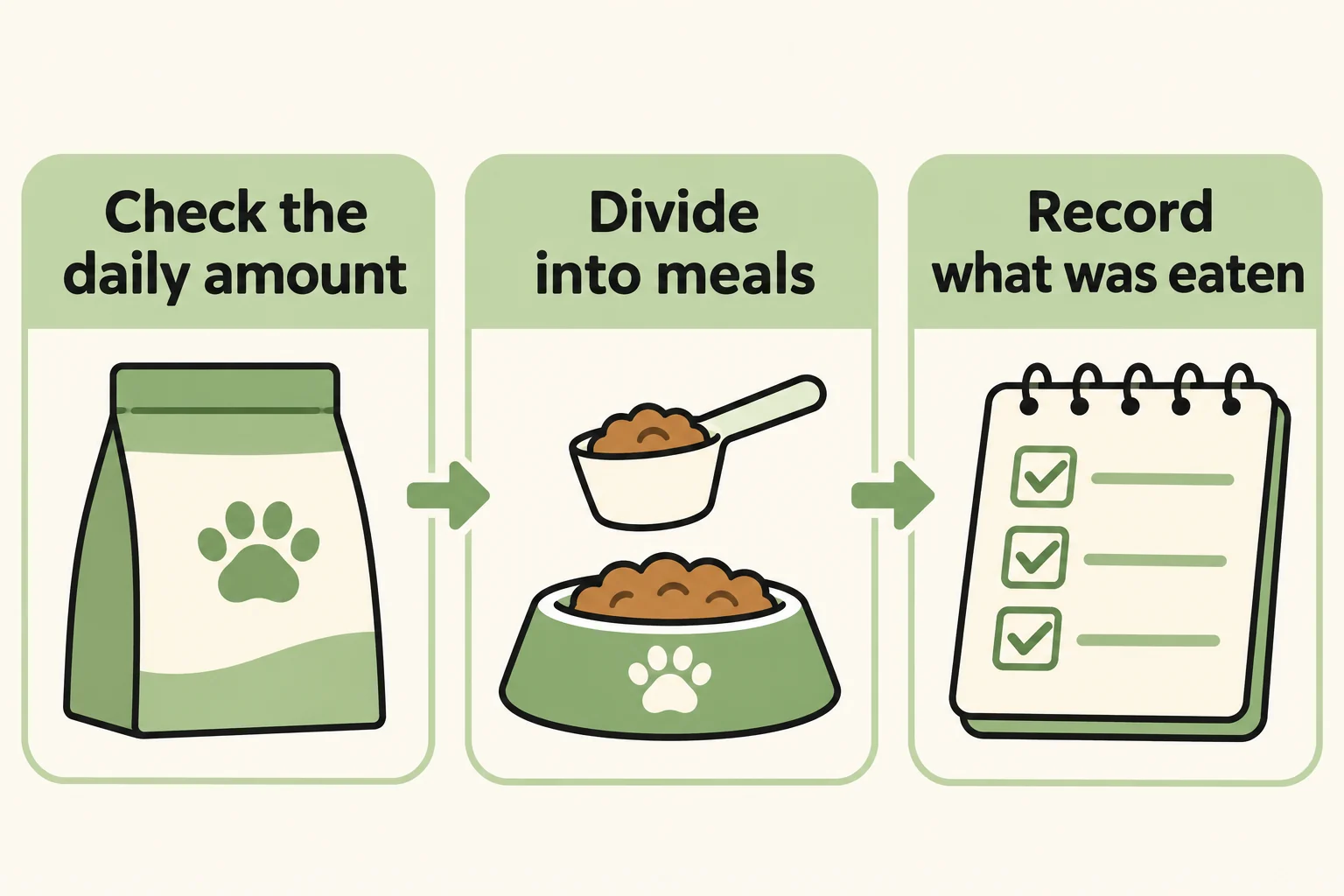
For a healthy kitten who already eats solid food, start with three or four small meals spaced through the day. Use the daily amount from your vet or the feeding directions for your specific kitten food as a starting point. Divide that total into meals, note what your kitten actually eats, and review the plan as they grow. A feeding schedule is most useful when it fits both the kitten in front of you and the people who have to follow it.
If your kitten still needs milk, hasn't been fully weaned, or is ill or underweight, ask your vet or rescue for an individual plan. The meal examples below are for independently eating kittens and start after the transition to solid food.
Choose the feeding routine that fits your kitten's stage
A kitten's ability to eat independently matters more than the date on a calendar. Ask the shelter, rescue, or breeder what your kitten eats now, how much they offer each day, and when they serve it. If the kitten just came home, keep the familiar food and meal pattern at first if you can. Starting with what they already know also gives you a useful comparison if their appetite changes.
Young, recently weaned kittens often do well with several small meals. VCA's guidance for growing kittens describes three to four or more small meals as suitable for most. An older kitten may be able to manage fewer meals, but change the schedule based on their appetite, growth, and your vet's advice. Ask for a review after spaying or neutering, when their energy needs may change. Keep using a food formulated for growth until your vet says it's time to move on. Use the age ranges below to decide what to check as your kitten grows, and let their feeding history and growth guide changes.
Stage | Practical next step | Check before changing the plan |
|---|---|---|
Still nursing or in the middle of weaning | Ask the vet or rescue for an age-appropriate feeding plan | Can the kitten eat enough on their own? |
About 2–3 months, fully weaned | Offer several small meals of complete kitten food | What food and amount were they actually eating before? |
About 3–6 months | Revisit the portion and meal pattern as their growth changes | Does the kitten finish meals and follow their expected growth trend? |
About 6–12 months | Review the routine as growth slows and ask when to transition | Timing depends on their growth and your vet's assessment |
Read the label for a daily amount
Choose a complete, balanced cat food with a nutritional adequacy statement that covers growth. On US labels, look for wording that includes growth or all life stages. Check the feeding directions for the kitten's age or weight and find out whether the amount is given per day or per meal. Ask your vet to help you interpret a broad range or a label with several columns. The directions belong to that formula, and a vet can adjust the starting amount for your kitten.
Keep the units consistent. If the label gives grams and you have a kitchen scale, weigh the food in grams. If the label uses a fraction of a can, check that you're using the can size it describes. When you change brands or switch to a different recipe, read the new label before using the old scoop or serving size. Two portions can look similar in the bowl while providing different amounts of energy.
Check the time unit before you scoop Circle or write down the words “per day” if that's what the label says. That total gets shared across the day's meals. It is easy to offer the whole day's amount several times when different people use the same feeding chart.
Turn the day's food into a schedule
Pick meal times someone can reliably cover. A four-meal pattern could be breakfast, midday, early evening, and later in the evening. For a healthy kitten with a three-meal plan, you might use breakfast, after work, and later in the evening. These are scheduling examples. If your kitten is young and your workday leaves a long gap, ask your vet how to keep a workable meal routine during the long gap.
Suppose the daily amount you and your vet are working with is 60 grams of one food. Four equal meals would be 15 grams each. Those numbers show the division only. Your kitten's daily amount comes from their actual food and care plan. If one person feeds breakfast and another handles dinner, post the schedule by the food and mark a meal as served. Record a partial meal or leftovers as well as an empty bowl.
If two kittens share a home, offer food in separate quiet spots so you know who ate what. Give each kitten time to finish before you move the bowls. If one always empties both and the other hangs back, a single combined total can't tell you whether both got enough. Make the meals easier to observe first, then use those observations to decide what to discuss with the vet.
Keep track when you mix wet and dry food
Either wet or dry food can fit a feeding plan if it meets your kitten's growth needs. If you offer both, work from one combined daily plan. A full daily serving of dry food plus a full daily serving of wet food gives two separate daily amounts. Ask your vet for a split if the labels only describe each food on its own. A simple note such as “wet at breakfast and dinner, dry at midday” can help everyone follow the same plan.
If you want to replace one dry meal with wet food, bring both labels to the conversation. The two packages may show energy in different units, such as calories per cup and calories per can. A spoonful of one food may contribute a different amount of energy from a spoonful of the other. Once you've worked out a split, write down the exact food and serving unit beside each meal. That gives the person feeding tomorrow something they can repeat.
Keep fresh drinking water available. Serve wet food in portions you can offer fresh and follow the package directions for storing leftovers. If the meal schedule has to change, start by keeping the total and the food familiar. Change one part of the routine at a time when practical. Then it's easier to tell whether the kitten is reacting to a different food, a new location, or simply a meal served at a different time.
Review what your kitten eats and how they grow
Use a short record for the first few days or after changing food. Write down the time, food and amount offered, and roughly how much was left. If your vet asks you to weigh your kitten at home, record the date and use the same scale so the measurements are easier to compare. Share the trend at checkups. A growth pattern and a clear account of what they eat are more informative than whether they licked the bowl clean once.
If the bowl keeps coming back full, first make sure you know who served the meal and whether a second animal ate from it. Tell your vet if your kitten stops eating, repeatedly eats less than usual, isn't gaining as expected, or seems unwell. If the kitten is weak, vomiting repeatedly, or still dependent on milk and struggling to feed, contact a vet promptly for individual advice. Keep the food package handy so you can describe exactly what was offered.
What to remember about kitten meals
Start with a growth-appropriate food, a daily amount that fits your kitten, and several small meals you can reliably serve. Write down what your kitten actually eats and review the schedule with your vet as they grow or their appetite changes.
PetMira for iPhone
Explore PetMira on iPhone
Get to know your cat or dog with tools for sound, photos, and everyday observations.
 Explore AI interpretations of recorded pet sounds
- Get breed suggestions from a photo
- Keep a photo log of visible changes
Available on the App Store.
Download iOS App