
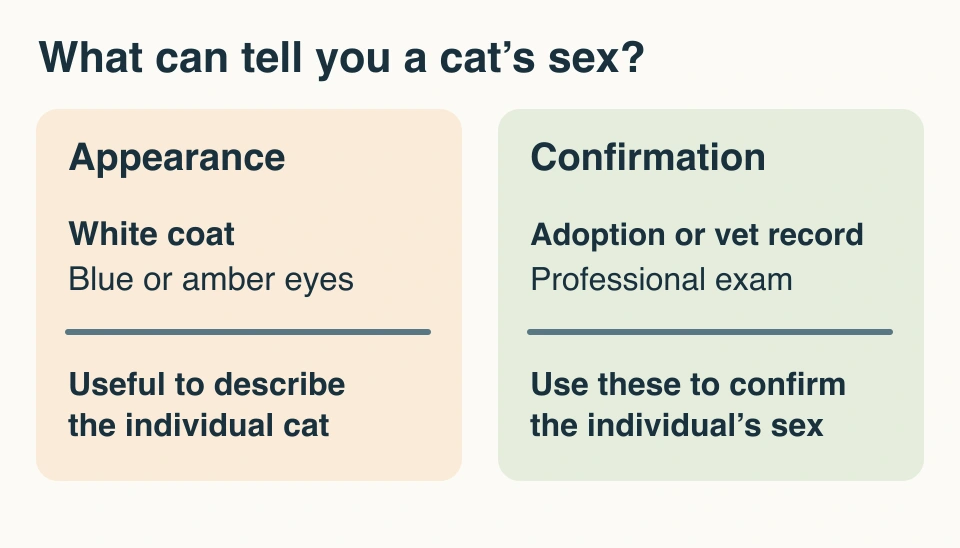
White cats can be male or female. A white coat tells you about pigment in the fur. It cannot reveal an individual cat’s sex. If you are adopting a white cat, check the shelter or veterinary record. If the record is absent or conflicting, ask the care team to confirm at the next exam rather than guessing from its coat or eyes.
The confusion makes sense because some other coat patterns have an association with sex. Calico and tortoiseshell usually involve the orange color gene on the X chromosome, and those cats are predominantly female. The common genetic mechanisms that produce white fur work differently. A white cat does not inherit the same association simply because it has a pale coat.
Why a white coat can appear in either sex
One route to a white coat is the dominant white variant studied in the KIT gene. A cat that inherits the variant can look fully white even when other genes would give it a different color or pattern. In that case, the visible coat does not show every inherited color trait. The dominant white variant is on an autosome, a chromosome outside the sex chromosome pair, so males and females can inherit it.
White spotting is a related but distinct pattern. White areas can cover a small bib, several paws, or so much of the body that other color is difficult to see. A pale, borderline example may look fully white in one photograph and show a patch near the tail in another. That observation helps describe the coat. It still does not identify the mechanism or the cat’s sex by itself.
Observation or record | What it can tell you | Where to verify sex |
|---|---|---|
Solid white coat | Male and female cats can both look this way | Veterinary or shelter confirmation |
Mostly white with a colored patch | Natural light helps confirm the visible patch | Shelter or veterinary record |
Calico or tortoiseshell | The orange and dark pattern is often associated with females | An individual exam when you need confirmation |
Blue or differently colored eyes | Useful to describe a cat or raise a hearing question | Shelter or veterinary record |
Sex listed on a vet record | A useful documented answer | Ask the clinic if records disagree |
Albinism is another reason people may associate pale fur with a genetic label. It describes a difference in pigment production and is distinct from dominant white. A photograph of white fur and pale eyes cannot tell you which explanation applies. A professional evaluation is more informative if there is a reason to determine a genetic cause. Most readers asking whether their white cat is male or female do not need to settle the cause of its color first.
Why the common comparisons can be misleading
A white coat can conceal color that would otherwise be visible. Even if a cat could pass on a color variant relevant to orange or dark patches, the all-white appearance does not let you read that underlying pattern. The rule people bring over from calico therefore cannot work from a solid white photograph. The guide to calico markings and what they mean covers the pattern and its limitations, including why using it to identify a particular cat’s sex still requires care.
Eye color is useful when you are describing the cat to another person. A note such as “white cat with one blue eye and one amber eye” distinguishes an individual in a household or foster chart. Eye color does not prove sex. A broad face, large paws, a particular meow, or an outgoing personality is no substitute for a record or exam either. Those cues vary with age and build, and different cats can share them. For help choosing a label for those visible traits, see the guide to cat types.
Do not infer a population ratio from one litter, a rescue list, or the photos you see online. A litter of white kittens may include more of one sex simply by chance. A shelter listing might show an uneven proportion because of which kittens from different litters were available that day. The supported answer is that either sex can have white fur. An exact population estimate would require a representative dataset with separately verified coat and sex information.
Label the information you have Use “white coat, sex not confirmed” when completing a temporary foster profile without reliable paperwork. Replace that part of the note after a veterinarian or the shelter team confirms it.
How to confirm an individual cat’s sex
Check the adoption, vaccination, or exam record first and ask the issuing organization when the entry was confirmed. If two records disagree, keep copies of both and ask the clinic or shelter to reconcile them. Do not assume that one was verified more carefully just because it arrived more recently. A kitten may have been entered under an estimate before its later checks.
A veterinarian or experienced shelter professional can assess the cat’s anatomy. For a young kitten, a cat that becomes distressed when handled, or a cat with uncertain history, let that person perform the check. A still photo of the face and coat is not suitable evidence. If you separately use PetMira’s iPhone photo suggestions to compare domestic breeds, keep the resulting appearance clues apart from the confirmed care information in the cat’s record.
Use a similar separation for questions about spay or neuter status. A confirmed sex label does not tell you whether the cat has already had surgery. Ask for the procedure history before making an assumption. That extra line in the record helps the care team know what documents or follow-up they actually need.
If your larger concern is hearing
White coat color, particularly when associated with blue eyes, can occur alongside an increased risk of congenital deafness. White cats can also hear normally. Eye color or a reaction to clapping cannot tell you how well each ear hears. If your cat often seems unaware of everyday sounds, bring a description of what happened to your veterinarian and ask whether a hearing assessment is appropriate. A brainstem auditory evoked response test, known as BAER, can help assess hearing when it is indicated and available.
The question about hearing belongs in a separate line from the question about sex. Record the behavior, such as which sound the cat did not react to and whether it was asleep or facing away. The vet can use that setting information to choose the next step. Avoid intentionally startling the cat to try to prove a point. A calm description of an ordinary incident is easier to interpret.
For households with two white cats, a photo and a name can prevent observations from ending up in the wrong record. Use a detail you can distinguish reliably, such as the eye colors or a visible patch, and confirm the identifying information with the clinic. If you call about a hearing concern, state which cat you mean and when you first noticed the response. You can give the clinician a useful account even if the cause of the coat color is unknown.
Keep the coat description and the confirmed detail separate
A white coat is possible in both male and female cats. Look up the individual record or ask a professional to confirm sex. Keep separate notes for appearance, surgery history, and hearing concerns so each question can be resolved with the right evidence.
Explore appearance separately
Compare a cat photo in PetMira
Use the iPhone app to explore possible domestic breed matches from a clear photo. Keep those suggestions separate from a confirmed care or adoption record.
 Explore photo-based breed suggestions
- Compare observable features
Photo suggestions do not determine sex or diagnose hearing problems.
Download iOS App