
Black and white cat types usually refer to coat arrangements such as tuxedo, large irregular patches, or a mostly white coat with black areas. They are not separate breeds. A shorthaired household cat and a pedigreed longhaired cat can both have black and white fur, while looking very different in every other respect.
If you want a useful name for your cat’s appearance, start by describing where the black and white areas sit. If you want to investigate a breed, treat that color description as one observation among several. Separating those two tasks avoids the frustrating cycle of finding ten breed lists that all show a cat with roughly the same markings as yours.
Common black and white coat arrangements
“Tuxedo” is an everyday nickname for a dark coat with white areas that suggest a shirt front, often accompanied by white paws or a white muzzle. There is no single informal tuxedo outline that every owner uses. One cat may have a narrow white chest; another may have white extending much farther down the body.
“Cow cat” is another informal nickname, usually applied to a white coat with distinct dark patches. It describes the visual impression rather than a recognized breed. Large black islands on the back, an uneven facial patch, and a black tail can all contribute to the look, but the nickname is not a precise measurement system.
A mostly white cat with black confined to a few areas needs a location-based description. “White with black ears and a black tail” is clearer than assuming a technical pattern name. Registry terms such as van and harlequin have particular uses, and the requirements can depend on the breed and organization. Do not attach a universal percentage of white to an informal photograph comparison.
Everyday description | What it helps convey | What it does not establish |
|---|---|---|
Tuxedo | Dark body with a white chest or underside | A breed or personality |
Cow-like patches | Separate black areas on substantial white | A standard patch shape or number |
Mostly white with black head and tail | Where the remaining black is concentrated | Turkish Van ancestry |
Black with a small white locket | A limited contrasting chest mark | A special breed category |
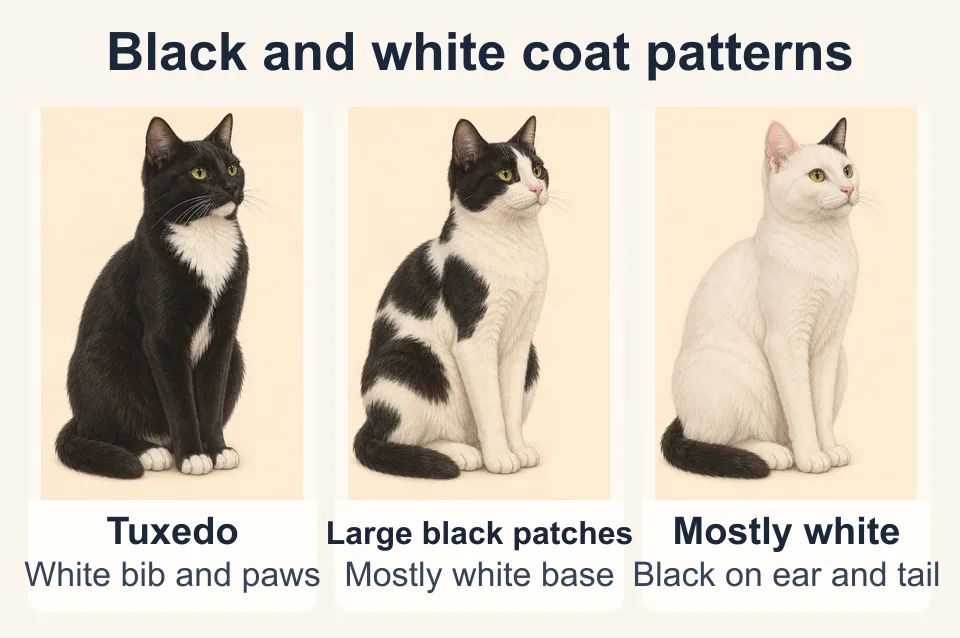
These are useful descriptions even when a cat falls between them. A coat does not need to fit an internet nickname perfectly. If “tuxedo” makes someone picture the wrong amount of white, add a short explanation rather than trying to decide whether the cat has earned the label. For facial blazes, socks, and smaller distinguishing details, see our cat markings guide.
The face and feet often distinguish similar cats
Compare two cats that you would casually call tuxedos. One has a narrow white bib ending high on the chest and white toes on the front feet. The other has a broad white chest continuing onto the underside and taller white socks. The nickname fits both, but their markings give you a better way to tell them apart. Start with those large differences before looking for a tiny facial patch.
Next, check the chin and muzzle. A black chin can sit above a white chest, while another cat has white running continuously from its chin downward. Note whether the white stripe between the eyes is centered or uneven. Finish by checking each foot separately; a sitting portrait may hide one paw behind the other. Use the cat’s own left and right in your notes so the description still makes sense in a different photograph.
The Alley Cat Allies identification guide uses details such as blazes, socks, and lockets to describe cats. You do not have to memorize every term. The practical goal is a description that another person can match to the animal without guessing which nickname you intended.
Which breeds can be black and white?
Several pedigreed breeds allow black and white coats. The CFA Cornish Rex standard includes black and white among its bicolors; its distinctive wavy coat is a separate characteristic. A straight-coated tuxedo cat does not become a Cornish Rex simply because the colors match a photograph of one.
The CFA Maine Coon standard also includes black and white. That allowance tells you a documented Maine Coon can have those colors. It does not tell you that a fluffy black and white cat must be a Maine Coon. Coat texture, overall structure, and known family background still matter, and long fur is not exclusive to that breed.
A useful comparison therefore has two parts: the shared black-and-white arrangement and a feature that is independent of color. For the examples above, that means a wavy coat versus a longer shaggy coat. If all you can establish is the color distribution, keep the breed question open and finish the coat description first.
For a cat without a documented pedigree, domestic shorthair or domestic longhair may be the appropriate broad description. Those terms do not specify a particular cross. They let you describe the animal without inventing two parent breeds based on a facial resemblance or a fluffy tail.
Black patches or dark tabby areas?
Look closely at the colored parts of the coat. A black and white cat has black areas alongside white. A tabby and white cat has patterned areas alongside white; dark stripes can make those areas look almost black in a distant photograph. The distinction is easiest to see on the side of the body rather than on a tiny facial patch.
This matters when someone searches for a “black and white striped cat.” The stripes may belong to a tabby pattern on a pale background, with additional white elsewhere. Describing it as tabby and white can be more informative than calling every dark marking black. You can also leave the tabby color uncertain until you have a clearer view.
Check whether there is a genuinely reddish patch as well. If black, reddish, and white areas are all present, the coat may fit a calico description instead. That is a different color combination, not a more detailed type of tuxedo. Our calico coat guide explains that distinction without turning the pattern into a breed.
Describe distribution before choosing a nickname Write “mostly black,” “large separate black patches,” or “mostly white,” then add the face, chest, and foot markings. Choose a familiar nickname afterward if it helps. The location-based description remains useful even if someone uses a different nickname.
What green eyes and short fur can tell you
Green eyes do not supply the missing breed identification. They are another visible feature to record, but a black and white coat plus green eyes still does not establish a pedigree. A search result that combines those features with one breed name is showing a possible resemblance, not verifying your cat’s ancestry.
Short fur is similarly a broad description. It helps you distinguish a close-lying coat from a long, flowing one, but it does not make the cat an American Shorthair or British Shorthair. Those capitalized names identify particular breeds. “Shorthaired black and white cat” can be accurate without implying either one.
Avoid assigning personality from the pattern as well. Your cat may be bold, cautious, talkative, or quiet, but the tuxedo nickname does not explain those individual behaviors. When choosing a companion, ask about the particular cat’s observed behavior, handling preferences, and needs rather than treating color as a personality test.
Choose the label that serves your task
For a casual introduction, “a black and white tuxedo cat” may be enough. For a shelter profile or a household record, add coat length and distinctive marks. For a formal breed question, check what documentation supports the breed name and use the appearance description as supporting context.
A useful example is “domestic shorthair, black and white, with a white chin, narrow chest patch, and white back feet.” That sentence answers the visible questions without pretending to know the family tree. If reliable breed records later become available, you can update the breed field while keeping the accurate coat description.
Keep pattern and breed separate
Tuxedo, cow-like patches, and mostly white arrangements help describe how black and white fur is distributed. Use them alongside specific markings, then investigate any breed claim separately rather than asking the coat to prove more than it can.
Explore with PetMira
Explore breed suggestions for your cat
Take or upload a clear photo in PetMira to explore possible cat breeds. Compare the suggestions with the coat pattern and other features you have described.
 Use a clear photo of your cat
- Compare the suggested breeds
Available on iPhone. Photo suggestions are not proof of pedigree or ancestry.
Download iOS App