
Cat markings describe how colors and patterns appear on a coat. A useful description separates the base color, the overall pattern, and small identifying details: for example, “brown tabby with a white chest and one white front paw.” These words can describe a cat accurately even when its breed and ancestry are unknown.
The easiest mistake is trying to choose one label for the whole animal. A cat can have stripes, white socks, and a facial blaze at the same time. Those descriptions answer different questions. Once you separate them, the markings become easier to recognize and much more useful on an adoption profile, a veterinary record, or a missing-cat notice.
Describe the coat in three layers
Begin with the colors you can see across the body. Then describe how those colors are arranged. Finally, add the individual marks that would help someone distinguish your cat from another cat with a similar coat. Coat length is a separate detail; it can make a pattern harder to see, but it does not replace the pattern name.
For instance, “black and white” tells someone which colors to expect. “Mostly black with a white chest” tells them about the distribution. “A small black patch on the left side of the nose” gives them an identifying detail. Each addition supplies information that the earlier description leaves out. You do not need a rare or technical term for every patch.
Layer | Question to answer | Example description |
|---|---|---|
Color | Which colors are visible? | Black and white |
Overall pattern | How are the colors arranged? | Black body with white underneath |
Individual marks | Which details distinguish this cat? | White chin; black spot on left side of nose |
Coat length | How long is the fur? | Short coat |
Use the cat’s own left and right when describing asymmetric features. If you mean the left side of a photograph instead, say so. This small distinction matters when two people compare images taken from different directions. A clear sentence can be more dependable than an unlabeled close-up.
Six useful pattern labels
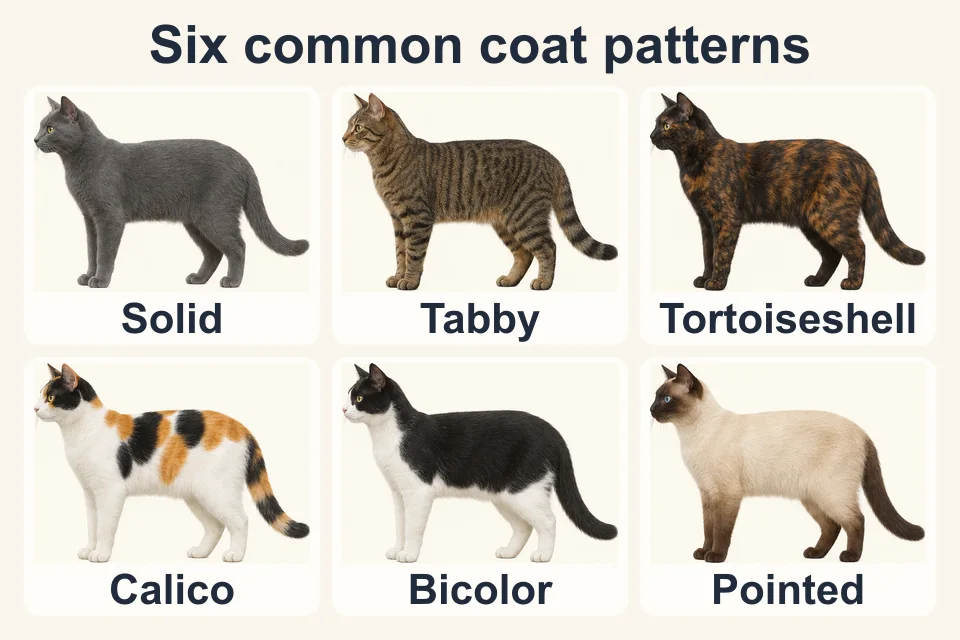
Solid describes a coat that appears to have one main color without an obvious contrasting body pattern. Tabby describes patterned fur that may show narrow stripes, broad swirls, separate spots, or a ticked appearance. A ticked body can look fairly even from a distance because the variation occurs along individual hairs rather than as large patches.
Tortoiseshell combines darker and reddish areas, often intermingled. Calico usually describes distinct dark and reddish patches together with white. Bicolor describes white combined with another color. Pointed describes darker extremities against a lighter body. The CFA coat and color guide treats appearance descriptions separately from breed names. For a closer comparison, explore black and white coat arrangements or the calico coat guide.
Dilute versions can look softer: blue replaces black and cream replaces red. A blue-and-cream tortoiseshell or a dilute calico with white still belongs to the same broad pattern family. If the colors look muted, describe the arrangement as well as the shades rather than assuming the absence of bright orange means the pattern has changed. If the coat is grey and white without cream patches, compare the clues in our grey and white cat identification guide.
These labels are a starting vocabulary, not six boxes that every cat must fit into exclusively. A tabby can also have white areas, and a pointed cat can have white markings. Write down the combination you can see instead of forcing it into whichever single category appears first in an online chart.
Imagine two shorthaired cats sitting beside each other. Both have brown striped backs. One has a white chest and four white feet; the other has no obvious white patches. Calling both “tabby” is correct but incomplete if your task is to tell them apart. Adding the white markings makes the description useful without guessing that they have different breeds.
Look at the sides before naming a tabby pattern
The broad side of the body usually gives you more information about the main tabby arrangement than the forehead alone. Narrow lines descending along the sides suggest a mackerel pattern; wide looping areas suggest classic tabby. Distinct separated marks suggest a spotted pattern. Those differences concern the coat’s arrangement, not how large, friendly, or closely related to a wild cat the animal is.
Look at more than one area before deciding. A narrow stripe can break into shorter segments, and a curled sleeping position can hide the parts that connect. If the pattern is unclear, “tabby with narrow side markings” is an honest description. There is no need to turn an uncertain view into a confident subtype.
The forehead’s familiar M-shaped marking can support a tabby description, but it cannot identify a particular pedigree. Nor do spots on the belly alone establish a spotted breed. If the sides show distinct spots and you want to compare named breeds, our guide to cat breeds with spots addresses that narrower question.
Name small markings by their location
A small white patch on the chest is often called a locket; white feet may be described as socks; a white stripe on the face may be called a blaze. These terms appear in the Alley Cat Allies identification guide. Their value is practical: they help another person picture where a contrasting patch sits.
Add the shape and extent when the name alone is vague. “White front socks” is less specific than “white toes on the right front paw and a taller white sock on the left.” Similarly, “white face” could mean a narrow central stripe, a white muzzle, or almost the entire face. Describe the visible area rather than expecting a nickname to carry all that detail.
Facial markings deserve their own note because a front portrait may be the image people recognize first. Check the chin, muzzle, area between the eyes, and each cheek. A white patch can divide the face unevenly. Describe that asymmetry plainly; a patch that resembles a heart or a mustache to you may not look the same to somebody else.
Write a two-sentence coat description Use the first sentence for color, overall pattern, and coat length. Use the second for two or three distinctive marks, including their locations. Keep the same wording alongside front and side photos so another person can compare the details.
Avoid three common labeling mistakes
First, do not treat every pale area as a white patch. Light falling across raised fur can create a bright edge, while a shaded underside can look darker than the back. Compare a second view in even daylight before recording a sharply defined marking. If the border disappears when the cat turns, the photograph may be showing lighting rather than a separate coat area.
Second, distinguish a whole patch from variation within the hairs. A dark-looking coat with pale roots is a different observation from a white chest patch. You can note “pale roots visible when the coat parts” without choosing a formal smoke or shaded classification from one image. Avoid pulling fur or restraining a cat simply to settle a naming question. For that dark-coat comparison, see solid black and black smoke coats.
Third, keep coat descriptions separate from ancestry. A name such as calico, tuxedo, or tabby may sound like a category of cat, but it does not supply a family history. Our cat breed identification guide explains the additional role of documented background. You can finish an excellent markings description while leaving that separate question open.
Turn the description into something useful
For a household record, save a front view, each side, and any unusual detail that is hard to see in the general pictures. Pair those views with the same short description. This is more useful than collecting several nearly identical portraits that all hide the same side of the cat.
For a missing-cat notice, prioritize visible, distinctive details over specialist terminology. A reader may not know what “bicolor” means, but can recognize “mostly black, white chest, white back feet, black chin.” Include other appropriate identification information through the relevant lost-pet process; coat markings alone cannot establish ownership when several similar animals are present.
A clear description is enough
Start with color, add the overall pattern, and finish with the marks that make your cat recognizable. Accurate everyday wording is more useful than an elaborate label you cannot verify, and it leaves breed identification as a separate question.
Explore with PetMira
Put your coat observations to use
Explore possible cat breeds from a photo in PetMira, then compare the suggestions with your own description of your cat’s color, pattern, and distinctive marks.
 Take or upload a clear photo
- Explore suggested breed matches
Available on iPhone. Photo suggestions are not proof of pedigree or ancestry.
Download iOS App