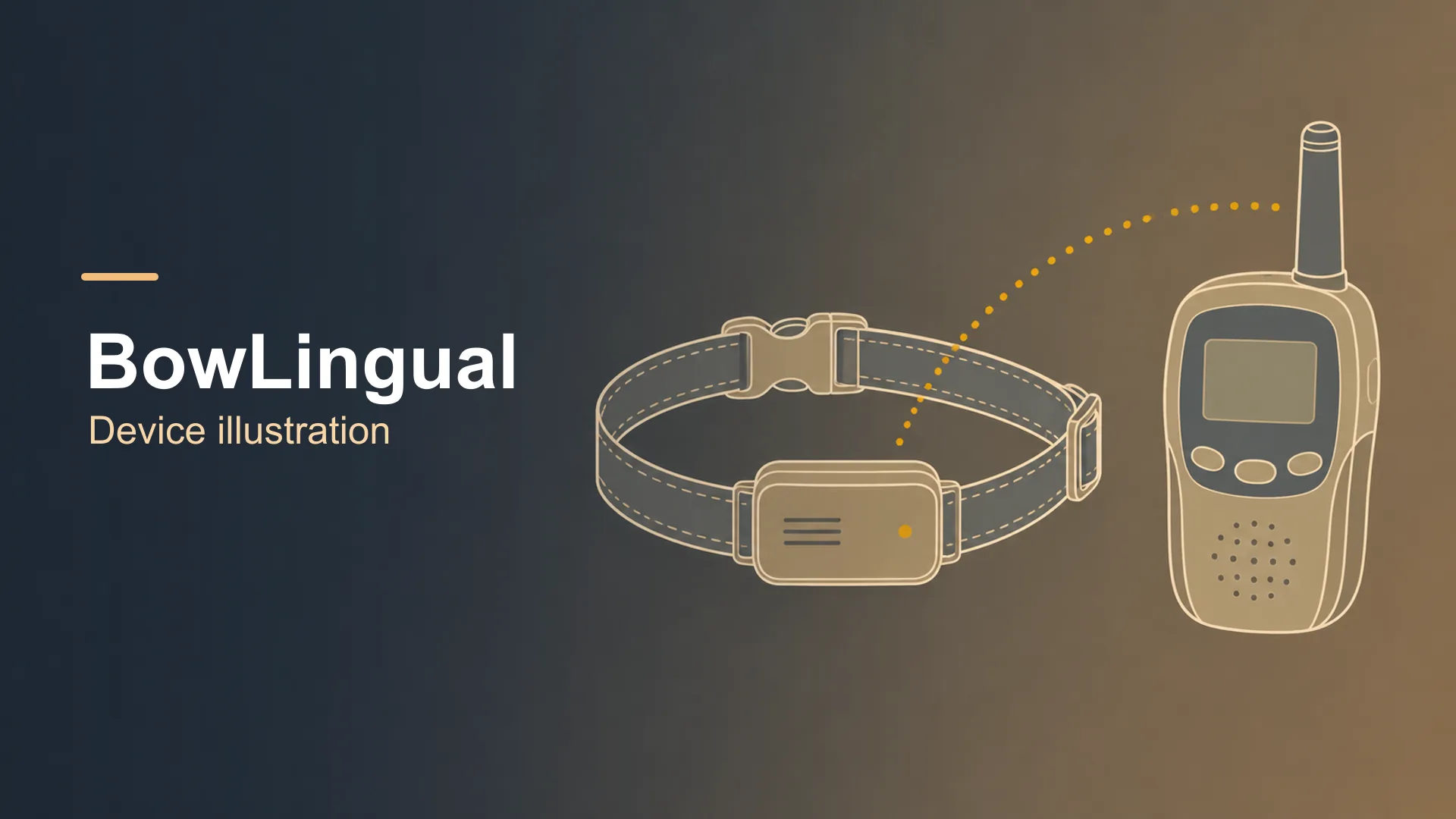
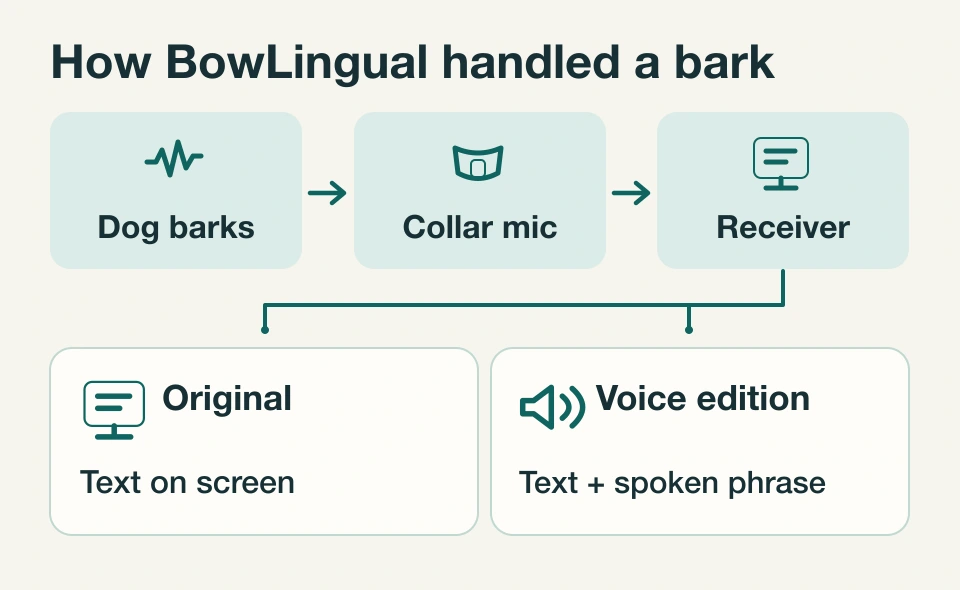
BowLingual was a dog-bark gadget released by Japanese toy company Takara in 2002. A microphone attached to the dog’s collar picked up a sound and sent it to a separate handheld receiver. The receiver classified the sound and chose a phrase to show on its screen. A later version, BowLingual Voice, added spoken output to the experience.
If you found one in a drawer or a used listing, start by working out which version is in front of you. The original device’s screen, the later Voice unit’s speech, and a modern app using a similar name are three different things. A photo of the complete set and a readable example from its display can tell you more than a listing title saying “dog translator.”
How the Original BowLingual Worked
Takara marketed the original model before smartphones made it routine to record everything from a single device. In BowLingual, the dog wore the microphone and the person held the receiver. With those jobs separated, the microphone could pick up a bark near the dog while the person read the result at a distance. The manufacturer lists BowLingual among its 2002 launches. Takara Tomy’s corporate history
A contemporary description explains how the receiver compared an incoming sound with its own categories. It chose from six broad classifications and displayed a matching phrase and a cartoon expression. Setup also included choosing a breed or a general build category from the available settings. The output was a selected line from the product’s library. The dog did not have to produce separate sounds that corresponded to the individual words in the sentence. Web Japan’s contemporary account
The central distinction is between what the gadget measured and what the owner saw. It received a sound. It displayed a short line that made sense to a person. The line carried more detail than the original classification. For example, a result that sounds like a request for play could follow a short bark that the system put in a particular category. Whether the dog was running toward a toy or backing away remains something to observe in the room.
Check the model on the device itself Ask for clear photos of the receiver, collar transmitter and packaging. A “Voice” label or a demonstration of spoken output is more useful than a seller’s description alone.
Original BowLingual, BowLingual Voice, and Modern Apps
Item | Input and output | What to verify |
|---|---|---|
Original BowLingual | Collar microphone sends a dog’s sound to a receiver that displays a selected line | Both parts, matching model, display language |
BowLingual Voice | Its receiver can present text and speak the generated line | Exact Voice model, language, working speaker |
A similarly named app | Function varies according to the developer and app version | Publisher, input, displayed result, and whether there is any manufacturer connection |
Takara Tomy’s Japanese BowLingual Voice manual was issued in 2009. It describes pairing the hardware, specifying information about the dog, and playing or displaying interpreted results. The voice comes from the device. It was a change in how a person received the interpretation, not evidence that the dog supplied spoken sentences. The manual is also useful because it distinguishes that model’s setup from instructions circulating for the first generation. Takara Tomy’s BowLingual Voice manual
Listings sometimes mix English translations of the names with photos of Japanese units. An English listing gives you the seller’s description. It does not tell you the menu language on that receiver. Ask for a picture of a powered-on screen and, for a Voice unit, a short clip of the sound coming from the unit. That gives you evidence about the exact device instead of a different one seen in an old demonstration.
What Its Phrases Can Tell You
The phrases were part of the product's design. A small set of categories made the display easy to read, and choosing a phrase could make the result feel personal. At the same time, a broad classification can fit more than one event. The receiver has its microphone input. The person with the dog can also see the floor, the door, the people nearby, and what the dog does in the next few seconds.
Think of a bark that occurs during a game and then a bark that happens when another dog walks past the window. If the same phrase comes up both times, compare what changed in each scene. In one, play may resume after the dog drops a toy. In the other, the dog may turn away when the visitor goes past. That amount of detail does more to explain the episodes than a phrase that fits both loosely.
The historical material describes what BowLingual was built to do. Evaluating how often it correctly identified a situation would need independently identified examples and published results for the exact device. A spoken line, a cartoon face, or a good match in one demonstration does not provide that evaluation. If you own a working set, use the phrase as part of the experience and rely on what you can observe to interpret your dog.
What to Check Before Buying a Used Set
Start with completeness. Compare the model label and the two parts with the manufacturer’s original BowLingual manual. Look for the collar transmitter, the handheld receiver, and the attachment for that version. Ask for a powered-on photo showing the menu language and a short clip showing the two units paired. A receiver that lights up has only passed the first of those checks.
Check condition separately from the advertised functions. Ask for a close photo of each battery compartment and check the controls shown in the exact model’s manual. The seller can show the menus and pairing without prompting a dog to bark. If you want to collect the gadget, confirm which pieces and packaging are present. If you want to use it, ask for a demonstration of the complete set.
Ask the seller to distinguish what they checked from what they assume. “The receiver turns on, the screen text is Japanese, and the transmitter hasn’t been paired” gives you three details you can use. If spoken output matters, ask for a clip of the power-on menu and the actual Voice receiver speaking. A photo of the Voice packaging alone leaves its condition and language open.
For a practical comparison with newer products, read how to evaluate a modern dog translator.
For a different moment in animal-translation history, see Google’s 2010 Translate for Animals joke and how it was distributed.
Takeaway
BowLingual was a real collar-and-receiver gadget that offered phrases selected from a fixed set. BowLingual Voice presented the interpretation with speech as well. Check the exact version, complete hardware, and language if you’re looking at a used unit, and take any interpretation alongside the behavior you can observe.
PetMira for iPhone
Record a present-day bark with PetMira
Use Dog mode in the iPhone app to capture one natural bark and compare the AI interpretation with what you saw before and after it.
 Capture the bark as it happens
- Reopen the recording and interpretation by date
Use the app’s suggestion as one clue alongside the scene you observed.
Download iOS App