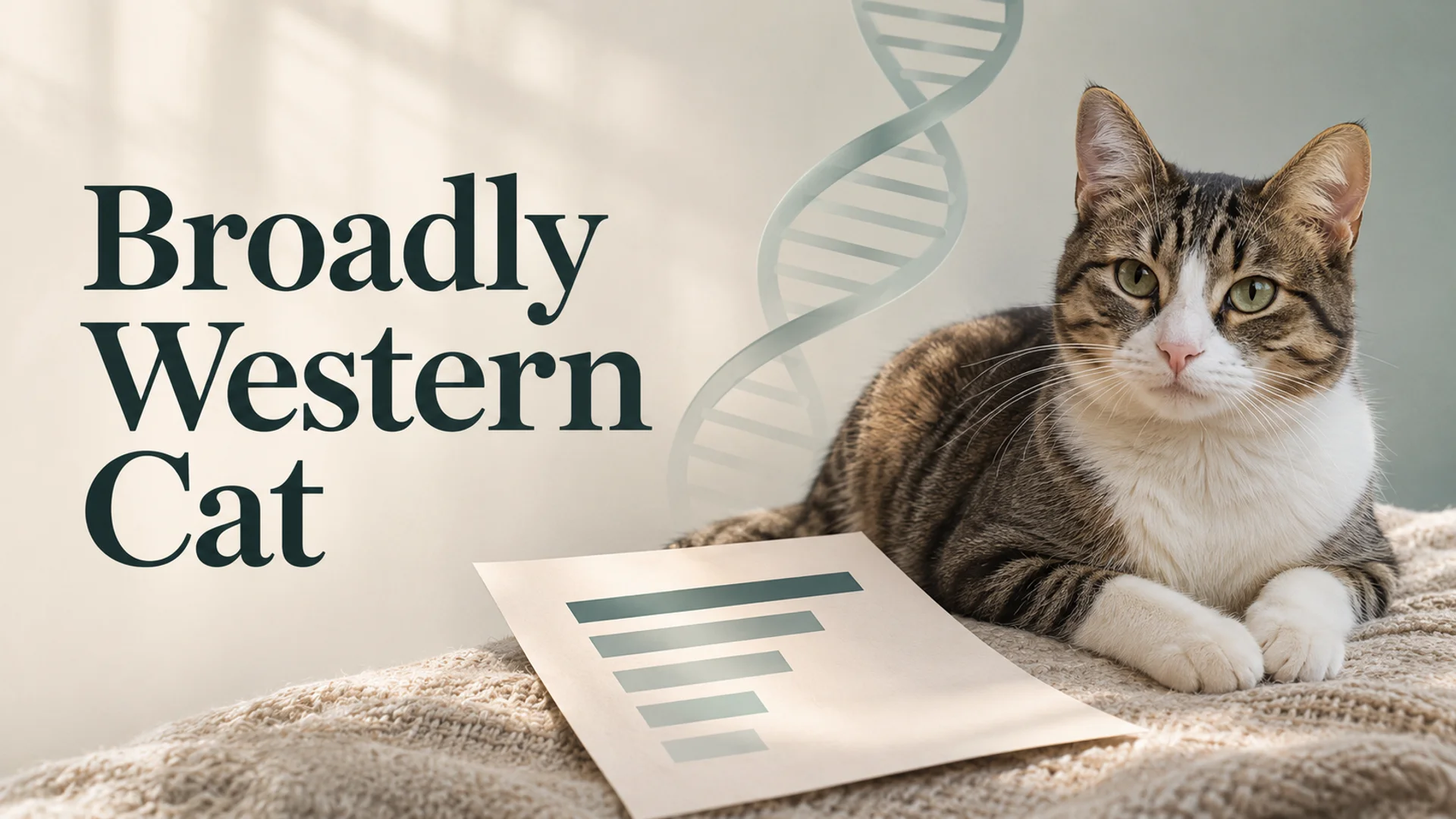
If “Broadly Western” appears in your Basepaws report, read it as a broad genetic-comparison label rather than the name of a cat breed. Check the group headings, named-breed comparisons, and explanatory notes in that particular report. The label alone does not tell you where your cat was born or name a particular parent.
The useful question is what that label allows you to conclude. You can understand the result without choosing a breed for your cat, buying another test, or making their appearance fit the highest number. Start with the report you actually received, including its date, rather than somebody else’s screenshot. This guide applies to reports that contain the label; it does not assume every current Basepaws report uses the same categories. For current test coverage and contact details, see Basepaws’ current report information. This overview does not replace the label explanations supplied with your own report.
Read the report at the right level
If your breed section places “Broadly Western” beneath a broader group heading, read those levels separately. Before adding percentages, check the report’s explanation to see whether one row is already included in another.
Earlier Basepaws explanations described breed results as comparisons with modern purebred cats in a reference database. Read the wording supplied with your own report to check how that version defines its comparison group. “Western” is not a nationality field, and a named-breed comparison is not a documented parent.
Report wording | How to read it | What it does not establish |
|---|---|---|
Western | The broader comparison group used by this provider | Your cat’s birthplace or a single breed |
Broadly Western | A broad similarity label within that reporting framework | A hidden breed that you can name from appearance |
A named breed | A more specific comparison with the provider’s reference cats | A documented parent or registered pedigree |
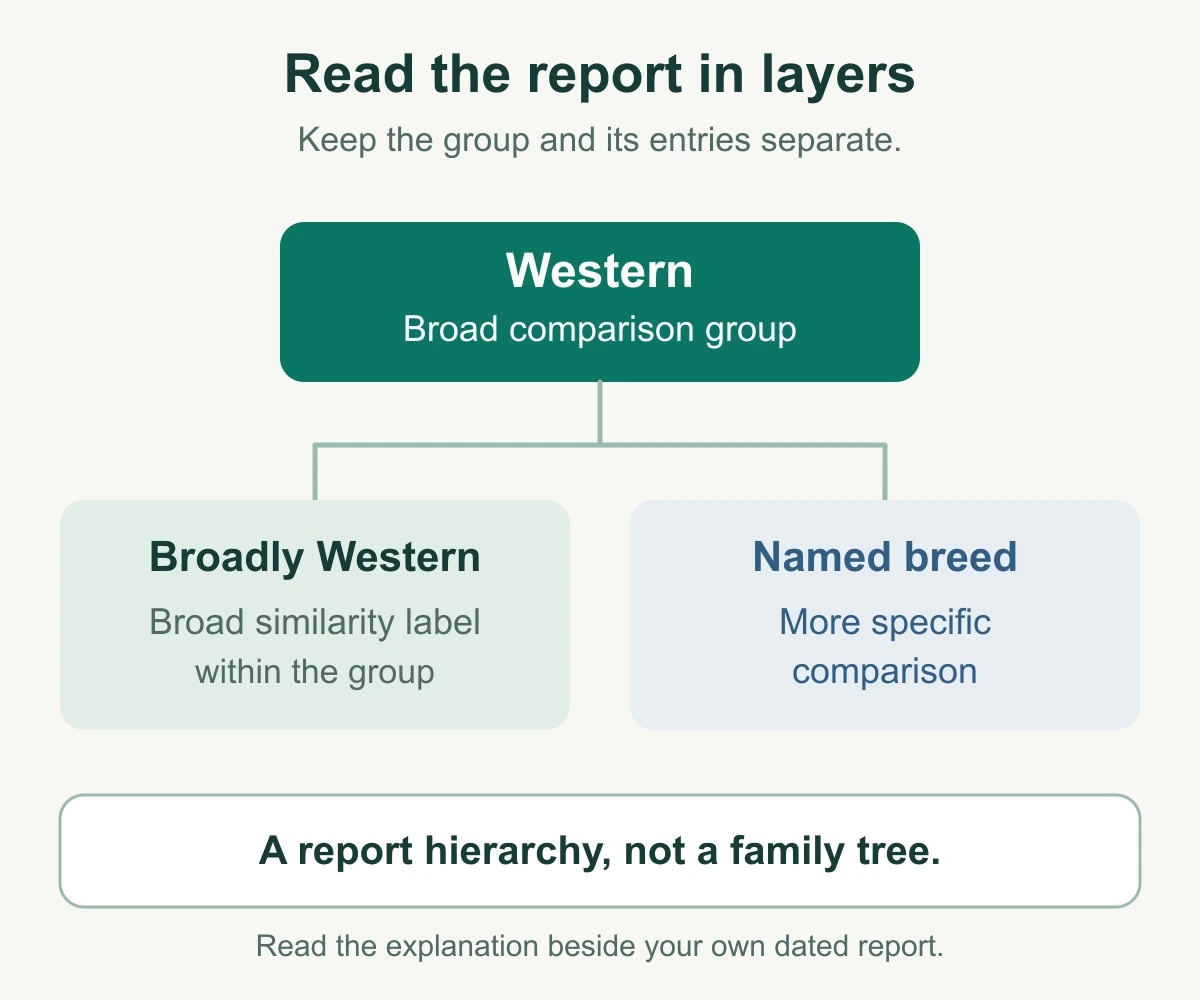
Read the explanatory text beside the numbers before comparing your cat with another cat. Two screenshots may show different report dates, different sections, or different display settings. A cropped image can also hide the group heading that explains the figures underneath. Save the complete page so that the label keeps its context.
Tip Copy the label exactly into your notes: “Basepaws report: Broadly Western.” Add the report date. That preserves what the provider said without turning a comparison into a new breed name.
Why a broad result can still be useful
A broad label can feel disappointing when you hoped for one familiar breed. It is still information at the level the report presents. The next step is to read that level accurately, not to redistribute the broad result among breeds you like. There is no basis for assigning it to Maine Coon because your cat is large, or to Russian Blue because the coat looks gray.
Try writing two separate sentences. The first describes the result: “The report includes a Broadly Western comparison.” The second describes your cat: “She has short gray fur and a white chest.” Neither sentence needs to explain the other. You have kept a genetic report and an observable description without inventing a connection between them.
A useful report note also includes the question you wanted answered. “I was curious about genetic similarity” is different from “I need proof of a registered pedigree.” If the second question matters, return to documents issued for that individual cat and ask the relevant registry what it accepts. A broad comparison label cannot supply missing names, dates, or family records.
For the wider choice between those evidence types, our cat breed identification guide explains how photos, adoption history, pedigree documents, and DNA comparisons fit together. Here, the task is narrower: interpret this particular label without upgrading its certainty.
Keep DNA, appearance, and family records separate
Earlier Basepaws explanations distinguished genomic similarity from a reconstruction of a domestic cat’s family tree. Read the percentages alongside the definitions in your own report. A similarity percentage does not, by itself, document a proportion of purebred ancestors.
Consider a fictional household example. An adoption record says “domestic shorthair,” a DNA report contains Broadly Western, and a photo comparison suggests a British Shorthair. These entries can coexist. The adoption record may use a coat-length description, the DNA report describes genetic comparisons, and the photo suggestion concerns resemblance. They are answering different questions, so there is no need to select one winner and erase the others.
Keep each entry attached to its source. For a care form, a clear description such as “domestic shorthair; ancestry undocumented” may be more useful than a newly invented mix. If a form offers only named breeds, ask its owner how to record an unknown breed. Do not choose the top comparison simply because the menu requires an answer.
Our guide to common cat labels and types separates registered breeds from coat descriptions and everyday labels. It can help when a report sends you searching unfamiliar names. Looking up a breed can be interesting without making that breed your cat’s verified identity.
Appearance remains worth recording on its own terms. A side view, coat-length description, and visible markings help you recognize and describe your cat. They cannot tell you which parts of the DNA report should receive a different label. Avoid working backward from a favorite breed photograph until the genetic result seems to match it.
What to do when the report changes
Basepaws has previously explained that expanding reference data and revising breed definitions can change reported comparisons. If you receive a revised report, compare the dates and its update notes before deciding what changed. A changed comparison does not mean your cat’s DNA changed between downloads.
First, check that both documents belong to the same cat and kit. Next, compare the same section in each version. Write down the exact label that changed rather than saying the whole test became different. Then read any update notice associated with the newer report. This sequence gives you a focused question if you contact support.
For example, you might ask, “My earlier breed section listed Broadly Western, and the newer version shows a different value. Did the reference data or the display definition change?” Include both report dates and use the provider’s private support channel for identifying details. A public discussion needs much less information; remove names, contact information, and kit identifiers before sharing a screenshot.
Keep both copies rather than replacing the old file. Name them by cat and report date, with a brief note about the change. If you cannot tell whether you are comparing equivalent measurements, leave that question open. Combining values from two reports creates a third result that neither report actually provided.
Turn the result into a clear record
A good summary is short enough to understand later. Record the provider, report date, exact label, and any explanation you received. Put your interpretation in a separate sentence. “I still do not know the cat’s documented ancestry” is a useful statement when it prevents someone from treating a comparison as a pedigree.
Keep health information in its own context too. “Broadly Western” is a breed-comparison label, not a diagnosis or a care plan. If another section raises a health question, take that section and its explanation to your veterinarian. Do not use the broad breed label to select medication, change food, or predict an individual cat’s temperament.
If you enjoy comparing visible traits, PetMira’s iPhone breed feature can suggest possibilities from a domestic cat’s photo. Treat those suggestions as visual leads to explore, separate from your saved DNA report. A photo result cannot confirm what “Broadly Western” means for that cat or resolve an uncertain genetic comparison.
What to remember
Read “Broadly Western” as a provider’s broad comparison label, and keep the surrounding report and date with it. Use the result to ask clearer questions, while keeping appearance, genetic similarity, and documented ancestry as separate kinds of information.
PetMira for iPhone
Explore your cat’s visible breed clues
Take or upload a photo of your domestic cat to explore possible breed suggestions. Keep visual comparisons separate from your DNA report and family records.
 Compare possible breeds from a photo
- Read about suggested breeds
Photo suggestions do not verify genetic ancestry or pedigree.
Download iOS App