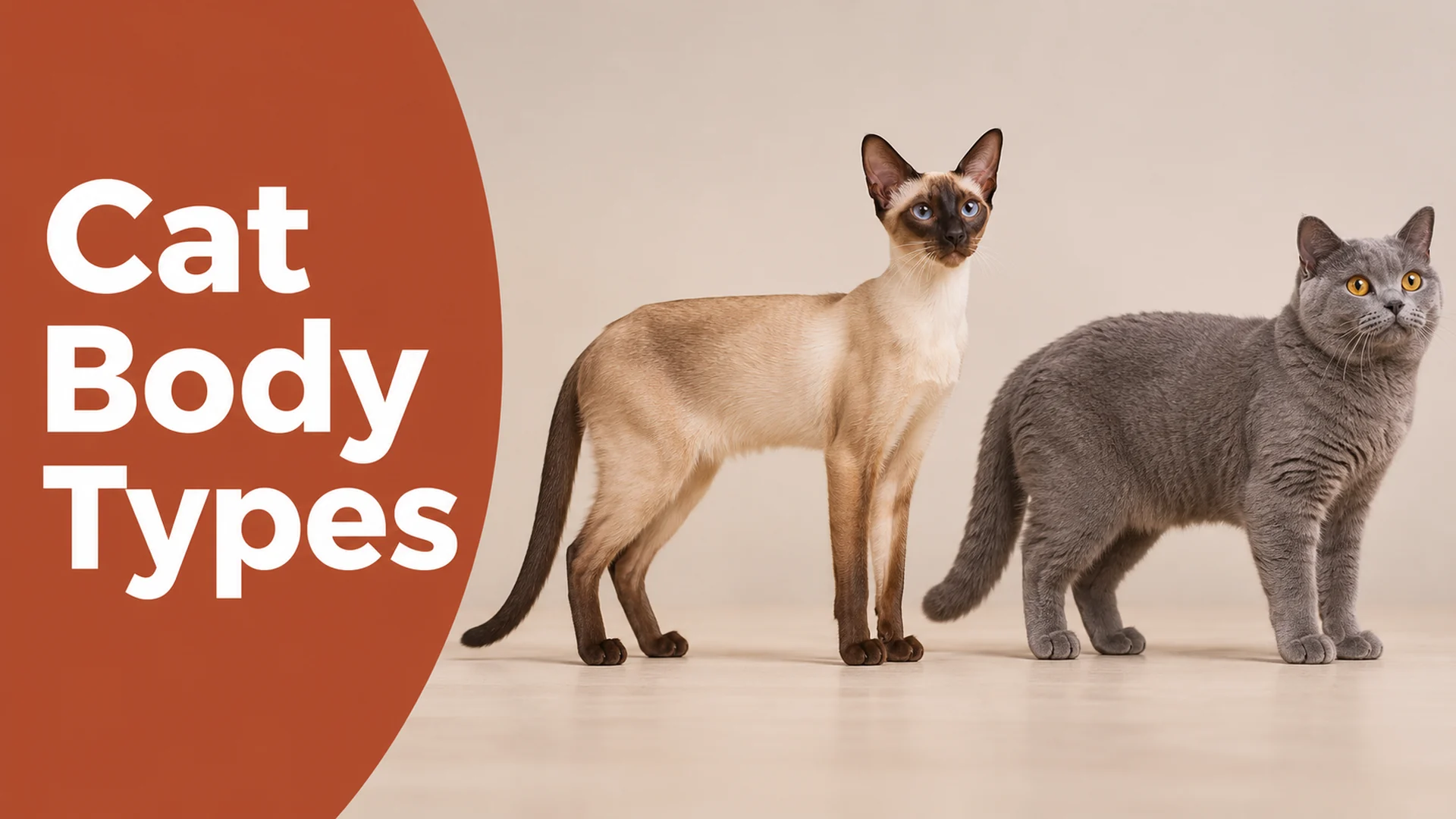
Cat body types describe how a cat is built. A cobby cat has a short, broad frame, while an oriental build is long and fine-boned. Some long cats have sturdy legs and a broad frame, and many fall between the extremes. To describe your cat, compare the length of the trunk, the height of the legs, and the width of the chest and shoulders while they stand naturally.
These clues give you a useful description even when the cat’s breed is unknown. A fluffy coat can hide a slim frame, and a broad chest can belong to a cat at a healthy weight. If a single word feels like a poor fit, “medium-length body, broad shoulders, and slim legs” is more informative than a category you have to stretch to make work.
The Main Cat Body Types at a Glance
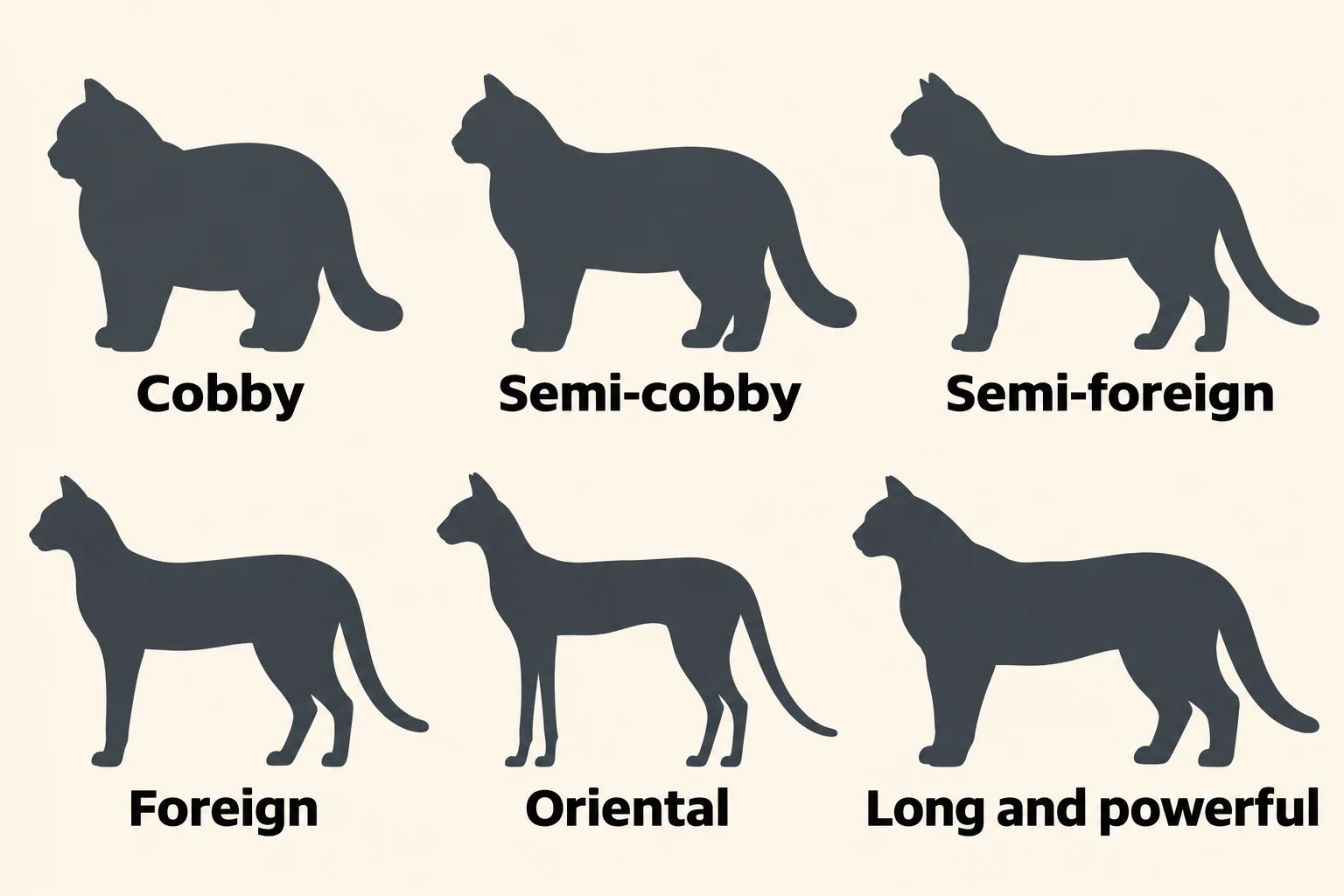
Cat registries organize body shapes in different ways. France’s LOOF registry describes four broad groups and divides its middle group into three more specific builds. That gives us six labels to compare. The examples in the table use its classifications. LOOF morphology guide
Body type | What to look for | LOOF example |
|---|---|---|
Cobby | Short, broad trunk with a deep chest and sturdy limbs | Persian |
Semi-cobby | Sturdy frame with more length through the trunk | American Shorthair |
Semi-foreign | A longer outline with a strong underlying frame | Egyptian Mau |
Foreign | A lighter, slender frame with a less extreme outline | Abyssinian |
Oriental | A long, narrow, almost tube-shaped trunk with fine limbs | Siamese |
Long and powerful | Considerable length with a substantial frame and strong limbs | Maine Coon |
Two pairs are especially easy to confuse. Cobby and semi-cobby both look sturdy, so check how much room you see between the shoulders and hindquarters. In a compact cat, the sturdy build takes up a relatively short distance. A semi-cobby cat has more length through the middle while keeping a solid frame. The roundness of the head can be a useful secondary clue, but it tells you little about the length of the trunk.
A long and powerful cat can share a long outline with an oriental-type cat. Look at the width through the front of the chest and the thickness of the limbs you can see. Those features separate two cats that look equally long from the side. At the middle of the range, compare the lighter build of a foreign type with the sturdier frame of a semi-foreign type. If long fur covers the chest and legs, treat that distinction as uncertain.
Names can also shift between registries. For example, the Cat Fanciers’ Association’s judging reference groups the Abyssinian under semi-foreign or moderate and uses a separate substantial category for several shorthair breeds. If two charts disagree, check whose terms each chart uses. You may be seeing different ways of sorting the same features. CFA body type reference
How to Describe the Frame You Can See
Start with the trunk and the legs
Wait until the cat is standing on all four feet. Look from the side with your eyes roughly level with the middle of their body. Follow the line from the shoulder to the rump, then compare that length with the height of the legs underneath. A cat reaching forward for a toy looks longer, and a cat crouched over tucked legs looks lower. If your first view catches a stretch or a crouch, wait for the cat to change position before describing the build.
Use a front view for chest and shoulders
A second angle helps when two cats have a similar side outline. When your cat faces you, see how far apart the forelegs stand naturally and how broad the chest looks between them. Watch a few steps if the coat hangs low over the front legs. A large ruff can hide the chest, while fur on the legs can make them look thicker. A clear side view plus a short walk usually gives you more to work with than a single still image.
Write the observations you can see If fur covers the chest, keep the trunk and leg description and leave chest width unknown. Avoid assigning a type from the apparent size of the coat.
Write one description before choosing a label
Imagine two longhaired cats side by side. One looks big while sitting because the fur fans out around the chest. On a walk across the room, their legs look slim and their trunk looks fairly narrow. The second has a similar coat, but the legs and chest look sturdy from several angles. “Long, narrow frame” and “long, broad frame” capture the difference before either cat gets a label. Even if both resemble pictures of the same breed, the two descriptions stay useful.
If the clues point in different directions, combine them in one sentence. A long trunk with relatively short legs still describes a real shape, even if a chart depicts its long cats on taller legs. The same goes for a compact cat with a narrow chest. You can record what you see and stop there, especially if the cat is young or you only have one angle.
When comparing two images, check the viewpoint before drawing a conclusion. A camera close to the head makes the front of the cat look larger, and a photo from above can make the legs disappear. Compare natural standing views taken from similar distances. That way, if the trunk looks longer in one picture and the chest looks broader in another, you can see whether the proportions persist when the position changes.
Body Type and Body Condition Answer Different Questions
Body type describes the frame. Body condition scoring looks at fat cover using clues such as how easily the ribs can be felt and whether a waist is visible behind them. A broad-chested cat can have a defined waist. A long, fine-boned cat can still carry extra fat over the ribs. The outline from a side photo cannot supply the touch-based part of a body condition assessment. WSAVA feline body condition chart
Start with the question you are trying to answer. If you want a description for a pet profile, write about frame, then add a separate note for coat length or markings. If you are trying to make sense of a change in your cat’s weight or shape, bring up what changed at a veterinary visit. Knowing that a cat has a compact build does not explain a change in their waist, and a breed-style label is too broad to guide a feeding decision. For the coat description, use our cat markings guide.
Takeaway
Read your cat’s build from a relaxed standing view, then check the chest and legs from another angle. Use a term like cobby, foreign, or long and powerful when it captures the features you can see. When it doesn’t, a short description of the actual frame is enough.
PetMira for iPhone
Keep your cat’s everyday observations together
Create a pet profile in PetMira and keep a photo log of visible changes in areas such as the eyes, ears, skin, or fur.
 Set up a profile for your cat
- Keep photos with everyday care observations
The photo log is for keeping track of what you observe over time.
Download iOS App