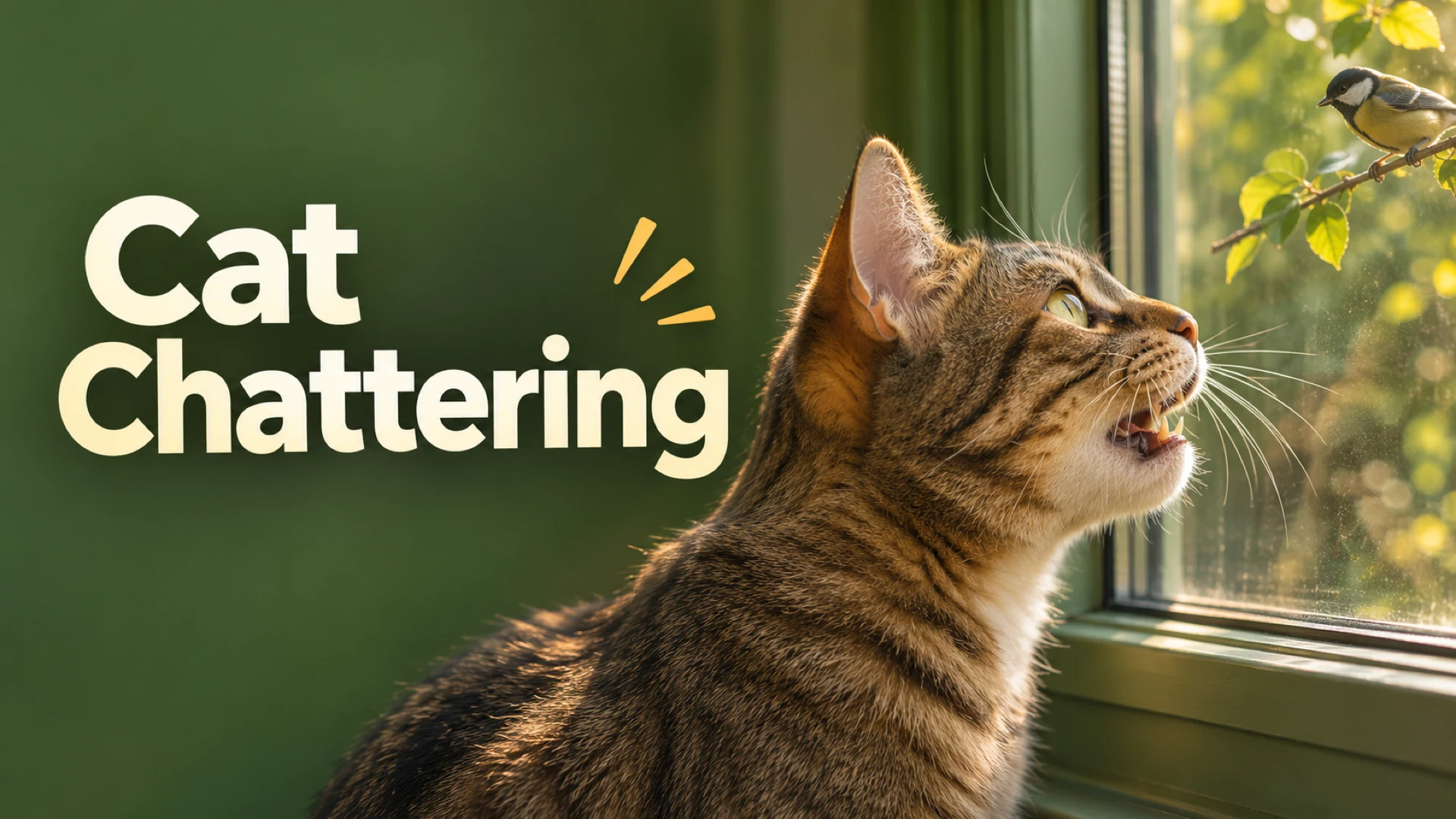
Cat chattering is a quick string of clicks that goes with small, fast movements of the lower jaw. You might hear it when your cat spots a bird through a window and keeps staring as their jaw trembles. Look for clicks and jaw movement together, then see what your cat was watching and when they stopped.
If your cat settles as the bird flies away, you’ve seen a common pattern. If their jaw repeatedly trembles while they eat or rest, especially with drooling or dropped food, call your vet. Those details matter even when the sound resembles the clicks you hear at the window.
What Does Cat Chattering Sound and Look Like?
It can sound like “k-k-k-k” in short bursts. From the side, you may see the lower jaw flick up and down while the cat’s eyes stay on the same spot. Some cats add a pitched squeak between bursts, so listen for the clicks and watch for the jaw moving in time with them.
The Meowsic project’s chirping and chattering examples describe a cat named Rocky making both sounds at a bird. The researchers separate a series of quick clicks from a short, pitched chirp. That distinction is useful when you hear both in the same few seconds.
To hear the difference, try humming just the part that has a pitch. A chirp can sound like a little peep even if it comes between clicks. The clicks are sharper and harder to hum. On a short clip, watch the jaw once with the sound muted, then listen for whether the clicks match those movements.
If you heard the sound from behind the cat, the timing may be all you have. A claw on the sill or something tapping against the glass can make a sharp click too. A side view that shows the jaw and part of the window can help you separate those possibilities when the moment happens again.
Why Do Cats Chatter at Birds and Other Moving Animals?
Birds, squirrels, and insects can catch a cat’s attention. Look for a fixed gaze and ears pointed toward the movement. Your cat may crouch at the glass, click in a few bursts, and follow the target with their eyes. What happens after the movement stops helps you put the sound in context.
The sound alone can’t tell you whether the cat is excited, frustrated by the window, or preparing to hunt. In a small Lund University study, Susanne Schötz recorded and compared sounds from three cats watching birds. The study described how the sounds varied. It didn’t test why an individual cat made them. Claims about copying prey or rehearsing a bite remain possible explanations.
The researchers counted 257 calls, all from those three cats, and found variation even within a sound category. That gives you examples to compare, while leaving the frequency of chattering in other cats open. In your own room, a sound beginning as the bird lands and fading as it leaves gives you a clearer observation than deciding which explanation fits best.
If you miss the bird, check the direction of your cat’s gaze before settling on a trigger. A cat watching something beside the glass may keep tracking it as it moves across the sill. With no clear view of what drew their attention, “watching the window” is an honest description of the scene.
Let your cat choose whether to keep watching
If your cat moves away on their own, give them room to settle. If they remain worked up after the bird is gone, you can offer a wand toy away from the window and let them approach it. Move it along the floor in short bursts and let them catch it. If they stay focused on the window, leave the toy for another time.
Chatter, Chirp, or Trill? Check the Jaw and the Scene
At the window, the clearest clue is a chain of clicks with visible jaw movement. A chirp has a pitch you can hear, like a brief peep. If your cat turns from the window, approaches you, and makes a short rolling mrrp with their mouth closed, that moment fits a trill. Everyday names overlap, and a cat can make several sounds in one encounter. If the sound is a single high note directed at you, compare a squeaky meow with the jaw movement during chatter.
If your cat opens their mouth and makes a more drawn-out vowel while looking at you, compare it with common cat meows. Follow the sound and jaw movement moment by moment when the call changes.
Imagine a cat making three dry clicks, one high peep, then another run of clicks. You can describe the clicks and peep separately, even if you would call the whole episode chattering. If you compare clips, start with a clear bit from the middle where you can see the jaw. A recording cut off at the beginning may contain only the peep.
If two cats are at the same window, give yourself one more check before identifying the sound. Watch which jaw moves when the clicks happen. One cat may be staring intensely while the other makes the noise. If you cannot see either mouth, describe what you heard without assigning it to a particular cat.
When Teeth Chattering Happens Away From the Window
Compare a cat who stops clicking when a bird disappears with one who repeatedly pauses and trembles at the food bowl. VCA’s veterinary guide to dental disease lists jaw chattering, drooling, and difficulty eating among signs you can report. Call your vet if these movements recur with no clear trigger, particularly if you see changes at meals.
When it happens | What to watch for | What to do next |
|---|---|---|
Watching a bird | Quick clicks with jaw flicks, then the cat settles when the bird leaves | Let the cat watch or move away |
During meals | Repeated jaw movement, food falling out, drooling, or hesitation over the bowl | Call your vet and describe what changed at meals |
At rest without a clear trigger | New jaw trembling that recurs when the cat is otherwise still | Note when it happens and call your vet |
What to Note Before You Ask Your Vet
Describe what happened before, during, and after the episode. If you can film safely, a short side view that includes the jaw and surroundings can help show the sequence. For a mealtime episode, tell your vet whether the motion happened while your cat was approaching food, chewing it, or walking away.
If you’ve seen it more than once, tell your vet whether it happens at every meal or only occasionally. Say whether your cat went back to finish eating or left the food untouched. Call with the observations you have if you miss the chance to film.
Give each episode its own short note. For a window scene, you might write, “Watching a bird on the sill, three bursts, quiet once it flew away.” If a similar movement happens at dinner, describe that separately and include when it began. Keeping those notes separate makes it easier to explain which behavior repeated and which only sounded similar.
If you are describing a pattern over several days, say what you actually saw. “I saw it during two evening meals and didn’t see the other meals” gives your vet a clearer timeline than “it happens all the time.”
Write down the moment in one sentence For example, “Her jaw flicked three times while chewing, she dropped a piece of kibble, and she walked away.” That gives your vet more information than the word “chattering” on its own.
What to Remember About Cat Chattering
Match the clicks to the jaw, then watch what happens when the target moves away. Brief window chatter and repeated jaw movement at meals deserve different responses. If you notice the second pattern, call your vet with the details you observed.
If you’re curious about familiar window chatter, use PetMira’s Pet Translator on iPhone to record it from where you’re standing. Read the AI interpretation alongside what you saw, such as whether the clicking stopped when the bird left. Save questions about new jaw movement or trouble eating for your vet.
PETMIRA FOR IPHONE
Compare your cat’s familiar window sounds
Record an everyday sound and consider the interpretation alongside where your cat was looking and when the sound stopped.
 Record a familiar sound
- Read an AI interpretation
- Compare it with your observation
For everyday observation. Ask your vet about new or repeated jaw movement during meals or at rest.
Download iOS App