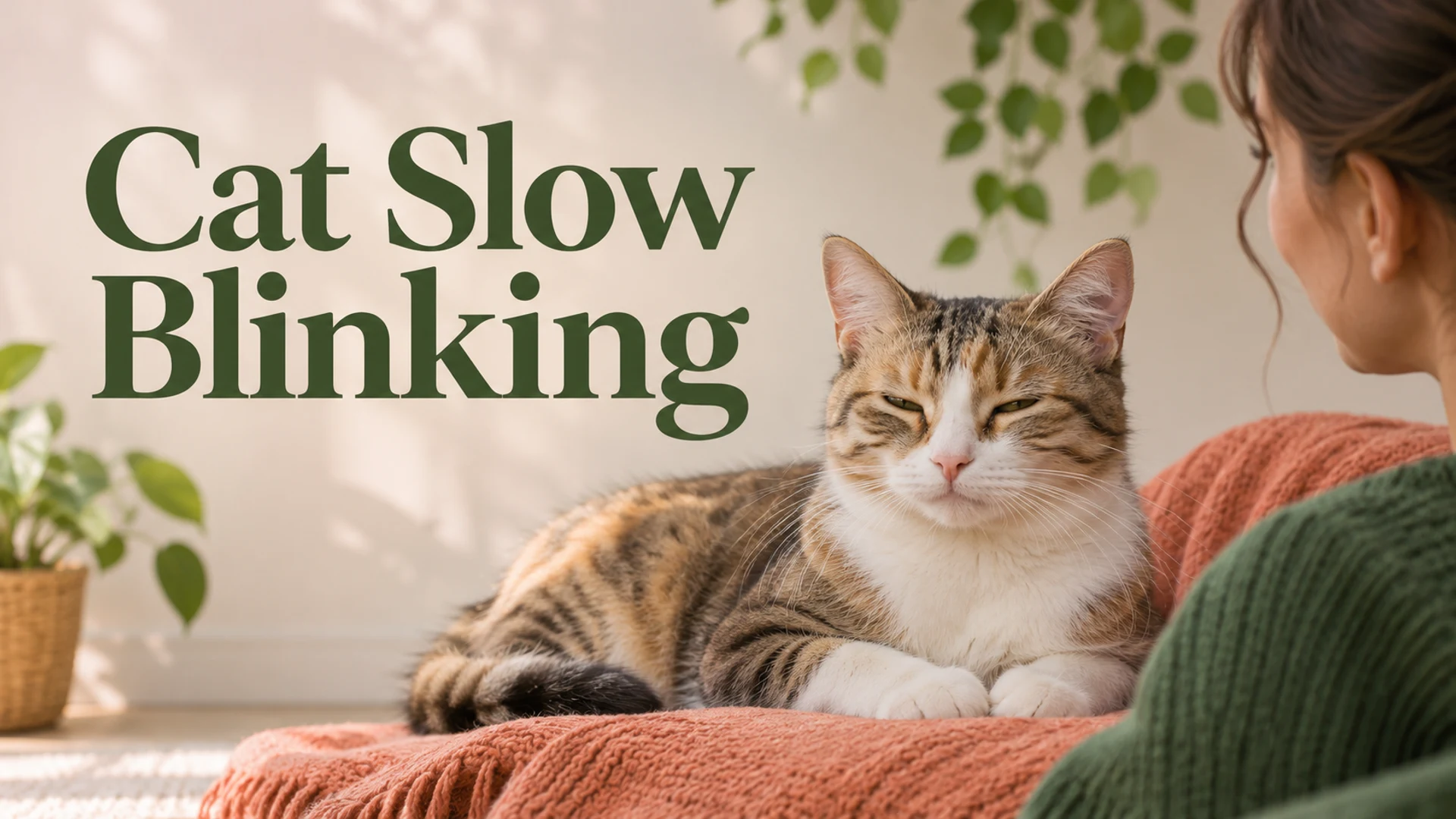
Cat slow blinking is a gentle narrowing or closing of the eyes that can occur during a calm interaction. You can respond with a relaxed blink and then look away, leaving your cat free to continue resting or approach. It can be a positive social signal, but it is not a literal translation of “I love you,” a test of your bond, or proof that a cat wants to be touched.
Context comes first. A comfortable cat resting near you offers a different situation from a cat who is tense, cornered, or holding one eye partly closed. Notice the rest of the face and body before treating narrowed eyes as an invitation. The goal is a quiet exchange that the cat can ignore, not a response you have to obtain.
What a slow blink actually looks like
A slow blink can include the eyelids moving partway together, remaining narrowed, or closing and reopening more deliberately than a quick ordinary blink. Some sequences are subtle. You may see the eyes soften without a dramatic full closure. Watch the movement across a moment rather than trying to identify it from one still photograph with half-closed eyes.
A drowsy cat can also have narrowed eyes. So can a cat facing bright light, and an uncomfortable eye can look partly closed. A single expression does not tell you why it happened. Look for a relaxed face, easy posture, and normal activity before interpreting the movement as part of an interaction. Do not wake your cat or shine a light at their face to obtain a clearer example.
Eye closure during another movement can be especially misleading. A cat rubbing their face against a cushion may close their eyes as part of that action. Look at whether the narrowing occurs while the cat is facing you or while their face is moving against something. Neither needs a score or a forced repeat. This distinction simply stops every closed-eye photograph becoming evidence for a social message that you did not actually observe.
Try describing the observation first: “she looked toward me, narrowed both eyes, then rested her head again.” That is more informative than deciding she has just made a promise of trust. Our cat language guide puts eye movements alongside the cat's posture and choices, which remain relevant even when a blink is easy to spot.
What the research supports, and what it cannot tell you
A study of cat–human eye narrowing published in Scientific Reports in 2020 compared human slow-blink interactions with control conditions. Cats showed more eye narrowing in response to human slow blinking, and in a separate experiment were more likely to approach an unfamiliar person after a slow-blink interaction. Those findings support a role in positive communication.
The study did not create a dictionary of individual feline thoughts or prove that every slow blink means affection. Its controlled comparisons also do not promise that a particular cat will respond on cue. Your cat's lack of a visible return blink is not evidence that they dislike you. Keep the result at the level it tested: a change in observed responses under the study's conditions.
Cats Protection also notes that eye narrowing can occur in other contexts, including stress. This is why it helps to distinguish a possible positive signal from a rule about all narrowed eyes. A cat's decision to keep resting, move away, or remain tense matters more for your next action than getting a satisfying interpretation of the eyelids alone.
Try it without making a staring contest
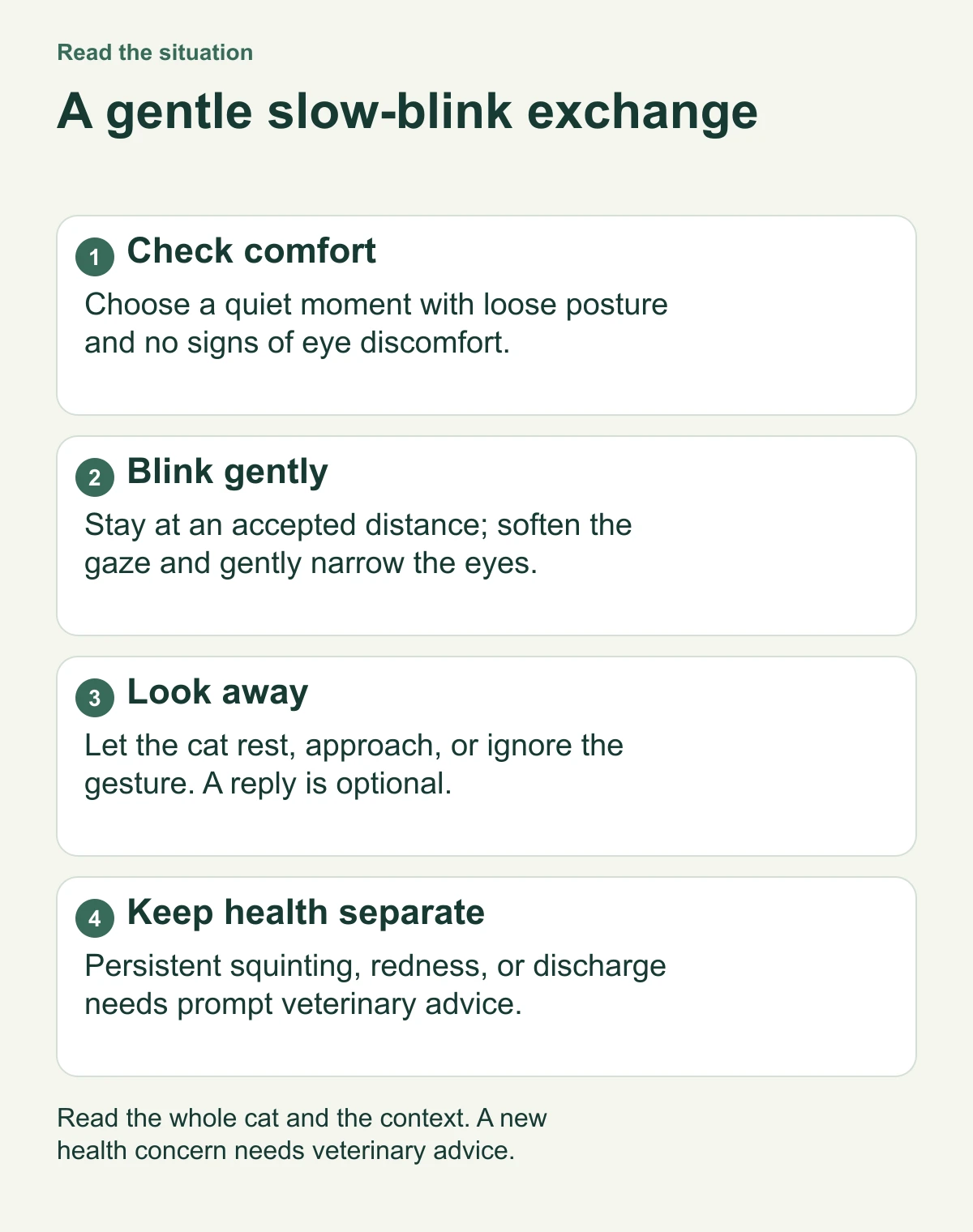
Choose an ordinary, quiet time when your cat is awake and comfortable nearby. Stay at the distance they already accept. Relax your shoulders and face, soften your gaze, and gently narrow or close your eyes before opening them again. Then look slightly away. You do not need to lean closer, call repeatedly, or hold a fixed gaze until the cat responds.
Let whatever happens next be enough. Your cat might narrow their eyes, turn their head, continue grooming, or do nothing obvious. You can return to your own activity. A calm exchange does not need to become a petting session. If the cat chooses to come closer, keep your position easy and let them decide whether proximity leads to contact.
For a cautious cat, distance may matter more than the gesture. A person sitting quietly across the room is less intrusive than someone crouching immediately in front of a hiding place. Do not follow a retreating cat to try the blink again. Keep the exit clear, reduce movement, and allow the cat to observe you without being watched continuously.
What happens next | What you can conclude | A useful response |
|---|---|---|
Eyes narrow and body stays loose | The exchange appears comfortable | Look away and let the cat rest |
Cat continues another activity | No clear response was observed | Leave the moment alone |
Cat tenses or retreats | More interaction is unwelcome now | Give space |
One eye stays partly closed | This may not be social blinking | Seek veterinary advice |
A return blink does not grant permission to touch
Suppose your cat slow blinks from the far end of the sofa. You blink back, and the cat remains where they are. Reaching across the gap would change the interaction, even if the exchange looked friendly. Staying nearby can be a complete social choice. Let the cat bridge the distance instead of treating a blink as consent to pick them up or stroke their belly.
If your cat approaches and usually welcomes a brief cheek stroke, keep watching for what changes during contact. A previously relaxed cat can become less comfortable after repeated strokes. Stop when the cat turns away, stiffens, or moves out of reach. The petting response guide addresses that separate task rather than asking a blink to answer every touch question.
Children can try a quiet blink while seated with an adult, but they should not put their face close to the cat's face. Give them a simple endpoint: blink, look away, and return to their activity. Avoid praising only the child whose cat “blinks back,” because that can encourage repeated attempts. The cat being left comfortable is a better outcome than a visible performance.
When narrowed eyes need a different response
Persistent squinting, redness, discharge, pawing at an eye, or a sudden change in how an eye is held warrants prompt veterinary advice. Do not assume those signs are an affectionate blink or wait to see whether the cat returns a gesture. An eye that looks painful or injured is a health concern, and a veterinarian can tell you what examination is needed.
If you can comfortably capture a visible eye change without handling the cat, PetMira's eye image log can keep the photo in the cat's digital profile for comparison. Note when you first saw it and whether one or both eyes were involved. The log does not diagnose an eye problem, and taking a photo should not postpone calling your vet. Ordinary social blinking does not need repeated health photos.
Keep the exchange easy
A slow blink is worth noticing as part of a relaxed interaction, with room for uncertainty about an individual moment. Offer one gently, look away, and allow your cat to decide what follows. Comfortable company is the aim; a returned blink is optional, and a persistently uncomfortable eye belongs with your veterinarian.
PetMira for iPhone
Keep visible eye changes in context
Use PetMira's eye image log for comparable photos of visible changes, with your timing notes kept alongside your observations. A persistent uncomfortable eye needs prompt veterinary advice.
 A digital profile for your cat
- Photo-based care logs
- AI care questions in one place
Available on the App Store. Guidance supports observation and does not replace veterinary care.
Download iOS App