Cat tail language can help you decide whether to wait, offer interaction, or give your cat more room. An upright tail often accompanies a friendly approach, while a rapidly lashing tail calls for a pause. Neither is a complete message by itself. Read the tail's position, movement, and change over time alongside the cat's body and the situation. A cat watching a toy and a cat being stroked can move their tails for very different reasons.
Start by watching without touching. Notice whether your cat is coming toward something, moving away, or staying in place. Then look at the tail from its base to its tip. A brief tip twitch is different from the whole tail sweeping across a cushion. You do not need to translate either into a sentence to make a useful decision about what to do next.
Read position and movement separately
Tail height describes where the tail is carried; movement describes what it is doing. A tail can be upright and still, upright and quivering, or low and sweeping. Keeping those observations separate prevents a familiar silhouette from overriding a change in behavior. Write “tail upright, tip trembling near the door” rather than immediately labeling the cat excited or worried.
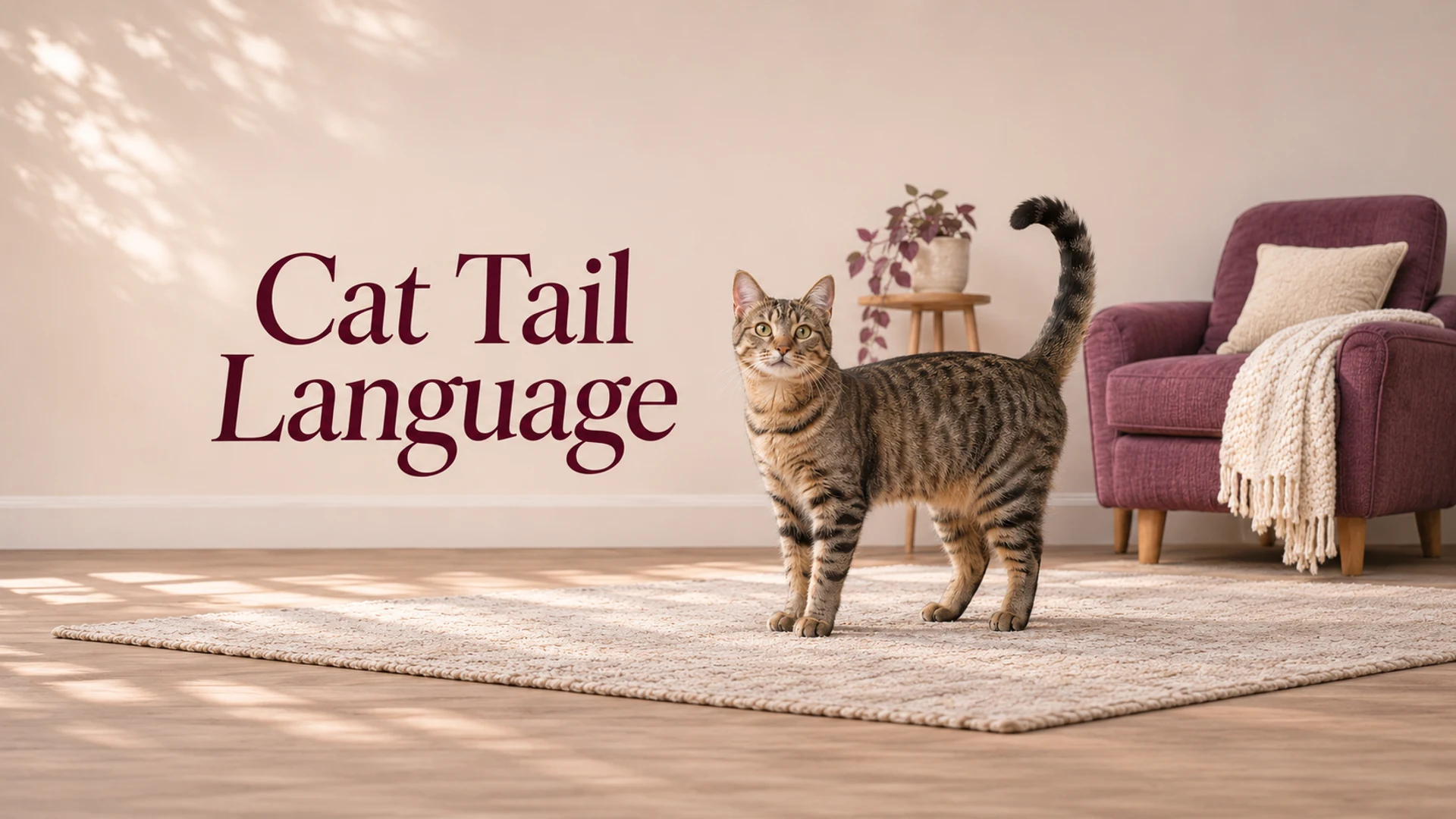
A loose upright tail during an easy approach often belongs to a greeting. Let the cat close the gap before offering contact. A hooked tip can occur in that same friendly sequence, but it does not tell you which part of the body the cat wants touched. If the cat walks past you toward the kitchen, follow that movement with your eyes rather than catching the tail or stopping the cat.
A low tail needs more context. Some cats ordinarily carry their tails lower than others. Compare the position with that individual's usual walking posture. A newly tucked tail, lowered body, and retreat from an approaching person suggest giving space. A tail resting around the feet of a comfortably seated cat can simply be a resting arrangement. Our guide to cat language explains how to combine those clues.
Tail observation | Check alongside it | Useful first response |
|---|---|---|
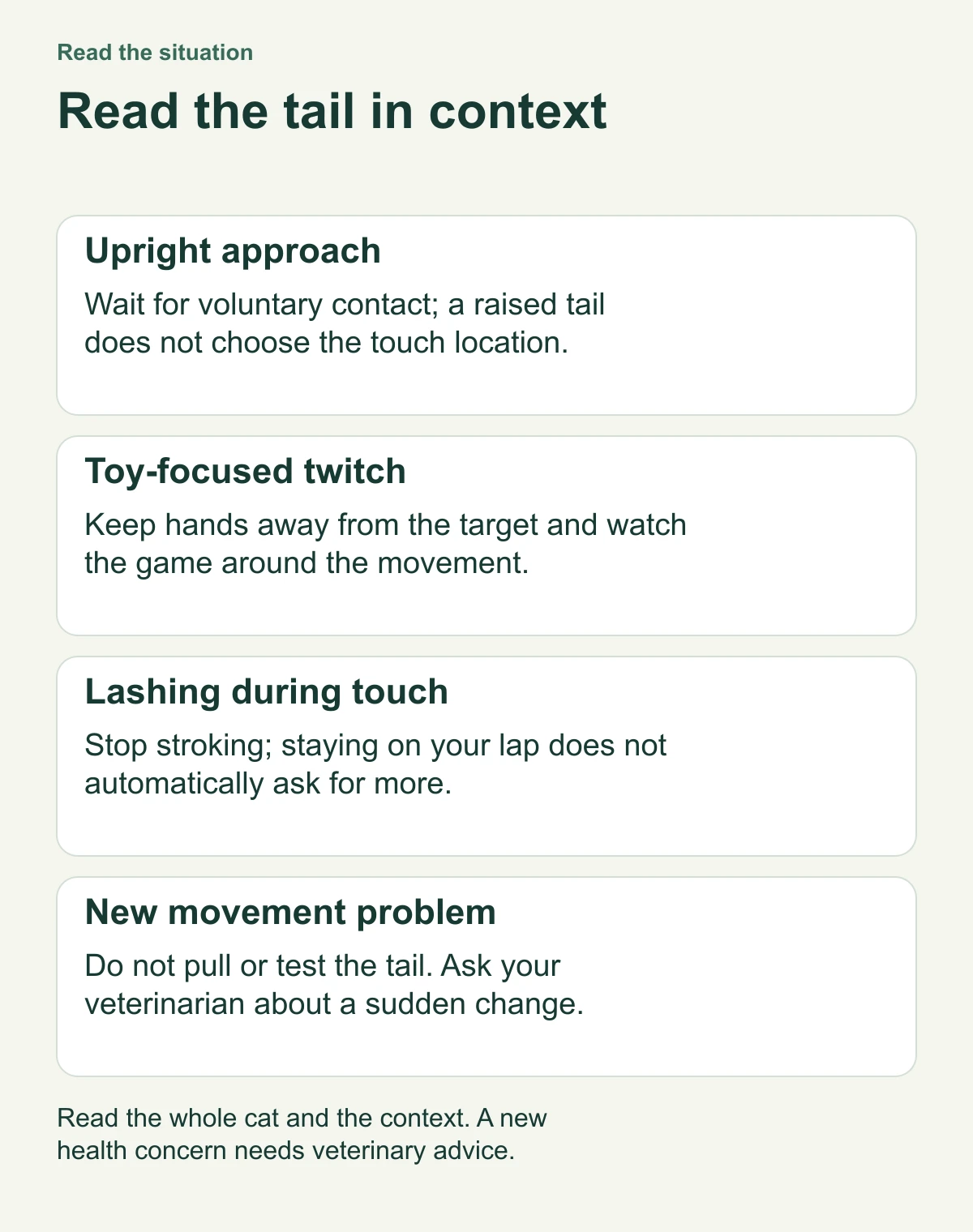
Upright during approach | Loose steps and voluntary proximity | Wait for the cat to choose contact |
Tip flicking during a game | Eyes following a toy | Keep hands out of the game |
Broad lashing during strokes | Ears changing and body tightening | Stop stroking and make room |
Puffed tail after a surprise | Arched or tense posture | Reduce activity and allow retreat |
Why a moving tail is not a simple happiness signal
A cat's wag does not have a single equivalent to a human smile. During hunting-style play, the tail may twitch while the cat concentrates on a toy. During petting, stronger tail movement may appear as the cat becomes less comfortable with the contact. Look at the object of attention and what changed immediately before the movement. The same word, “swishing,” can hide very different speeds and ranges.
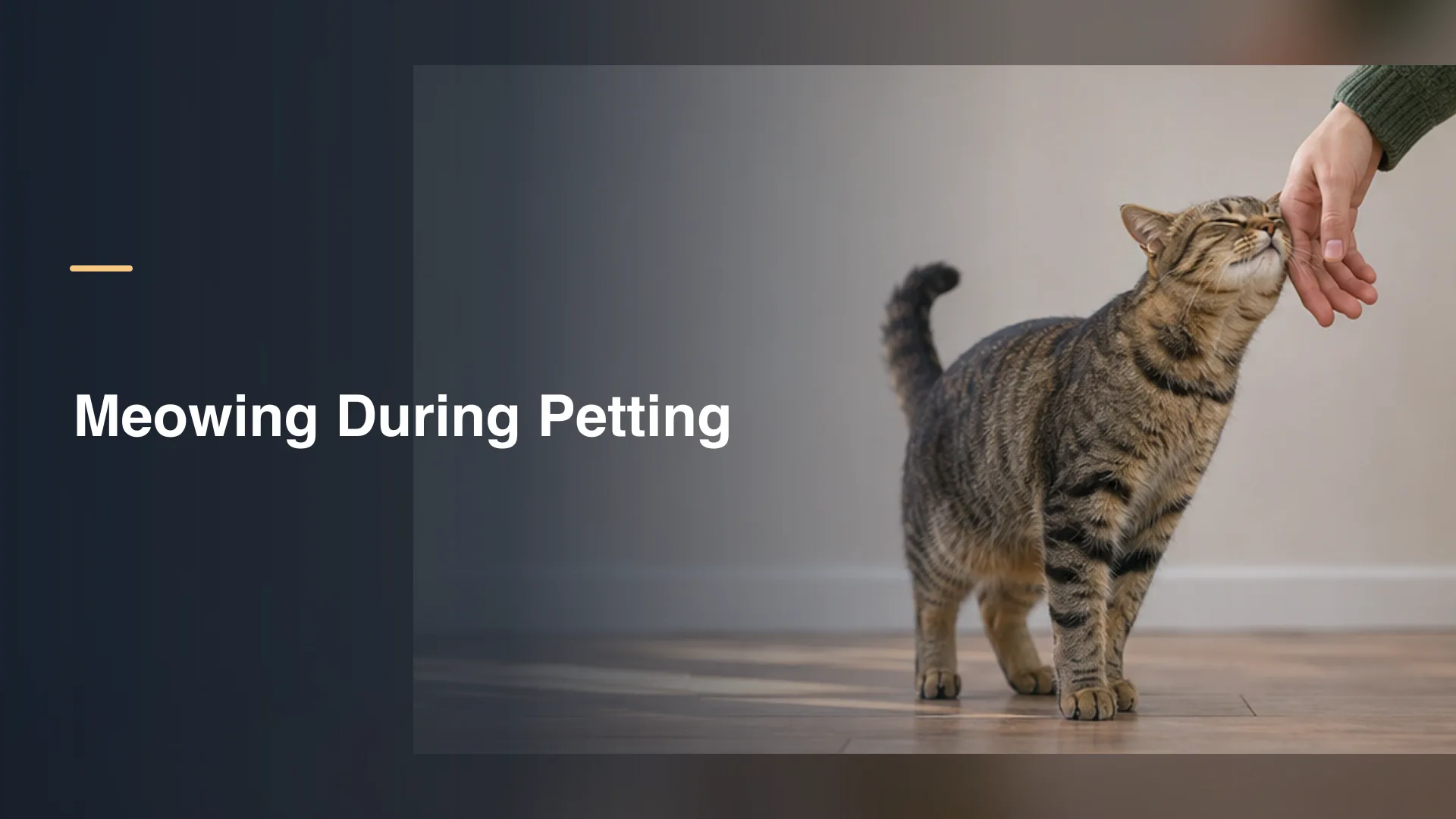
Imagine your cat crouched behind a chair, watching a wand toy travel across the floor. The tail tip moves, the eyes follow the toy, and the cat can leave freely. Let the toy remain the target; do not replace it with your fingers. Now imagine the cat on your lap, with the tail beginning to slap the cushion as your hand repeatedly moves down the back. Stop the strokes before trying to decide what the movement means.
After you stop, a cat may settle, leave, or choose another kind of contact. Each response is useful. Remaining on your lap is not automatically a request to resume petting. Some cats want a warm place beside a person without continuous touch. If a call accompanies the change, the petting and meowing guide focuses on the timing of that sound and your hand.
A puffed or tucked tail changes your next move
A puffed tail makes the cat's outline larger and commonly appears during a sudden startle or heightened arousal. It does not tell you whether the cat will run, stay still, or react if approached. Stop moving closer, keep other pets back, and leave an accessible route to a familiar hiding place. Avoid picking the cat up to reassure them; close contact can remove the option they need most.
Check the surroundings before assuming the reaction is directed at you. A dropped pan, an unfamiliar animal outside, or a noisy visitor may explain the sequence. Reduce what you can without reaching over the cat. If another cat is involved, do not put your hands between them. Create distance using doors or another safe barrier when possible, and let both animals settle separately.
A tucked tail with new withdrawal, unusual movement, or sensitivity deserves attention beyond a body-language chart. Call your veterinarian if the change persists or comes with other changes in daily activity. A tail that suddenly hangs limply after an accident, or a cat who seems unable to use it normally, needs veterinary advice promptly. Do not bend or pull the tail to test movement, and do not wait for an app interpretation before seeking help.
Tail quivering, wrapping, and individual differences
A lightly quivering upright tail can occur during a familiar greeting, particularly when a cat approaches an expected person or place. Note the rest of the event. A cat backing toward a vertical surface with the tail raised may be performing a different behavior, including marking. Check whether urine was actually deposited rather than deciding from a tail tremble alone. Recurrent elimination changes belong in a discussion with your vet.
Wrapping a tail around a person or another cat may occur in a comfortable social encounter. A tail wrapped around the cat's own body can also appear during rest. Avoid charts that assign every wrapped tail the same emotion. Ask whether the cat is resting loosely, hunching tightly, hiding, or monitoring something nearby. The surrounding posture often changes the practical interpretation more than the curl itself.
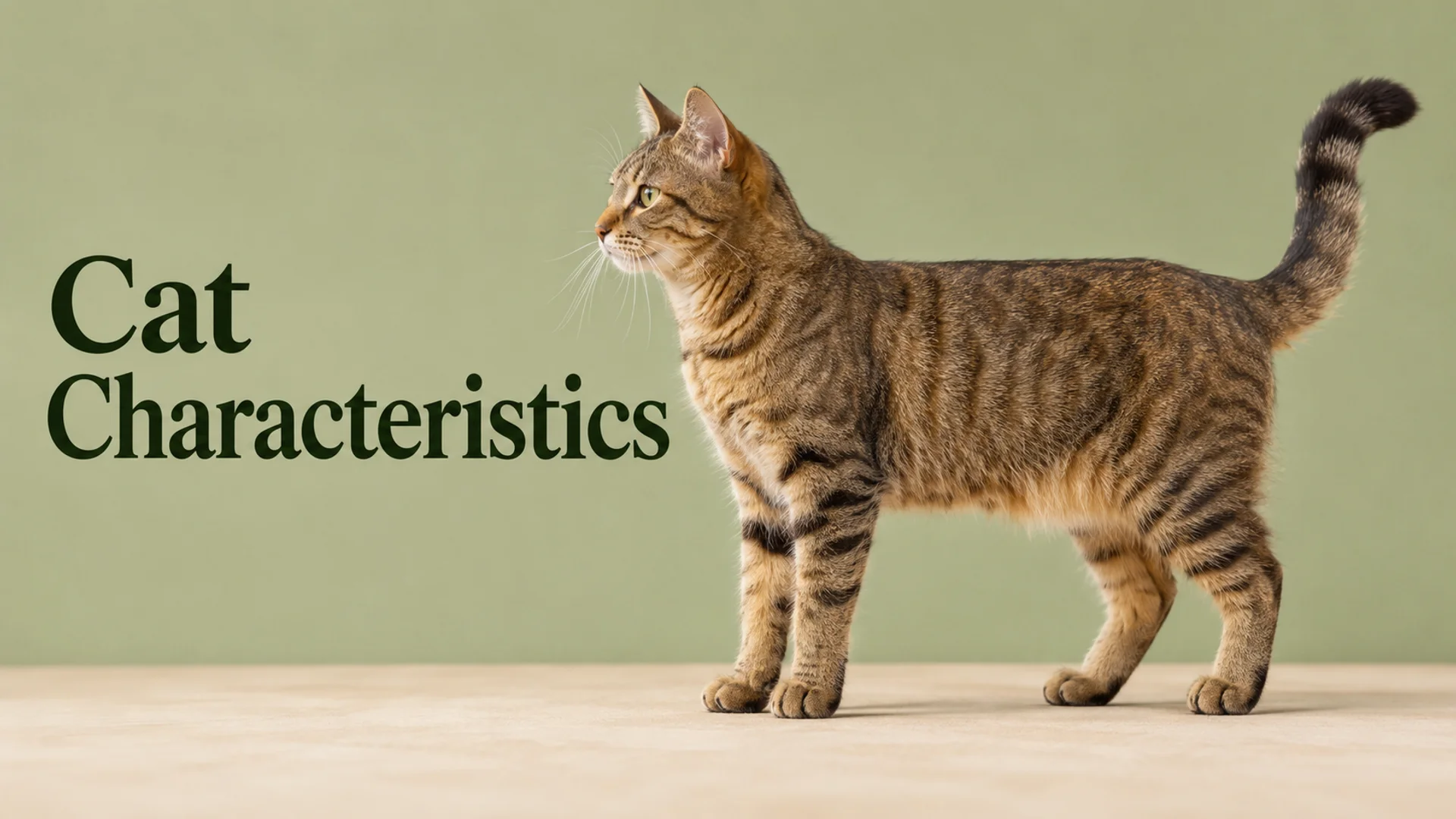
Cats with short tails or little visible tail movement still communicate through posture, ears, gaze, and movement. Do not manufacture a tail signal by touching or lifting what you can see. The cat characteristics guide separates physical features from momentary behavior, which is especially useful when comparing cats with very different outlines.
Keep an observation you can compare
Choose one recurring, ordinary situation, such as greeting your cat after work. Notice the tail position before you speak, what the cat approaches, and what happens after any contact. A short description of that sequence is more useful than repeatedly collecting dramatic close-ups. Keep the camera far enough away that the cat can continue normally, and stop if filming changes the encounter.
If a concern involves a visible skin or fur change near the tail, PetMira's photo-based care log can keep comparable images in your cat's digital profile. Record the behavior separately in your own words; a still image cannot show how fast the tail moved or what happened beforehand. Use those observations to explain a change to your veterinarian, without treating the app as an emotion detector or an injury check.
What to take from your cat's tail
Read height, movement, and context together, then choose the least intrusive useful response. A friendly approach can stay voluntary, increasing tail movement during touch can prompt a pause, and a new movement problem warrants veterinary advice. Learning your own cat's ordinary patterns will tell you more than memorizing a fixed message for every curl.
PetMira for iPhone
Keep visible changes easy to compare
Use PetMira's photo-based skin and fur care logs to keep comparable images in your cat's digital profile. Describe movement separately; a still photo cannot decode a tail signal.
 A digital profile for your cat
- Photo-based care logs
- AI care questions in one place
Available on the App Store. Guidance supports observation and does not replace veterinary care.
Download iOS App