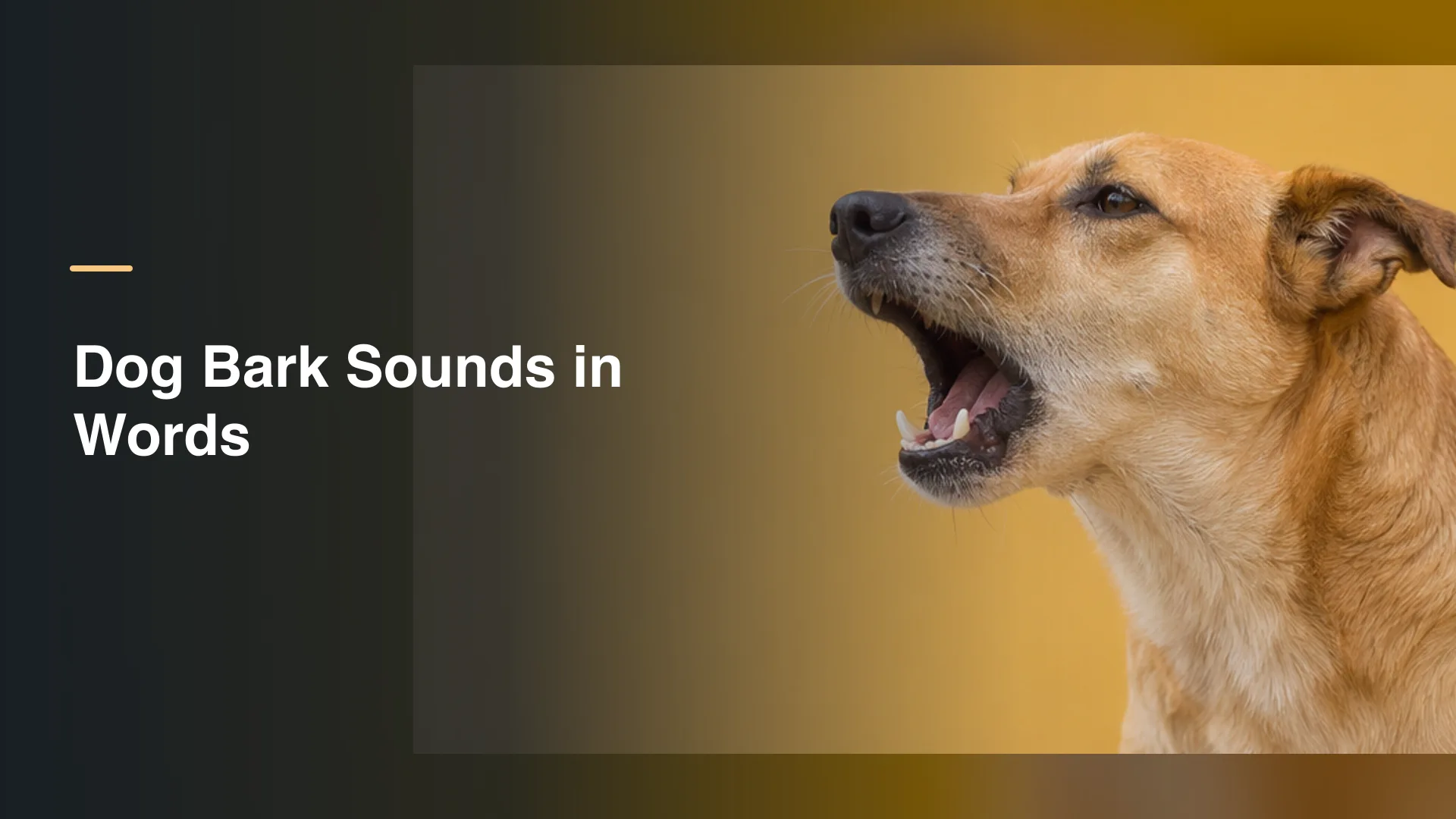
Common English words for a dog bark sound include “woof,” “arf,” “ruff,” and “yip.” Choose the spelling that fits the sound you want someone to imagine. “Woof!” suggests a full bark to many English readers, while “Yip!” suggests a short, higher sound. Add the pace, volume, or location in the sentence if the spelling alone leaves something important out.
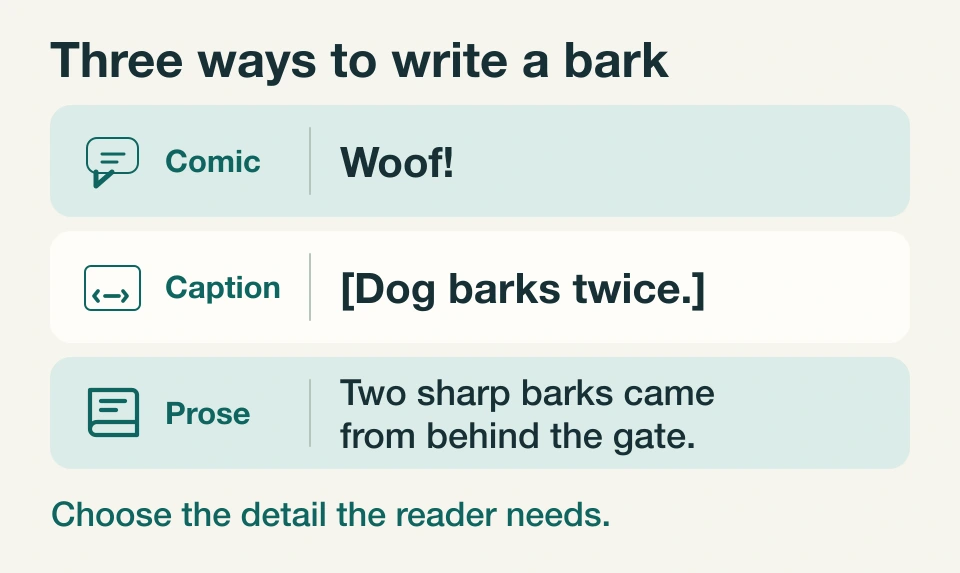
You can also just write “the dog barked.” In a story, that keeps the attention on what happens after the sound. In a comic, “Arf!” fits neatly in a panel. For a note you want someone else to use, “three sharp barks, then quiet” is easier to compare with another recording than a string of capital letters.
Dog Bark Words and When to Use Them
Sound words are examples of onomatopoeia, where a spoken or written form imitates a sound. The spelling is approximate. Two people hearing the same bark might write it differently, especially if they grew up reading dog sounds in different languages. In a passage written for English readers, a familiar sound word gives them somewhere to start. Researchers comparing English and Slovak use English dog-sound examples including “bow-wow,” “ruff,” and “woof.” Comparative study of onomatopoeia
Word or phrase | Effect on the page | Example |
|---|---|---|
Woof | Familiar, full-sounding bark | “Woof!” came from behind the gate. |
Arf | Short, crisp effect | A bright “Arf!” interrupted the silence. |
Ruff | A rougher effect a writer can use for a bark | “Ruff, ruff,” went the dog in the next yard. |
Yip | A short, higher-pitched sound | A single yip came from under the bench. |
Bow-wow | An established imitation that often suits playful dialogue or children’s writing | The puppet said, “Bow-wow!” |
A burst of barking | Several close sounds, with the count left open | A burst of barking stopped when the car passed. |
Read the choices aloud. The opening vowel of “woof” can feel rounded, and the final consonant stops the word sharply. “Arf” starts with a more open sound, and its final consonants give it an abrupt finish. “Yip” is brief and clips off at the end. Those are qualities of the English spellings as readers say them. A real dog’s bark can be higher, longer, or rougher than the word you picked.
If the noise is one sharp bark with a pause afterward, leave space around it. “Arf!” can sit on its own line in a comic. In prose, “A bark came from upstairs. The house went quiet again” gives the silence room too. A run of “woof, woof, woof” suggests a different pace. Put the pause into the sentence when it matters that another sound or action occurs between barks.
Give the Sound a Place and a Pace
A simple way to improve a written bark is to say where it came from. “The dog barked” tells us there was a dog. “A bark came through the apartment wall” tells us what the character could hear and gives us a clearer sense of the setting. Use the distance or the barrier if it changes the scene. A bark muffled by a stairwell reads differently from the same bark at someone’s feet.
Pitch and timing can do more work than extra spelling. A brief high sound can be “a sharp yip.” Several low sounds with gaps can be “two low barks, then a third after a pause.” Sound words work well when you want the audience to hear the first impression. Timing descriptions are especially useful when you want readers to notice a pattern or a change. Researchers studying barks also look at features of the sound and the setting where it occurred. These are measurable observations, while spellings are writing choices. Yin and McCowan’s bark acoustics study
Keep one detail that matters to the scene If the silence after a bark matters, describe that pause. If the character hears something far away, describe where it seemed to come from. One useful detail is often enough.
Use the Right Word for the Sound You Heard
“Bark” names a kind of dog sound. “Woof” or “arf” can imitate it, and “barking” can describe a sequence. Other words suggest a different sound pattern. A howl is typically held out. A growl is usually described as lower and sustained. “Whine” often suggests a higher, drawn-out sound. A yelp is short and sharp. If you aren’t sure what it was, “a short, high sound” may be the most accurate way to write it. Cambridge Dictionary’s animal sound guide
Imagine someone hears something from the other side of a garden fence. “A dog barked twice” works if they recognize the noise. If they are less sure, “two sharp sounds came from behind the fence” puts the reader in that person’s position. If a second character later sees the dog, you can name the sound then. This kind of sequence is useful in fiction and in ordinary notes, where you may only have seen part of what happened.
Size offers an unreliable shortcut. A reader might associate “woof” with a larger dog and “yip” with a smaller one. Real dogs can produce more than one sort of sound, and the same dog may sound different at a distance or on a recording. Choose the word for the particular bark, then describe the dog separately if its appearance matters.
Match the Description to Where It Will Be Read
In a picture book or comic, a short “Woof!” gives the reader an immediately recognizable effect. Keep the lettering large enough to read and make sure it belongs to the right animal in the scene. In a longer story, repeated sound effects can interrupt the pace. A brief description can carry the event, especially if you want to show how another character reacted.
In captions, choose wording that helps someone follow the action. “[Dog barks twice.]” tells the viewer what happened and how many times. “[Dog barks in the distance.]” is more useful if the source is out of frame and its location matters. When barking continues under a conversation, describe enough of the sound for the viewer to follow the scene.
If the caption must be short, choose between frequency and location based on the scene. A person stopping at the second bark makes the count useful. A character looking for a dog they cannot see makes the direction or distance more useful. Capital letters are optional in ordinary prose. They suggest emphasis on a page without explaining by themselves what made the sound abrupt or loud.
For your own notes about a recurring sound, keep the observation plain. Write the time, the pace, and what was happening if you know it. “Two sharp barks came from behind the gate” fits a short description. If you are working from a recording, replay it and count the barks and gaps before writing the pattern down. Use that detail when your family, a trainer, or your future self needs to compare it with another day.
For an actual dog, read about dog signals and the context around a bark.
Takeaway
Use “woof,” “arf,” “ruff,” or “yip” to imitate a bark in writing. Use plain details such as pitch, distance, number, and pauses when the reader needs to know what actually happened. Start with the sound you heard and choose the form that fits the page.
PetMira for iPhone
Replay a bark before you describe it
Record a natural bark in Dog mode on iPhone, then replay it from translation history to check how many times your dog barked and where the pauses fell.
 Replay an original recording
- Check the number of barks and the gaps between them
Write what you can hear in the recording, including any sound that obscures the bark.
Download iOS App