
If your dog is barking at night, check them before deciding how to quiet the room. They may be reacting to a sound, asking to go outside, or struggling to settle. Look at what happened just before the barking and what your dog does next. A new nighttime pattern deserves a vet check, even when you cannot see an obvious problem.
For a dog who is otherwise comfortable, tonight's aim is to meet an immediate need and reduce whatever keeps waking them. You can work on a longer-term routine once the house is calm. Start with the dog in front of you, rather than assuming every wake-up has the same cause.
Check your dog before changing the routine
Approach quietly and look before reaching toward them. Are they standing at the outside door, watching a window, or repeatedly trying to lie down? Notice whether they move normally and can get comfortable. If they seem painful or unwell, contact your vet for advice rather than starting a training exercise.
Difficulty breathing, blue-tinged gums, weakness, or collapse call for urgent veterinary help. Cornell's veterinary guidance on breathing distress recommends prompt emergency care; recording the barking or testing a bedtime change should not delay it.
For a dog who appears comfortable, check simple needs: access to water, a usable resting place, and whether a toilet trip is due. Keep any necessary trip quiet and return inside afterward. Dogs Trust's nighttime barking advice notes that barking may be how a dog wakes you when they need to go out. The need matters more than waiting for silence first.
Match your response to what you can observe
Use the setting to choose a next step. The same bark beside a window and beside an outside door can lead you to different checks. This table offers starting points for an otherwise comfortable dog, with follow-up when the pattern suggests they need more support.
What you notice | What to do now | What to record |
|---|---|---|
Barking follows hallway noise or passing headlights | Reduce that exposure and offer a quieter familiar resting spot. | The sound or sight and whether your dog settles after it passes. |
Your dog goes to the outside door | Offer a calm toilet trip. | Whether they toilet and settle after returning. |
Barking starts when you leave the room | Check for distress and stay nearby if needed. Seek advice for a recurring pattern. | Pacing, panting, door scratching, and whether proximity changes things. |
A normally settled dog starts waking and cannot get comfortable | Contact your vet about the change. | When it began and changes in movement, appetite, thirst, or toileting. |
For example, suppose your dog looks toward the window each time headlights cross the wall. Closing the curtains gives you a specific change to observe. If the dog then rests, record that sequence. It does not prove that every future bark is about headlights, but it tells you which part of tonight's setup to review.
A second dog might walk to the back door, toilet outside, then return to bed. Calling both dogs attention-seeking would miss that difference. If a toilet trip does not help, look again rather than repeating trips automatically. You are checking a possible need, not running a test that the dog must pass.
Make bedtime easier to settle into
Before the next bedtime, review the sleeping area from your dog's position. A bed beside a shared hallway may expose them to footsteps you barely notice upstairs. Close a curtain if moving lights are the trigger, or offer a familiar bed farther from the disturbance. Keep an easy route to the bed and enough room for your dog to stretch out.
Choose one sensible adjustment and note it. Moving the bed, changing bedtime, and adding background sound together makes it harder to tell what helped. If the new location leaves your dog pacing at a closed door, reconsider it rather than insisting they adapt. A quieter room only helps if your dog can actually rest there.
If your household works different shifts, compare the barking with the first person leaving or the last person coming home. Prepare the sleeping space before that event where possible. A note such as “barked when the garage opened” gives the family something concrete to change; “bad every night” leaves everyone guessing. Avoid changing meal or medication instructions to fit an experiment with bedtime.
Build calm practice into the day. When your dog is already comfortable on their bed, quietly reward that settled behavior. Keep the daily opportunities for activity, interaction, and rest predictable. VCA's barking guidance describes reinforcing quiet, settled behavior within a regular routine. Practice when your dog can respond, instead of making their first lesson a noisy wake-up.
Agree on the overnight response Tell everyone who may get up which checks to make and what changed at bedtime. That keeps one person from beginning a game after another has already offered a toilet trip and a quiet return to bed.
Avoid shouting, startling devices, and punishment collars. The American Veterinary Society of Animal Behavior recommends reward-based methods for training and behavior problems. If you are exhausted, arrange for another household member to take a turn where possible; choose support that lets you respond calmly.
Keep four useful notes about the night
You do not need a long diary. Answer four questions: When did it start? What was nearby? What did your dog do? What helped them settle? If nothing helped, say that. Leave an uncertain answer blank rather than inventing a reason for the barking.
For notes another person can use, describe the number and spacing of the barks as well as what happened around them.
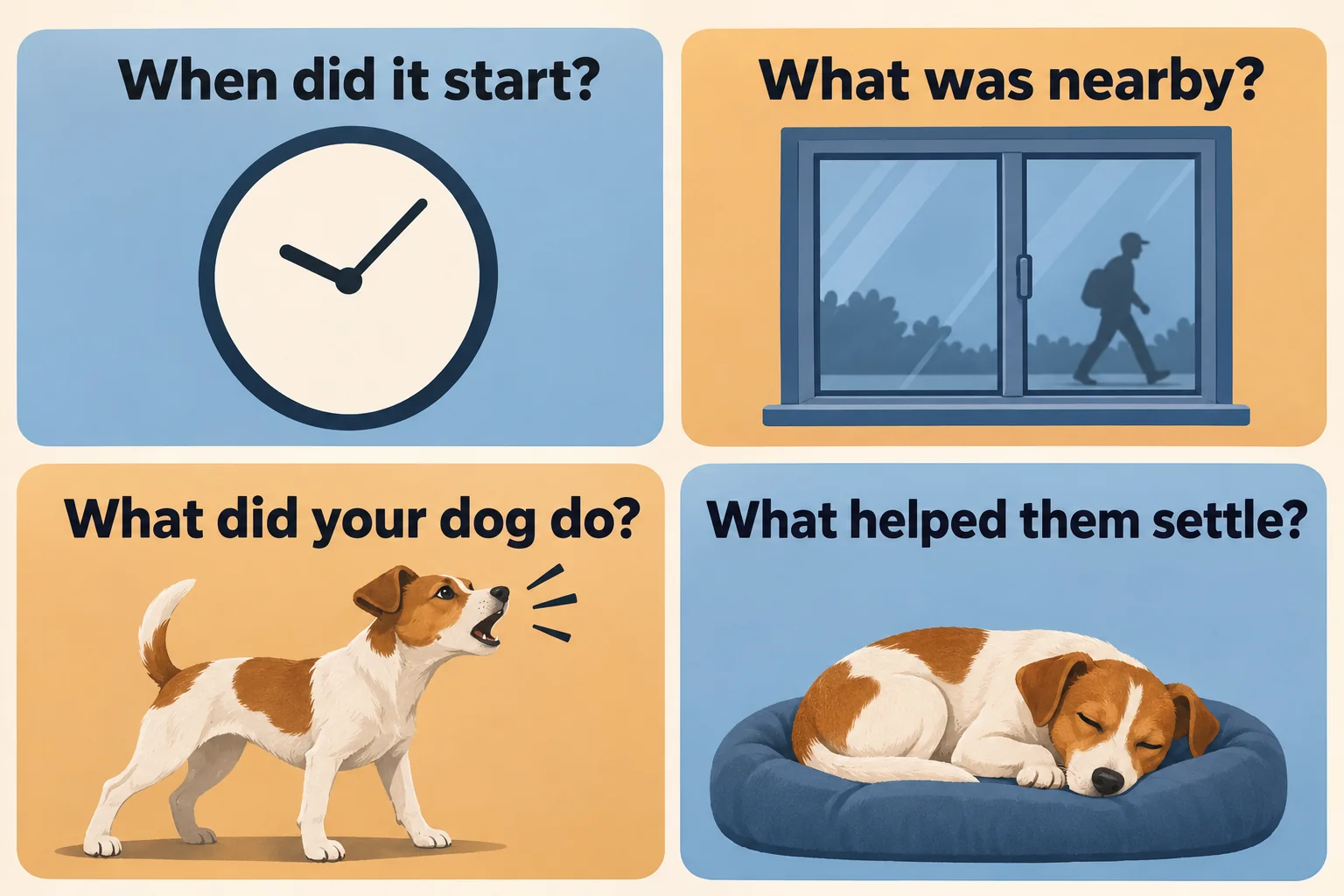
An example entry might read: “Woke at 1:20; footsteps in the hall; stood facing the front door; returned to the bed after the hallway was quiet.” Compare that with the next ordinary occurrence. Barking at the same hour with different surroundings is not automatically the same problem. Record when you changed the bed location so the comparison remains useful.
Include what happened after the sound stopped. Did your dog lie down and remain comfortable, or keep walking between rooms? Silence by itself does not tell you whether the dog has settled. If another person handled the wake-up, ask them for the same four observations so you can compare events without relying on who thought the barking sounded louder.
For a familiar, non-distressing bark, PetMira's dog translator can record the sound and keep its AI interpretation in translation history. You can replay the clip later alongside your separate notes about the situation. Treat the interpretation as a suggestion, not a diagnosis or an explanation of why your dog woke. Let the sound happen naturally; there is no need to provoke another bark for the app.
Get help when the pattern changes or keeps returning
Contact your vet when nighttime barking is new, your dog seems uncomfortable, or you notice other changes. For an older dog, mention confusion, altered sleep, house-soiling, or difficulty moving if you see them. The ASPCA's guidance on older dogs explains why changes deserve assessment rather than being dismissed as aging. Night barking alone does not establish cognitive dysfunction.
Recurring barking when separated from you also deserves a closer look. Pacing, destructive attempts to get out, or other distress can accompany separation-related problems, as the ASPCA's barking guide explains. Ask your vet about appropriate behavior support. Bring observations you already have; you do not need several nights of recordings before making the call.
A calmer plan for tonight
Check your dog's comfort and immediate needs, then respond to the situation you can actually observe. Make one manageable change when appropriate, note the result, and seek help for new or persistent problems. The useful goal is a dog who can rest comfortably, with a clearer plan for the next wake-up.
Everyday sound observations
Revisit a familiar dog sound
Record a natural bark with PetMira and compare its AI interpretation with what you observed in the moment.
 Record a natural dog sound
- Return to saved interpretations by date
AI interpretations are suggestions, not a diagnosis or a substitute for veterinary advice.
Download iOS App