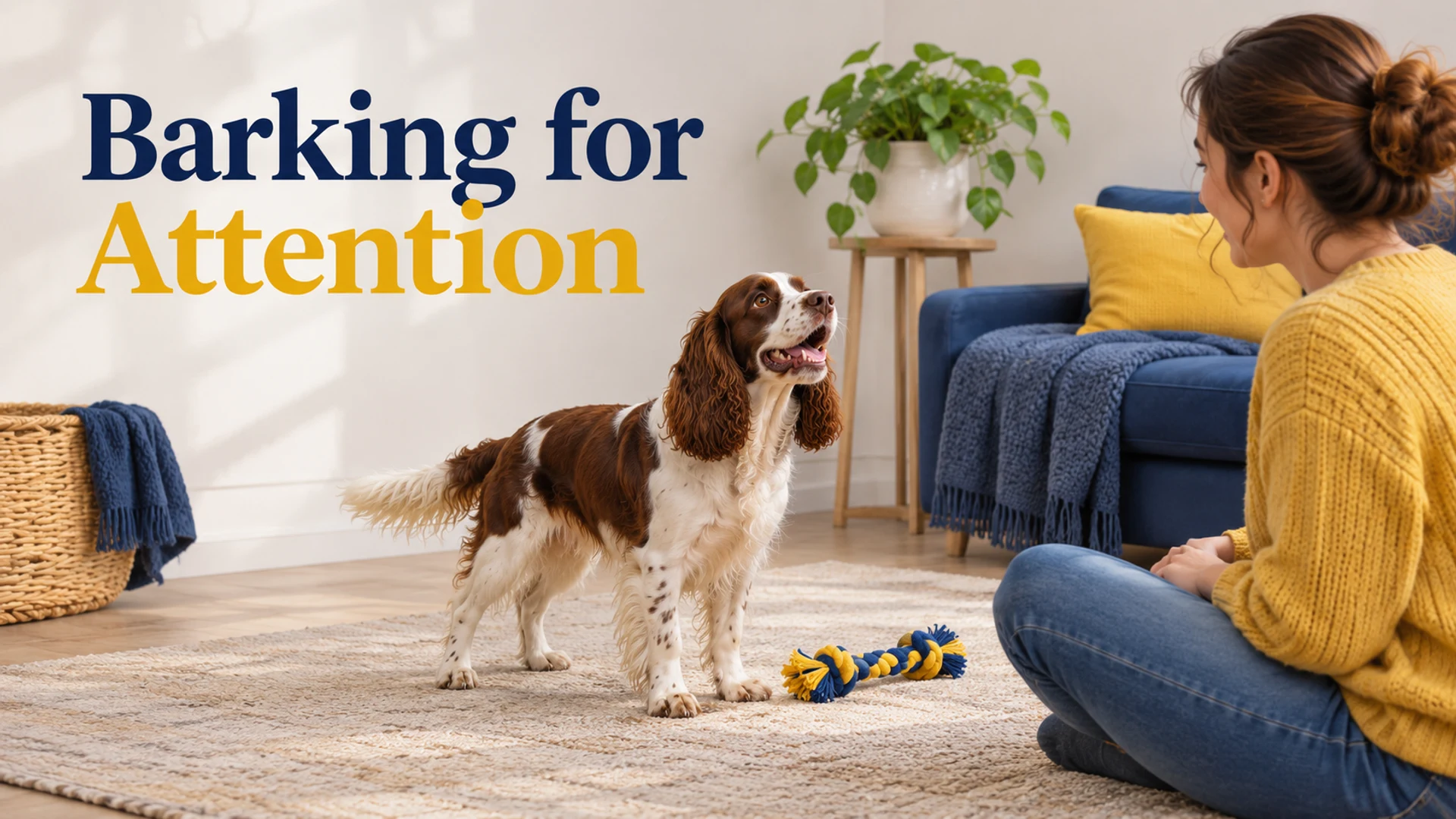
When barking reliably brings you over, starts play, or gets a wanted object, your dog can learn to use it as a request. The solution is to check the need, prevent predictable frustration, and teach a quieter request that works before barking starts. Simply ignoring every bark can miss a toilet need, discomfort, fear, or distress about being alone.
Use the plan below for a familiar situation in which your dog otherwise appears comfortable and can engage with you. If the barking is new, accompanies pain or another health change, or involves panic or risk of a bite, seek appropriate veterinary or qualified behavior help instead. Breathing difficulty or collapse requires urgent care, not a training exercise.
Check the need before calling it attention barking
Notice who or what your dog is facing. A dog looking toward you and an unreachable toy offers a different problem from a dog staring at movement outside a window. Barking at another dog, at a startling noise, or when separated from you may require a different response. The dog language guide can help you add posture and direction of attention to the picture.
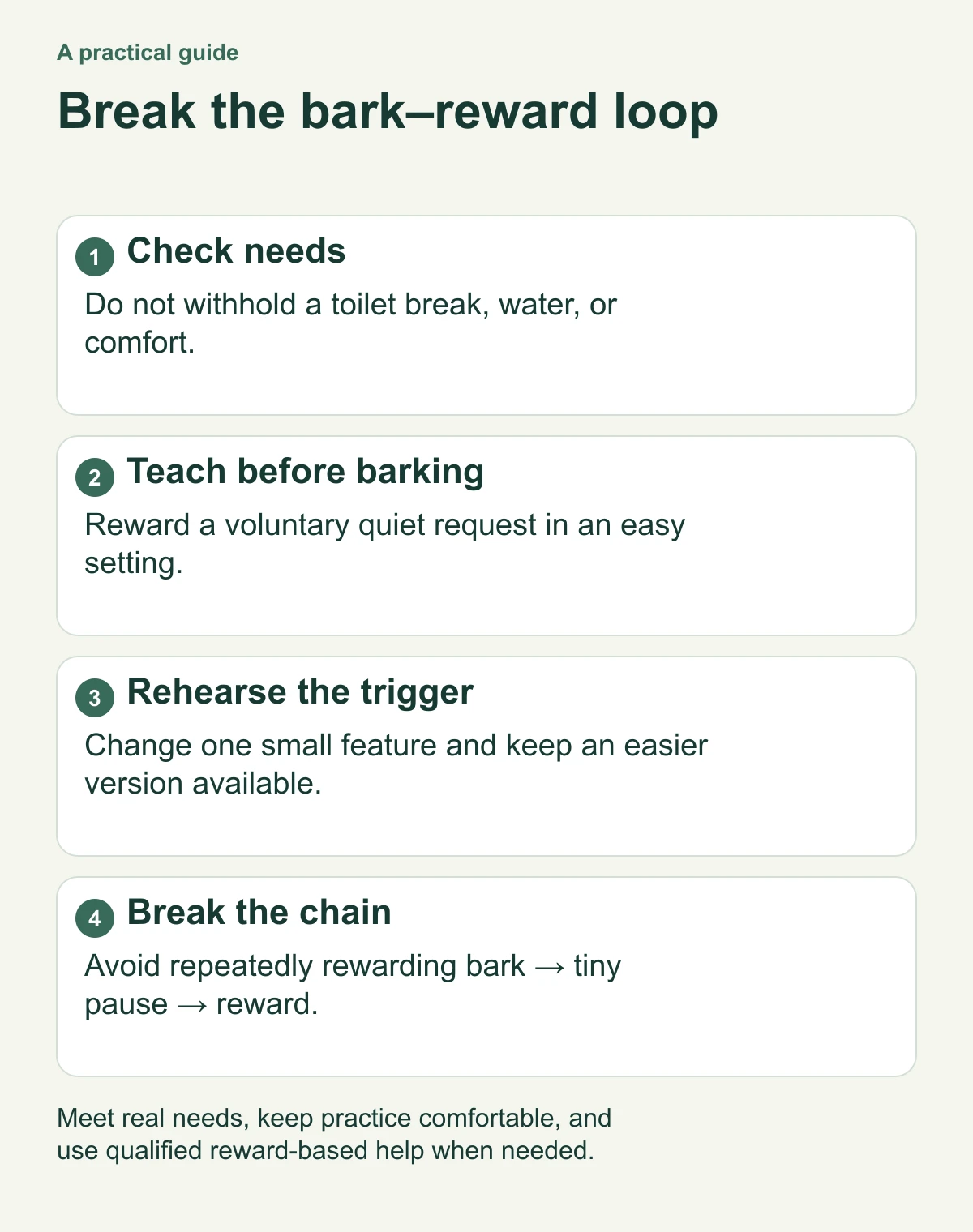
Check practical needs without turning them into a test. Provide water if the bowl is empty, give a due toilet opportunity, and make sure the dog can access a comfortable resting place. Do not withhold these things to see whether barking stops. A dog can have learned an effective request and still have a genuine need that should be met.
Then identify one predictable, low-pressure situation to work on. “Barks when I pick up my phone after our afternoon walk” is specific enough to plan around. “Barks all the time” is not. If the dog cannot settle across many different settings, ask for advice rather than assuming every episode has the same learned function.
Work out what your dog gets from the exchange
Write the sequence once: what happens before the bark, what the dog does, and what you do afterward. Perhaps you open the toy cupboard, the dog barks, and you begin a game. Or you start typing, the dog barks, and you speak to them. Even a lengthy conversation about being quiet can provide the interaction they were seeking.
Look for an easier setup before choosing a training cue. If a ball repeatedly rolls under furniture, block that gap. If the difficult moment follows a long stretch without suitable activity or company, adjust the routine. These changes address a predictable problem; they do not imply that exercise alone treats anxiety or that a dog must be exhausted to behave acceptably.
Pick one replacement you can recognize and reward. For this example, use approaching a familiar mat near you and pausing quietly. A relaxed look toward you or bringing an appropriate toy could work in another household. Choose something the dog can do voluntarily rather than a pose you need to hold them in.
Teach a quiet request before the usual trigger
Practise while the dog is awake, comfortable, and not already barking. Put the mat in a familiar space with room to leave. Have small rewards your dog can safely enjoy, and decide what counts as success: stepping onto the mat and pausing with you nearby. Begin with a version that is easy for this dog.
When the dog voluntarily steps onto the mat, mark that moment with a quiet word they know and deliver the reward there. Let them move away and choose another approach. If they do not approach, make the setup easier or use a behavior they already offer; do not pull or repeatedly place them on the mat. Finish while the dog can still participate comfortably.
Once that approach is familiar, reward a brief quiet pause on the mat before asking for more duration. If the dog leaves, reset with an easier version rather than blocking the exit. Add a spoken cue only when the action is becoming recognizable. Our guide to clear cues and rewards explains the basic teaching process without requiring you to invent a new signal mid-bark.
Use the plan during a predictable attention moment
Start with a small rehearsal, not an important work call. After needs are met and the dog is comfortable, invite the familiar mat behavior, then pick up the phone briefly. Reward an easy quiet pause before the usual barking begins. Put the phone down and finish while the task remains manageable. You are separating a small trigger from a full distracting event.
Increase only one part of the task when the dog can cope: a little more phone movement, a short spoken sentence, or a slightly longer pause between rewards. If the dog starts barking, repeatedly gets up, or cannot engage, return to an easier version. Being able to stay comfortably is more useful than completing a planned number of repetitions.
For a real call that exceeds your dog's current ability, arrange a practical alternative. A household member may provide suitable company, or you can choose a different time or shorter call when possible. Do not expect a brief mat lesson to replace a long period of interaction or compel a worried dog to remain separated. Management lets you avoid practising the problem while the new skill develops.
What happens | Change the next attempt | Look for progress |
|---|---|---|
Barking begins as the phone appears | Rehearse a smaller phone movement | Dog can approach and pause comfortably |
Dog leaves the mat repeatedly | Shorten the pause or simplify the setting | Voluntary return without pressure |
Dog becomes distressed when you move away | Stop this exercise and assess the problem | A plan suited to separation difficulty |
If barking starts, reset without creating a bark-reward chain
First check whether the situation changed. Someone may have arrived outside, the dog may need to go out, or the exercise may simply be too hard. Do not continue a quiet-request drill through fear or discomfort. Make the immediate setting manageable and plan an easier repetition later.
For a comfortable dog in the familiar request situation, keep your response calm rather than arguing or shouting. Avoid repeatedly paying out the same sequence of bark, tiny pause, then treat or play. The dog may learn that barking is the first step in the exchange. Put more of your effort into rewarding the quiet approach before the bark and preventing the predictable trigger from becoming too difficult.
A pause is not the whole plan. The replacement behavior needs practice when barking is absent. If every reward still follows a bark, simplify the setup and change your timing rather than waiting for a longer, louder episode to end.
Make the household response consistent
Tell everyone what the new request looks like and when it should be rewarded. One person handing over a toy after barking while another waits for the mat approach makes the outcome unpredictable. Keep ordinary attention available throughout the day, including when the dog quietly checks in. The aim is a dependable way to ask, not a rule that the dog must always entertain themselves.
Keep a short note about the trigger, what the dog could do, and when the task became harder. PetMira can record a familiar, naturally occurring bark and provide an AI interpretation, but it cannot determine that the dog is manipulating you or diagnose the reason for barking. Keep your own sequence note separately, and do not provoke another bark for the recording.
If progress stalls, seek a qualified, reward-based professional who can watch the actual exchange. The AI dog training guide explains why an automated plan needs human review and clear stopping conditions. Increasing fear, abrupt behavior changes, or difficulty being alone calls for support beyond a generic attention-barking exercise.
Make the quiet request easier to choose
Meet real needs, prepare for the predictable difficult moment, and reward a simple request before barking starts. Make practice smaller when comfort or timing breaks down. A successful plan gives your dog an effective way to communicate and gives the household something consistent to do.
PetMira for everyday care
Keep the sequence clearer than the label
PetMira can record an ordinary, naturally occurring pet sound. Use a separate note to track the trigger, your response, and the quieter request you are teaching.
 Record familiar pet vocalizations
- Read everyday care guidance
- Treat AI interpretations as suggestions
An app cannot establish intention or replace a humane, situation-specific training plan.
Download iOS App