
Dog breed differences show up most clearly in physical traits such as adult size, coat, and body shape. Breeding history can also help explain why certain activities come naturally to some dogs. An individual dog’s response to a specific situation depends on much more than the breed name. For everyday care, compare the trait that affects your routine, then check what the dog in front of you actually does.
Divide the comparison into physical traits, tendencies, and observations
Difference | Useful evidence | Everyday consequence |
|---|---|---|
Adult size and build | Measure the individual dog | Fit transport, equipment, and resting space |
Coat and grooming needs | Check the coat and ask how it is maintained | Set brushing, clipping, and grooming time |
Interest in chasing or following scents | History of the breed plus walks with the dog | Choose safe routes and training exercises |
Response to visitors or noise | Repeated observations in similar situations | Set up a quiet retreat or plan introductions |
Breed-associated health concerns | Appropriate screening and your veterinarian | Plan checkups, activity, and care for that dog |
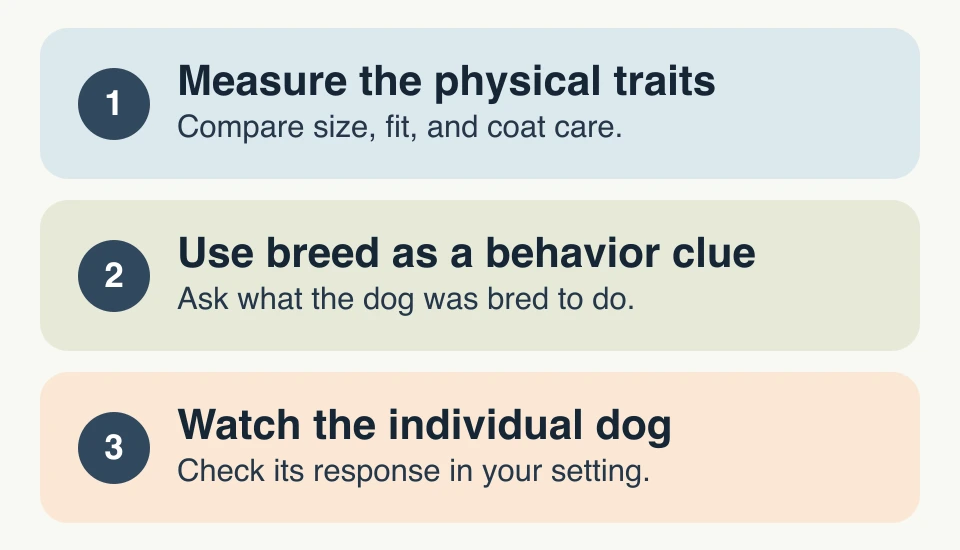
Breed profiles are often written for an ideal example. Even a useful standard cannot tell you how long a particular adult is, whether its coat tangles behind the ears, or how it reacts to a visitor at the door. If a number or description is going to affect something you buy or a plan you make, check the physical trait or the behavior directly. People often compare dogs as a whole when they would learn more by comparing one feature.
Similar dogs can have very different coat routines
A Standard Poodle and a Labrador Retriever can both look large and athletic. The Poodle’s curly coat needs maintenance to prevent mats and is normally clipped. A Labrador has a short, dense coat that sheds. Start by deciding which tasks you can take on. With a curly coat, ask how often the individual dog needs brushing in areas that tangle and what the groomer recommends for the current length. With a shedding coat, plan for brushing and cleanup rather than assuming a short coat means a hair-free house.
Notice the difference between a maintenance schedule and a dog’s tolerance for it. A dog with a textured coat that is comfortable with brushing can be straightforward to groom. A dog that flinches when a brush reaches its rear leg may need a slower routine or an assessment of discomfort. A breed profile helps you anticipate the work, while the animal’s response tells you how to carry it out.
Compare the part that changes the plan Before a first grooming visit, describe the coat, current clip, and any mats or handling difficulties. The groomer can work from those details even when a rescue dog’s ancestry is uncertain.
The same breed group can contain different ways of working
The Beagle and Greyhound are both hounds, but following a scent and pursuing by sight involve different cues. When a dog pauses with its nose down at a busy trail junction, your next move may be to allow time to sniff somewhere it can do so safely. When a dog visually locks onto fast movement, adding distance and maintaining a secure lead may be the more relevant choice. Use breed history to come up with observations you can test on an ordinary, leashed walk.
Consider two examples that look the same from across the park. One dog surges forward slowly with its attention moving between scent spots. Another speeds up the moment a small animal moves and stops scanning the ground. Both put tension in the lead, and both may need help walking safely. Comparing their sequence helps you decide whether to work on getting past scent hotspots, noticing movement at a distance, or reducing overall excitement. Our dog language guide explains how to pair posture with the situation before interpreting a response.
Similar weight does not guarantee similar equipment
A dog’s weight gives you a helpful starting number for transport and handling. Chest depth, neck circumference, and back length can still differ substantially between dogs that weigh the same. A long-backed dog may need a different resting space from a more compact dog. With a harness, compare the manufacturer’s measurement guide with the dog standing naturally, then check that the straps do not interfere with normal movement. Weight from a breed chart will not answer those fit questions.
The same principle applies when comparing exercise. A fit adult’s recent walks tell you more about what it will tolerate this week than another dog’s usual mileage. Match the route to both the dog’s preparation and the weather, then watch for signs it needs an easier plan.
What the behavior research tells you
A 2022 Science study by Kathleen Morrill and colleagues combined owner surveys and genetic data. In that sample, breed explained about nine percent of variation in the behaviors studied. That is a share of variation across the study dogs. It is not an individual score and does not mean nine percent of what any particular dog does comes from breed. The researchers found heritable components of behavior while also showing how little a breed label settles about a particular dog.
Use the finding to improve the question you ask. “Are Beagles vocal?” starts a discussion about a breed. “What did this dog do each time someone rang the doorbell, and how quickly did it recover?” produces evidence you can use. On another day, ask what happens when the dog hears the same sound without a visitor arriving. Checking a similar situation more than once tells you what lesson the dog may already have learned.
Dogs of the same breed can have different histories. One has walked in a lively neighborhood for years, another seldom leaves a quiet yard, and a third is still a puppy. If one strains on the lead near buses, look at the distance, noise, and time of day before assuming the difference is built in. If an abrupt behavior change accompanies signs of discomfort, discuss it with your veterinarian rather than trying to explain it with breed history.
Compare two dogs on the same measures
Use a few ordinary observations to translate a description into a care plan. Weigh or measure both adults with the same method when comparing equipment. Ask about the last two grooming appointments, including what could be done comfortably at home. For walks, note the length, surface, temperature, and any triggers. Comparing an hour on an empty grassy path with fifteen minutes on a noisy sidewalk tells you more about the route than about the dogs. If you are narrowing an adoption shortlist, test those observations against the household’s real weekday routine.
Keep a short written record of what happened on an actual walk or care day, then compare similar situations. PetMira’s iPhone app can complement those notes with a photo log of visible changes, such as the coat over time. If one dog sleeps after a relaxed outing and the other paces, write what you saw and what happened before it. Those observations give you a more useful starting point than a guessed breed label.
The takeaway
Compare build and coat when the decision is practical, and check how the individual behaves in the situations that matter. Breed history can explain why a trait is worth looking for. What you observe repeatedly tells you whether it changes your care plan.
Keep photos of visible changes
Keep coat and skin photos in PetMira
On iPhone, keep photos of changes in your own dog’s coat or skin as you get to know what care that dog needs.
 Log individual coat and skin photos
- Compare visible changes over time
Keep a separate written record for walks and behavior.
Download iOS App