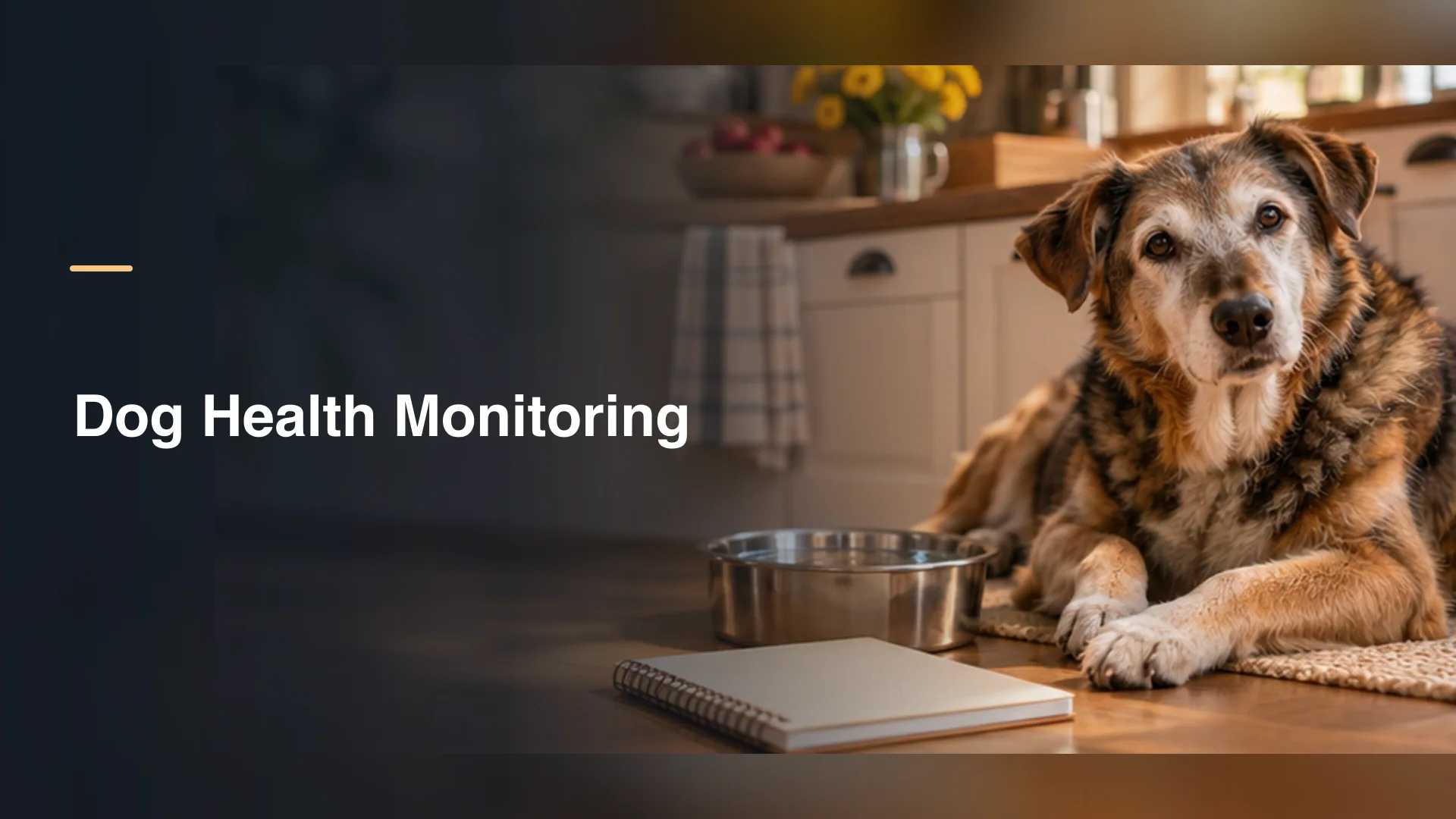
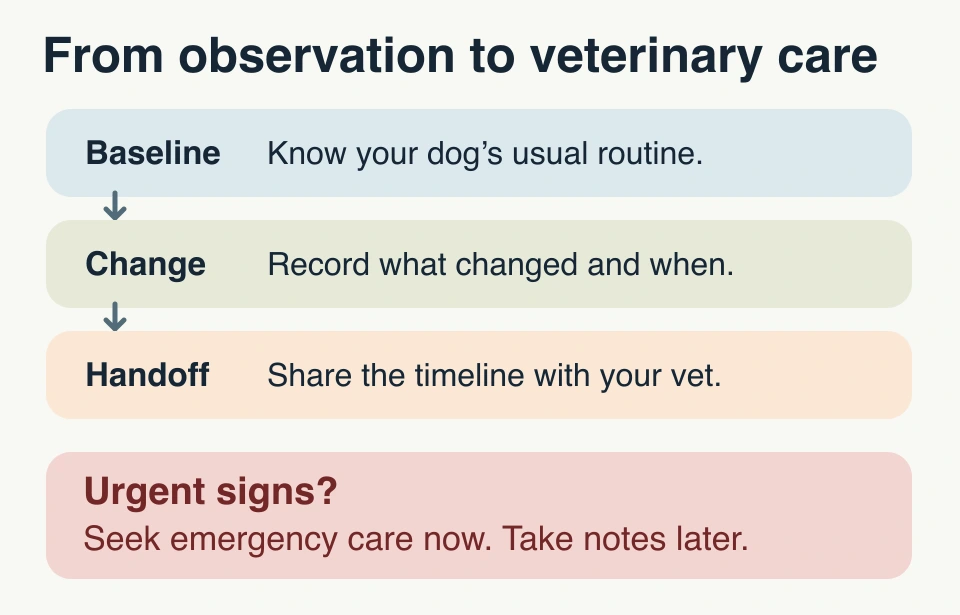
Good dog health monitoring starts with knowing your dog’s usual appetite, drinking, movement, elimination and behavior. Observe at the same point in the day, record concrete changes and bring a short timeline to your veterinarian when something is different. A notebook or phone app can keep this information together. It cannot diagnose a change, and an emergency sign should be acted on immediately.
Think about what you could explain clearly if someone asked about your dog this afternoon. “He usually gets up with me at seven, but for the last two days he stayed on his bed until I set down the bowl” is something another person could observe and check. “He has been off lately” can be hard to act on. The useful information is often the change from your own dog’s pattern.
Routine | Baseline cue | Useful note |
|---|---|---|
Meal | Usually finishes promptly | Left half, first noticed Tuesday |
Walk | Normally climbs front steps | Paused on step, then used ramp |
Bathroom | Usual frequency and effort | Repeated attempts; little output |
Rest | Settles after evening walk | Paced for half an hour |
Build a baseline you can repeat without extra work
Start with a dated observation Describe the dog’s behavior and what was happening before you guess at a cause. Seek urgent care before taking notes when you see an emergency sign.
Start with common points in your day: the first trip outside, a regular meal and a familiar walk. Notice whether your dog wakes easily and rises as usual, whether meals disappear at the expected rate and whether your dog reaches the same landmarks at the normal pace. Note anything that makes the day unusual, such as visitors, heavy rain or a schedule change. Pick observations you can recognize even when you are busy.
Make a predictable food observation. If everyone in the household gives food, put a note near the feeding area or use a shared routine so a second breakfast is not mistaken for a change in appetite. Write down when an ordinary meal took longer, how much appeared to remain and who fed the dog. When several dogs share a bowl or water source, mark that your observation could be incomplete. Ask your vet whether they want an actual measurement before changing access to food or water.
Use the same short walking stretch as a comparison if it is safe for your dog. A hot day, steep hill, wet surface or novel route can change pace. A familiar flat stretch makes it easier to spot a recurring change. On walks you already take, note if your dog stops earlier, takes a wider path around a curb or keeps shifting weight after you stop. A clear description helps the veterinarian ask better follow-up questions.
Make observations another person can use
A date, time and basic context are usually enough to make the first record useful. Write what happened and how long it lasted instead of attaching a diagnosis. For example, “coughed three times after drinking, then walked away and settled” is a more precise entry than “has a breathing problem.” If you hear the same sound again, write whether it happened while resting, eating or moving. A safely captured clip can clarify what you mean by “cough” or “hack.”
For stool or urination changes, include whether you saw the event yourself and whether the dog tried more often than usual. If you are unable to tell which animal was responsible, preserve that uncertainty. Keep the first observation in the timeline even if you later learn that it belonged to another pet. Correct it explicitly so a family member does not continue reading the wrong event as a trend.
PetMira’s photo-based care log can help you keep images of visible changes such as stool, coat or skin in order. Keep a plain written note for an observation that a photo cannot show, such as “left breakfast” or “paused on steps.” Add the usual pattern and any new event that could explain it. Share a clear summary when needed. A sequence of dated events is easier to interpret than a collection of unmarked photos or app-generated labels.
If this keeps happening after bedtime, use our guide to tracking nighttime barking to note the trigger and what happened next.
Separate ordinary variation from a reason to call
Hot weather, a different caregiver and a later mealtime can change what you see on a given day. Record those details without deciding that they explain everything. A dog who has reduced exercise on one hot day may act normally in cooler conditions. A dog whose activity changes along with appetite or comfort may need a call to the clinic. You can still call if you are worried and cannot identify a pattern. Your veterinarian can tell you what to watch and whether the dog should be seen.
Seek emergency veterinary help right away if your dog struggles to breathe, collapses, has uncontrolled bleeding, is unable to urinate, or has repeated unsuccessful attempts to vomit with a distended abdomen. Suspected poisoning also calls for immediate professional advice. Avoid waiting for a smart device to confirm what you are seeing. If it is safe, have another person call ahead while you follow the clinic’s instructions. The dog’s care takes priority over a perfect record.
Some dogs have a veterinarian-designed plan with specific measurements and thresholds. Follow that plan and ask the clinic to clarify anything you do not understand. A wearable can capture movement or another proxy, but a reading can shift because the device is loose, unplugged or worn differently. Check the equipment and look at your dog. Discuss recurring changes with a veterinarian who can interpret them in the context of the individual dog. If you want to compare those devices, our dog fitness tracker guide separates activity, GPS, and health-trend features.
Bring a useful summary to the appointment
Start with the first date you noticed the change and describe what your dog did before and after. Include what is normal, what is different now and whether the pattern is improving or getting worse. Add recent changes in food, medication or routine, if you know them. Bring a short clip when you already have one, and be prepared to say when it was recorded. Ask the clinic how they prefer to receive video or photos and whether any additional details would help. Keep your dog’s actual or estimated age in that summary; our dog-to-human age guide explains why a human-equivalent number is only an approximate comparison.
After the appointment, turn the clinic’s instructions into a routine you can follow. Write when to check, the measurement they requested and the number to call if the situation changes. Use your record to help communicate, while leaving interpretation of signs and treatment decisions to the veterinary team.
The takeaway
Monitor your dog through familiar parts of the day and capture changes in words someone else can understand. The most helpful note includes the event, its timing and what is typical for your dog. Call your veterinarian when you see a worrying change, and seek urgent care immediately for emergency signs.
PetMira for iPhone
Keep a photo log for visible changes
Use PetMira’s care log to organize images of visible changes, such as stool, skin and coat.
 Keep photos in time order
- Review your dog’s usual appearance
For urgent signs, seek veterinary care before taking photos.
Download iOS App