

To translate dog years to human years, start with your dog's actual age, choose an age guide that explains its method, and keep the result approximate. A commonly used guideline for a medium-sized dog counts the first year as about 15 human years, the second as another nine, and each later year as about five. Using that rule, a six-year-old dog comes out at roughly 44 human years.
Body size and the model you choose can change the estimate. A “human age” is a way to compare stages of life across species. For a vet form or a care decision, keep your dog's actual age and the changes you have noticed alongside that estimate.
Start With the Dog's Actual Age
Actual age means elapsed time since birth. If your dog was born six years ago, enter six into a dog-to-human calculator. If someone says the dog is “42 in dog years,” ask whether they mean six calendar years multiplied by seven. The phrase can refer to either side of the calculation, which changes the answer completely.
Check the unit before using a calculator. Eight months is about two-thirds of a calendar year. It is still eight months when you write your dog's age on a medical form. A field that accepts whole years may be unsuitable for a young puppy. Look for a month input or an early-development chart.
For an adopted dog, the birth date may be an estimate. Keep that qualification. If a shelter recorded “about four years old” last year, an exact birthday on an app does not make the original age more certain. Use “estimated five years” in your notes. If age will affect a care plan, ask your veterinarian what they can assess from the dog's history and examination.
Use One Rule and Keep Its Limits Attached
The AKC's explanation of age calculations describes the medium-dog guideline behind the opening example. Start at 15 for the first year, add nine for the second, then five for each year beyond two. For a dog older than two, the arithmetic is 24 plus five times the number of additional years.
Here are worked examples using that one guideline. These are calculations from the stated rule, with its medium-sized-dog assumption kept in place.
Actual dog age | Calculation under this rule | Approximate human-age equivalent |
|---|---|---|
1 year | First-year allowance | 15 years |
2 years | 15 + 9 | 24 years |
3 years | 24 + 5 | 29 years |
6 years | 24 + (4 × 5) | 44 years |
10 years | 24 + (8 × 5) | 64 years |
A six-year-old has completed four years after their second birthday. That is why the calculation adds four lots of five. Multiplying six by five and adding 24 would count the first two years twice. If you check the arithmetic yourself, name the actual age, the two-year starting value, and the remaining years before calculating.
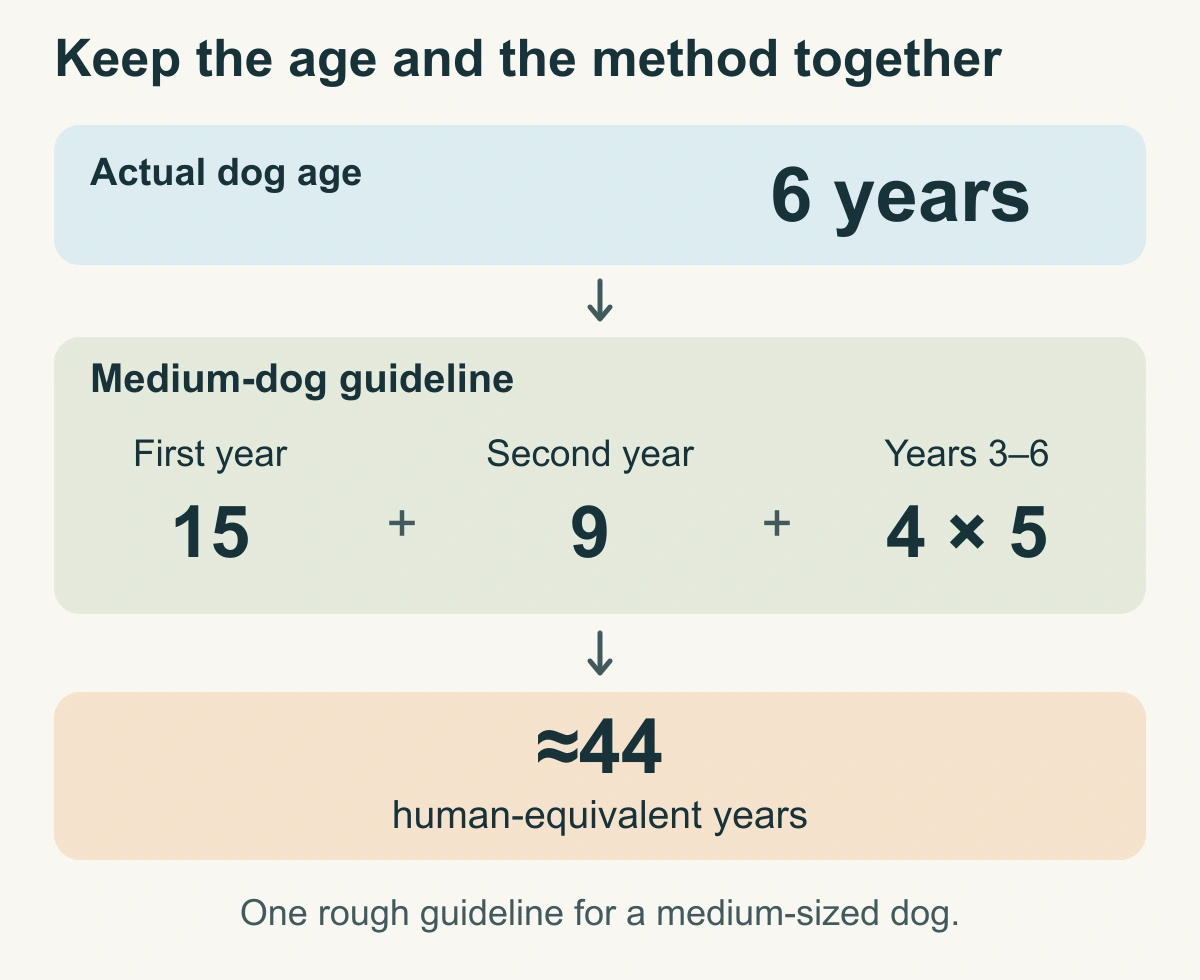
This method is useful for a quick conversation. A size-based chart may give another number because it uses different assumptions. Keep the source or method with the estimate if you plan to compare it again next year.
Label both sides Write “6 actual dog years → about 44 human-equivalent years using the medium-dog guideline.” Clear labels prevent someone from treating 44 as the dog's age when entering another calculator.
Check What a Size-Based Chart Is Comparing
Many charts give separate columns for small, medium, large, or giant dogs. Look for the chart's weight ranges and whether they refer to adult size. Two charts may draw those categories differently. A mixed-breed dog near a boundary can reasonably receive slightly different estimates.
A compact adult and a very large adult can share the same birthday and occupy different positions on a size-based aging chart. Their calendar ages remain the same. The difference reflects a population-level comparison of development and lifespan. An equivalent number does not tell you whether either individual is fit, uncomfortable, or ready for a longer walk today.
The guide to dog breed differences explains why body dimensions and individual observations matter when making practical choices. If your dog is still growing, an adult-size estimate may also be uncertain. Ask how the chart handles puppies before selecting a column based only on today's weight.
If two sources disagree, compare the input, weight category, and rule first. One may use five human-equivalent years for each later calendar year, while another varies the later increment by size. Use a single source consistently for a casual annual comparison. For healthcare, bring the actual age and specific observations to the clinic.
Why the Logarithmic Formula Gives Another Answer
You may see the formula “human age = 16 × ln(dog age) + 31.” The abbreviation ln means natural logarithm. The original DNA-methylation study compared age-related molecular patterns in 104 Labrador Retrievers with human data. That is a particular research model with a defined study population.
For a six-year-old dog, the natural logarithm of six is approximately 1.79. Multiplying by 16 and adding 31 gives approximately 60. The quick medium-dog rule above gives 44. The calculations answer the question under different models. The difference is a reason to identify the model before presenting a number as meaningful.
The Labrador study does not supply a universal calculator for every breed, size, or health condition. It also studied dogs up to 16 years old. Putting a 19-year-old dog's actual age into the equation extends it beyond that study's oldest participants. That result would need the extrapolation stated plainly.
More decimal places cannot resolve those limitations. You can round an estimate to a whole year for discussion and still keep the model's boundaries visible. If a website offers only a result and no method, look for its explanation before relying on a precise-looking age.
Reverse the Calculation Carefully
“Human years to dog years” can mean reversing an equivalent age, or asking which dog age resembles a person's stage of life. In either case, choose the rule first. The same number can land at different actual ages under different rules.
For the medium-dog guideline after age two, subtract 24 from the human-equivalent age, divide by five, and add two. A displayed equivalent of 44 gives four additional years, then two starting years, for six actual years. This reverse shortcut applies only to the part of the model after the second year.
If someone brings you “62 dog years,” clarify which value they mean. A human-equivalent value of 62 can be reversed under a named rule. An animal described as 62 calendar years old would require checking the underlying record. Applying a formula before resolving that label would produce a confident answer to the wrong input.
For example, a human-equivalent value of 62 gives (62 minus 24) divided by five, plus two, or 9.6 actual years under this shortcut. That fractional value follows the arithmetic of the selected rule. It does not recover a missing birth record. If the starting value was rounded or came from another model, the reverse estimate inherits that uncertainty.
Turn an Age Estimate Into a Useful Care Question
An age comparison can prompt a conversation about your dog's current stage of life. Give your vet the actual or estimated age, size, and changes you have noticed. “He pauses before climbing the stairs now” is a more actionable detail than an equivalent age alone. The dog health monitoring guide gives examples of observations you can compare during ordinary routines.
For visible changes, PetMira's photo-based care log can help keep images of the coat, skin, or other supported care areas in order. Keep the date and relevant context with your own observations. A photo log supplies information about what you saw. It cannot calculate a dog's biological age.
Takeaway
Start with the actual age, then use a clearly described rule with its size and research limits. Keep the approximate equivalent beside the dog's real age so you can explain where it came from. For care decisions, bring that age and the changes you have observed to your veterinarian. A dated photo record in PetMira can supply visible context alongside your notes.
PetMira for iPhone
Keep visible changes with your dog’s care record
Use PetMira’s photo-based care log for supported visible observations, and keep the actual or estimated age with your own notes.
 Organize photos of visible care changes
- Compare images over time
Available on the App Store
Download iOS App