

Pet dogs are the same kind of domesticated animal, whether they are Chihuahuas, Great Danes, or dogs with no known breed background. The American Society of Mammalogists’ Mammal Diversity Database lists the domestic dog as Canis familiaris. You will also see Canis lupus familiaris in sources that rank the dog as a subspecies of the gray wolf. Both names point to domestic dogs. Breed differences such as coat, height, and head shape do not make those dogs separate species.
The word dog can also refer to relatives with dog in their common names. The African wild dog, for example, is Lycaon pictus, a distinct wild member of the dog family. To navigate the language, look at the scientific name and where the source places it. If the question is about a pet, look for the domestic dog entry before choosing a more specific breed profile.
What family, genus, and species mean on a dog list
A family is a group of related animals. Canidae is the family that includes dogs, wolves, coyotes, foxes, jackals, and several other branches. Canis is a genus inside it. Mammal Diversity Database entries for the domestic dog, gray wolf, and coyote all use Canis at the beginning of their names. A fox in the genus Vulpes shares the larger family without being in that genus.
Common name | Scientific name | What to look for |
|---|---|---|
Domestic dog | Canis familiaris | The domestic animal across breeds |
Gray wolf | Canis lupus | The wild wolf entry |
Coyote | Canis latrans | A separate member of Canis |
Red fox | Vulpes vulpes | A different genus within Canidae |
African wild dog | Lycaon pictus | A separate wild canid |
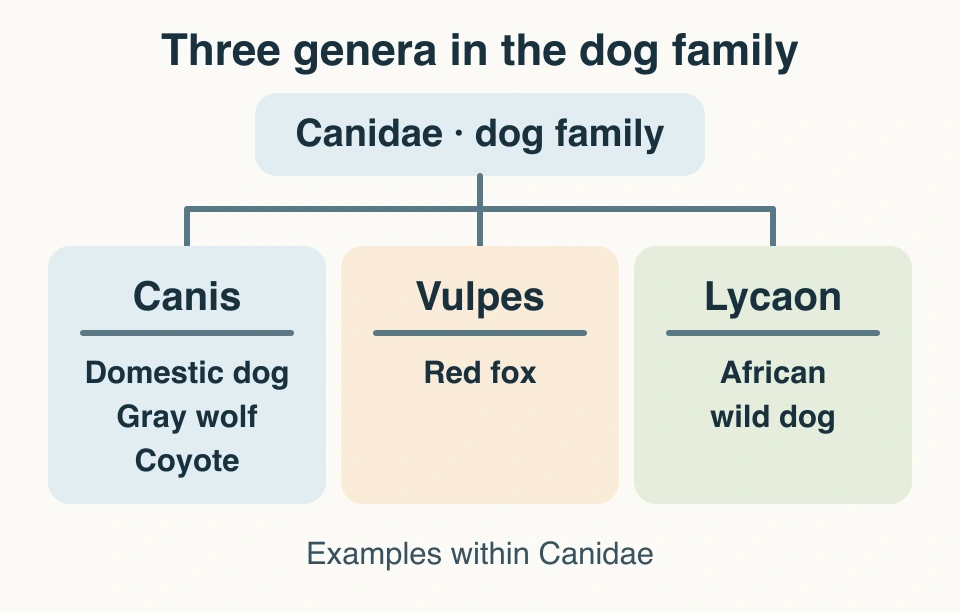
A species name gives you a more precise label than the family name. Both words are useful. Canis alone could refer to several animals, and writing just the second word loses the information about the genus. In a field note or school report, record the full name and the reference that uses it. If one source uses a three-word dog name, preserve that original wording before comparing it with a two-word entry elsewhere.
Why two scientific names can describe the same pet dog
The two-word name Canis familiaris treats the domestic dog as a species label. The three-word name Canis lupus familiaris places it under Canis lupus and marks it as a subspecies. If a zoo glossary and a paper use different names, ask what classification each follows. Seeing both names is an ordinary feature of reading across sources, so you can explain your choice of wording without assuming the text is describing two kinds of domestic dog.
The domestic dog’s relationship with wolves is supported by genetics. Ancient genome research published in Nature in 2022 traced dogs’ ancestry to ancient gray wolf populations while leaving open questions about which populations contributed and how that ancestry came together. A modern wolf seen in a nature documentary is a living relative. There is no basis for naming that individual wolf or its local population as the direct ancestor of your pet. That distinction matters when someone uses a picture of a wolf as proof of a particular origin story.
A husky-like coat or upright ears also tells you less about recent ancestry than you might expect. Domestic breeding and normal variation can produce visual similarities to wild relatives. A photo can document those features, but if you mean to verify a claim of recent wolf ancestry, you need reliable records or appropriate testing interpreted by qualified specialists. This is a different question from what scientific name to put beside an ordinary breed.
Look up the scientific name on a wildlife label If a sign or caption says “wild dog,” copy the scientific name before comparing it to a pet breed. The common name alone may refer to more than one animal.
Wolves, foxes, and animals called wild dogs
Gray wolves and coyotes are familiar examples of wild species in the genus Canis. Jackal is an example of a shared ordinary name used for more than one animal. The golden jackal is listed as Canis aureus, while some other jackals are classified in a different genus. The ordinary word is still useful in conversation, and the scientific name tells you which entry a species list is discussing.
Foxes in Vulpes demonstrate a more distant branch of the same family. A red fox’s long muzzle, pointed ears, and tail may remind you of a particular pet. Those features describe a resemblance. The family tree identifies the animal as a separate species, and a wildlife guide provides the details you need for identification. Give animals you suspect may be wild space and use local wildlife guidance rather than approaching them for a closer look.
The African wild dog gives you another reason to read beyond the English name. It is also called the painted dog, and the name Lycaon pictus identifies the same wild species. A stray pet dog living outside retains the domestic dog classification. The phrase free-roaming dog describes where or how it lives. Looking for the full name keeps a domestic animal’s living situation from getting mixed up with another animal’s biological identity.
Where dog breeds fit into the picture
A breed designation describes a group within the domesticated population. Modern breeds can differ substantially in size, outline, and coat. They can also share those characteristics with dogs whose ancestry is mixed or unknown. Breed standards and registration documents address membership in a named domestic group, while taxonomic lists address how the domestic population relates to other animals. For examples from the domestic population, compare the major dog breed groups.
If you are filing a school report, put the scientific dog name in the species field and identify your reference. If you are completing a shelter or veterinary form, use the breed description supplied by the relevant records. A plain description such as “medium mixed-breed dog with short brown hair” can be useful when something more specific has not been verified. For help sorting photos and records, read how to identify a dog breed from the available clues. PetMira’s iPhone photo suggestions can help you find domestic breed candidates to compare, while species classification belongs with zoological references.
When two sources disagree, first check that both entries describe the living animal you meant to look up. A dog history article might discuss ancient specimens, a wildlife database might list a local population, and a shelter form might use a convenient everyday category. The terminology can vary because the documents have distinct purposes. Copy the scientific name and the rank from the taxonomy reference, then use the other documents for the questions they are designed to answer.
What to write when the name matters
Use Canis familiaris when following a source that lists domestic dogs at species rank, and explain Canis lupus familiaris if your reference uses the subspecies name. Keep breed names underneath the domestic label and give a wild relative its own scientific name. Cite the authority you followed whenever the classification is part of an assignment or record.
Explore domestic dog breeds
Compare a pet dog photo with PetMira
Use the iPhone app to explore possible domestic dog breed matches from a clear photo. Check the suggestions against visible features and the dog’s individual records.
 Compare a domestic dog photo
- Explore possible breed matches
Use zoological references for wildlife species questions.
Download iOS App