Puppy recall training teaches your puppy to leave what they are doing and come close enough for you to reward and, when necessary, secure them safely. Begin a short distance apart in a quiet, enclosed space, reward the return generously and add difficulty gradually. A head turn at their name is useful attention, but it is not yet the full journey back to you.
Keep physical safety in place while the skill develops. Use secure boundaries and appropriate leash management, and never test a puppy’s recall near traffic, livestock or another hazard. Even well-trained dogs can miss a cue. A puppy who suddenly cannot hear, move normally or engage as usual needs veterinary advice, while a puppy who repeatedly flees or is frightened needs an individual training plan.
Define a return you can finish safely
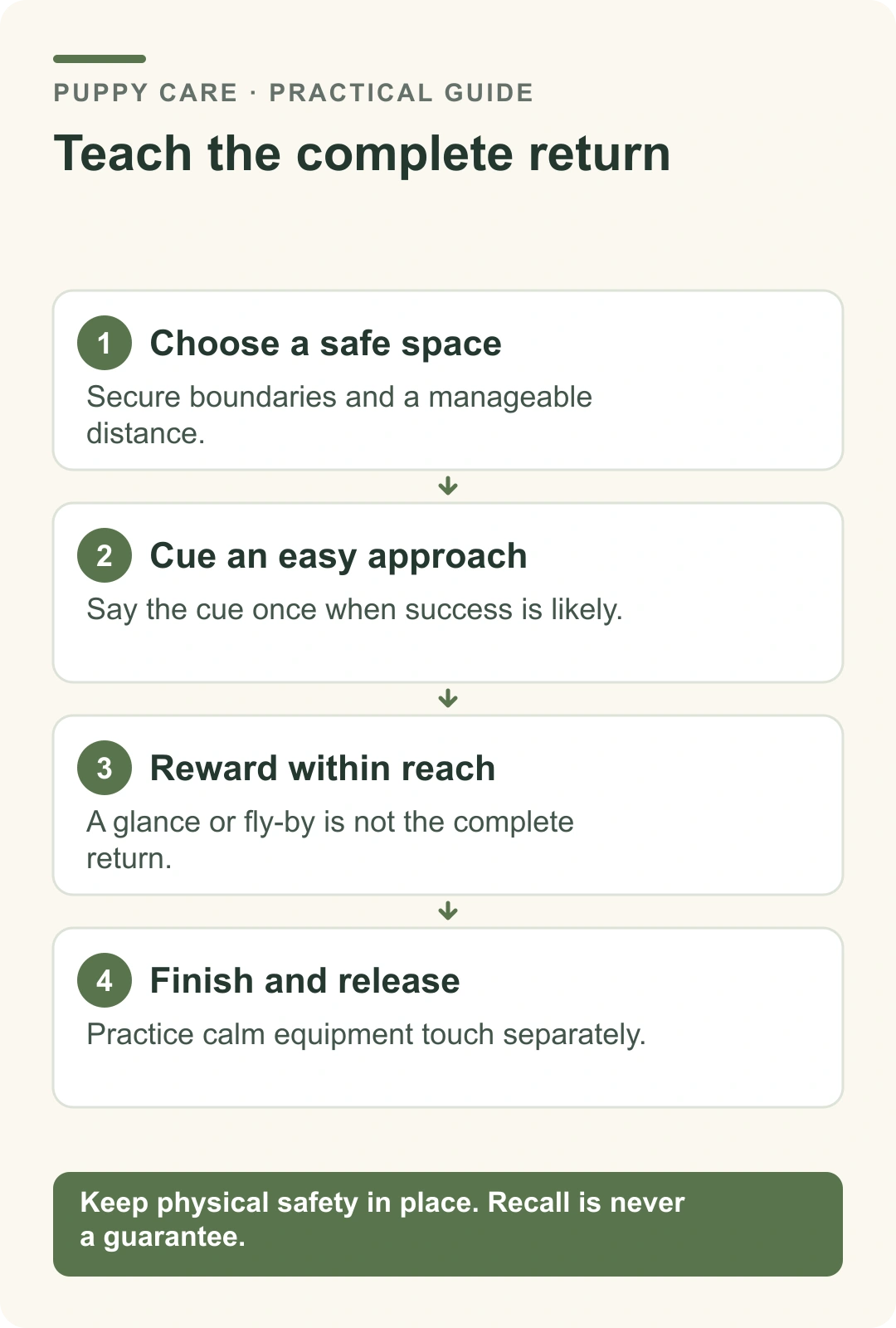
Decide what completion looks like: the puppy approaches within reach, stays long enough to receive the reward and permits the next appropriate action. That might be a gentle touch of the harness followed by a release back to sniffing, or calm attachment of a leash. You are not aiming for a brief fly-by that ends with the puppy several steps away again.
Choose one recall word, such as “come” or “here,” and agree on it with the household. Keep name response as a separate attention skill. Our guide to talking to dogs covers that foundation, so you can use this lesson to teach the movement and arrival rather than repeatedly rehearse the puppy’s name.
Prepare rewards that suit the puppy and the task. Small food rewards are easy to deliver at arrival; a manageable toy game may also work for an individual puppy. Do not choose a reward that starts a frantic chase when your current goal is calmly reaching the handler. Keep the reward ready without holding it so far forward that the puppy only follows a visible snack.
Teach the movement before testing the word
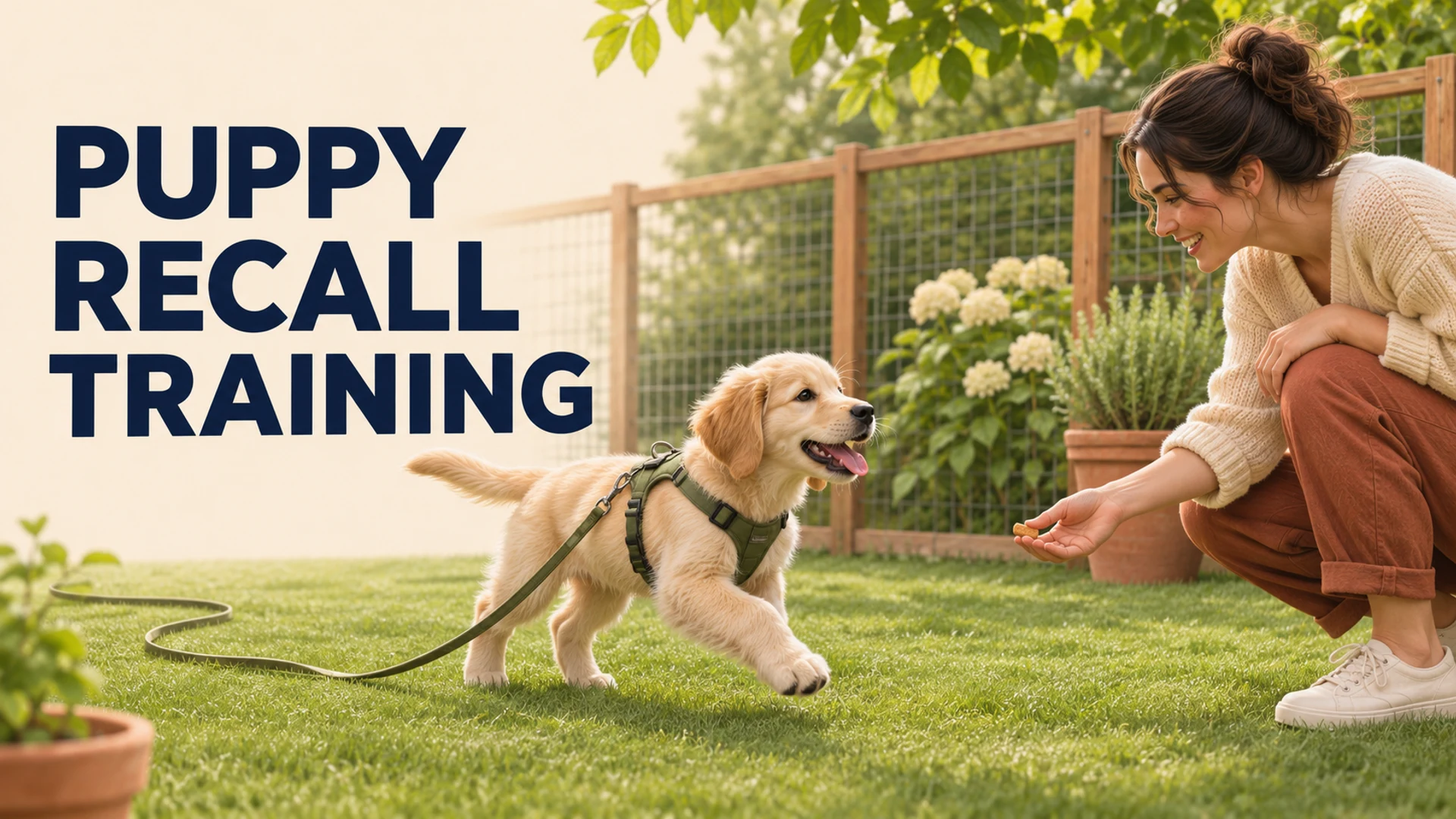
Start in a quiet room or secure, appropriate garden with the puppy only a few steps away. Invite them to move toward you with welcoming body language and a small step backward if you can do that safely. As they approach, mark the useful movement and reward close to your body. You are building a pattern in which traveling to you leads to something worthwhile.
Do not begin by calling a puppy who is absorbed in another animal, a dropped meal or a loud event. Set up an easier moment where they are already likely to approach. If the puppy does not move, reduce the distance and surrounding distraction. A training session can consist of several easy invitations, followed by an ordinary break rather than a harder final test.
A second adult can help create a gentle back-and-forth game in a clear space. Each person invites the puppy only when the other has finished rewarding and released them. Do not hold the puppy back while they struggle to chase the other person. Keep turns predictable, avoid calling over one another and finish before speed makes the game difficult to control.
Add a cue and reward the arrival
When the puppy is readily making the short journey, say your recall word once just before the movement you expect. Mark and reward when they reach you, delivering the reward low and close enough that they do not have to jump. Let them finish taking it before starting another repetition. The word should predict a clear action, not a long stream of increasingly urgent shouting.
Reward a completed return even if it was slower than you hoped. Do not scold the puppy when they arrive because they were previously digging or did not come immediately. You can prevent access to the earlier problem and make the next practice easier, while keeping coming to you a safe choice. Anger at arrival can undermine the very behavior you want to preserve.
Vary what happens after an easy arrival. Sometimes reward and release the puppy to an allowed activity; at other times calmly continue with the next part of your routine. If every call ends play or predicts an uncomfortable procedure, the cue may become less appealing. You can prepare for necessary handling separately instead of hiding it behind repeated surprise recalls.
Make being reached and released comfortable
Practice a brief, gentle touch near the puppy’s harness during an easy moment, reward and release. Build that handling independently before combining it with a return. The puppy should not discover only during an urgent situation that a hand reaching toward their equipment feels frightening. Do not lunge over the head or grab a puppy who is trying to move away.
Once both pieces are comfortable, combine an easy return, reward, a brief permitted equipment touch and another reward or release. You do not need to demand a perfect sit before acknowledging that the puppy came back. A stationary finish can be taught separately, but it should not become a new obstacle that makes every successful return feel unsuccessful.
The Dogs Trust recall guide also emphasizes rewarding returns and building difficulty gradually. Treat the finish as part of your actual household needs: a puppy returning from a safe sniffing break needs an easy transition, not a competition-style performance before they receive anything valuable.
Increase distance or distraction one at a time
After several comfortable close returns, add a little distance in the same place. When that is manageable, change the location but shorten the distance again. Introduce a modest distraction only when the simpler version is easy, and reduce another difficulty while you add it. A familiar room with a quiet person seated nearby is different from a park where dogs are running.
Watch whether the puppy can notice the cue and disengage from the situation. If they remain fixed on the distraction or move farther away, you have useful information about the setup. Move to a calmer starting point rather than repeating the same demand beside the same event. Our puppy socialization guide covers how to introduce the surrounding world without forcing contact.
Allow sessions to end at an easy success instead of increasing the challenge every time. A useful comparison is whether the same ordinary setup produces a more prompt, comfortable return, not whether the puppy can now defeat the biggest distraction available. Progress may look uneven as locations and developmental stages change. Keep safety management consistent while you adjust the lesson.
Use a long line as a backup, not a towing rope
A long line attached to a suitable, well-fitted harness can help manage practice in an appropriate open area. Get instruction in handling it before adding distance. Choose clear ground with room to notice other people and dogs, and keep the line from wrapping around bodies, furniture or obstacles. Do not let the puppy build speed into the end of a tight line.
Keep your hands and the line arranged safely without winding it around fingers or your body. The line is a backup for access and distance, not a way to pull the puppy through a recall they have not learned. Walk closer while gathering slack when you need to simplify the situation. If you cannot manage both the puppy and the line safely, return to a smaller secure space with qualified help.
Do not tether the puppy to a fixed object to simulate off-leash freedom or leave them unsupervised in training equipment. A line caught around a leg can create a problem quickly. Local leash rules and the safety of the setting still apply when a recall looks good, and a successful garden session does not establish that an unfenced area is appropriate.
Protect the cue after a missed return Avoid repeating the recall word while the puppy continues a different activity. Calmly make the situation safe, shorten the distance or remove the distraction, then practice a version they can actually complete.
Keep the next practice specific
PetMira’s care encyclopedia can help you prepare an everyday training question before practice, such as how to simplify an early recall game. Choose one change from that preparation and compare it with what the puppy does. It does not observe the live return or certify off-leash reliability, so seek a qualified reward-based trainer for repeated difficulty, fear or unsafe handling.
Keep a return worth repeating
Teach the whole journey, reward the arrival and practice a calm finish before changing distance or distraction. Use PetMira’s everyday care guidance for preparation when useful, and keep secure boundaries or safe leash management in place. Coming back should remain worthwhile even when the next session needs to be easier.
Everyday care with PetMira
Plan a return your puppy can repeat
Explore everyday behavior guidance in PetMira, then choose an easier distance, distraction or reward question for your next safe practice session.
 Explore the care encyclopedia
- Ask a focused everyday care question
- Use guidance alongside real-world observation
Available on iPhone. AI-generated information is for educational reference.
Download iOS App