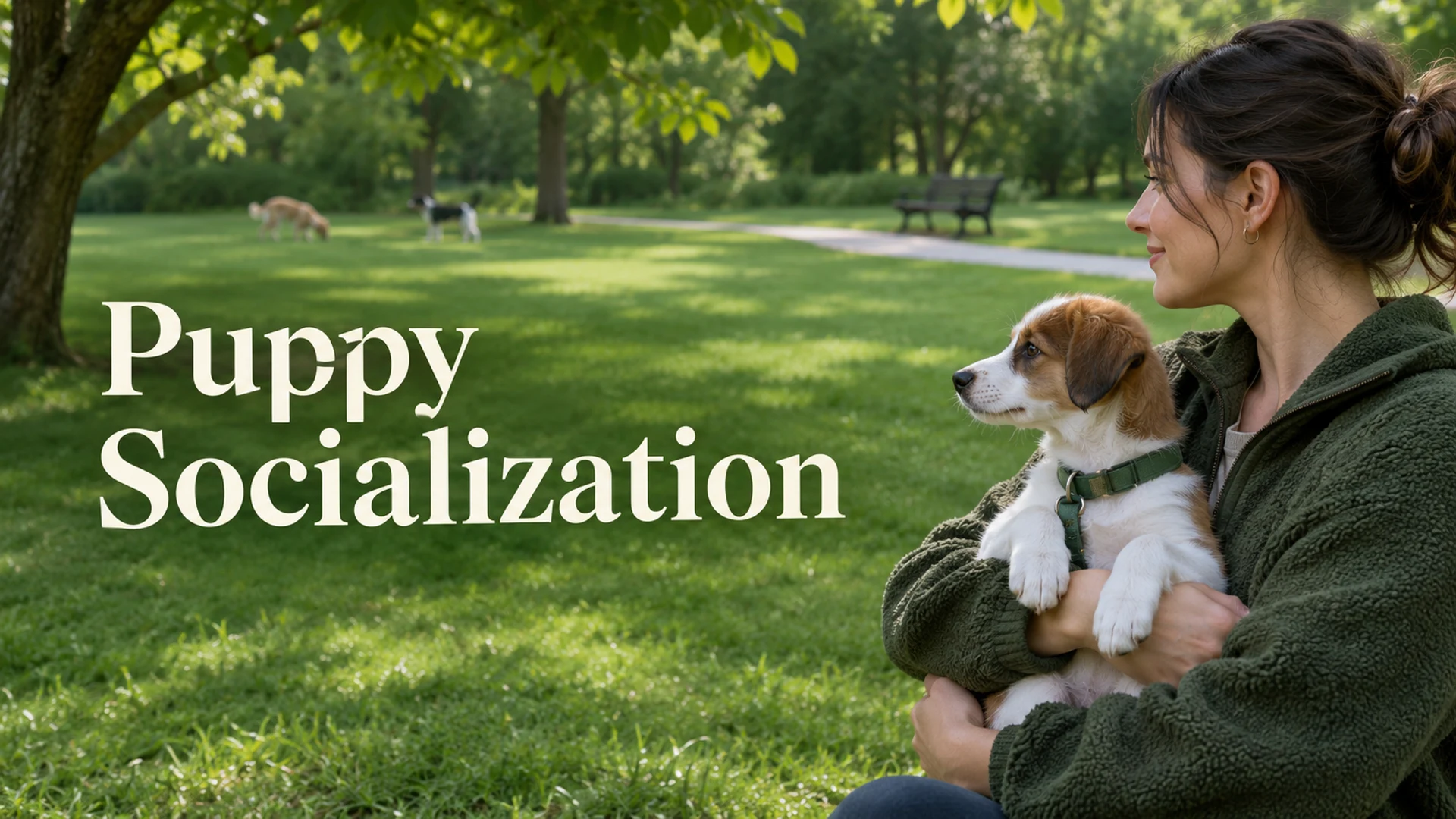
Puppy socialization means helping a young dog feel comfortable around the people, animals, sounds, surfaces and situations they will encounter in everyday life. Start with gentle experiences at a distance the puppy can manage, make them positive and let the puppy move away. Watching a bicycle calmly can be a successful session without approaching the rider or greeting anyone.
The American Veterinary Society of Animal Behavior identifies the first three months as an especially important socialization period. Learning should continue afterward, and early practice still has to account for infectious-disease risk as well as behavior. Ask your veterinarian which locations, contacts and puppy classes are appropriate for your puppy's health and vaccination history. Neither visiting every busy dog area nor avoiding all experience until a fixed birthday is a suitable universal plan.
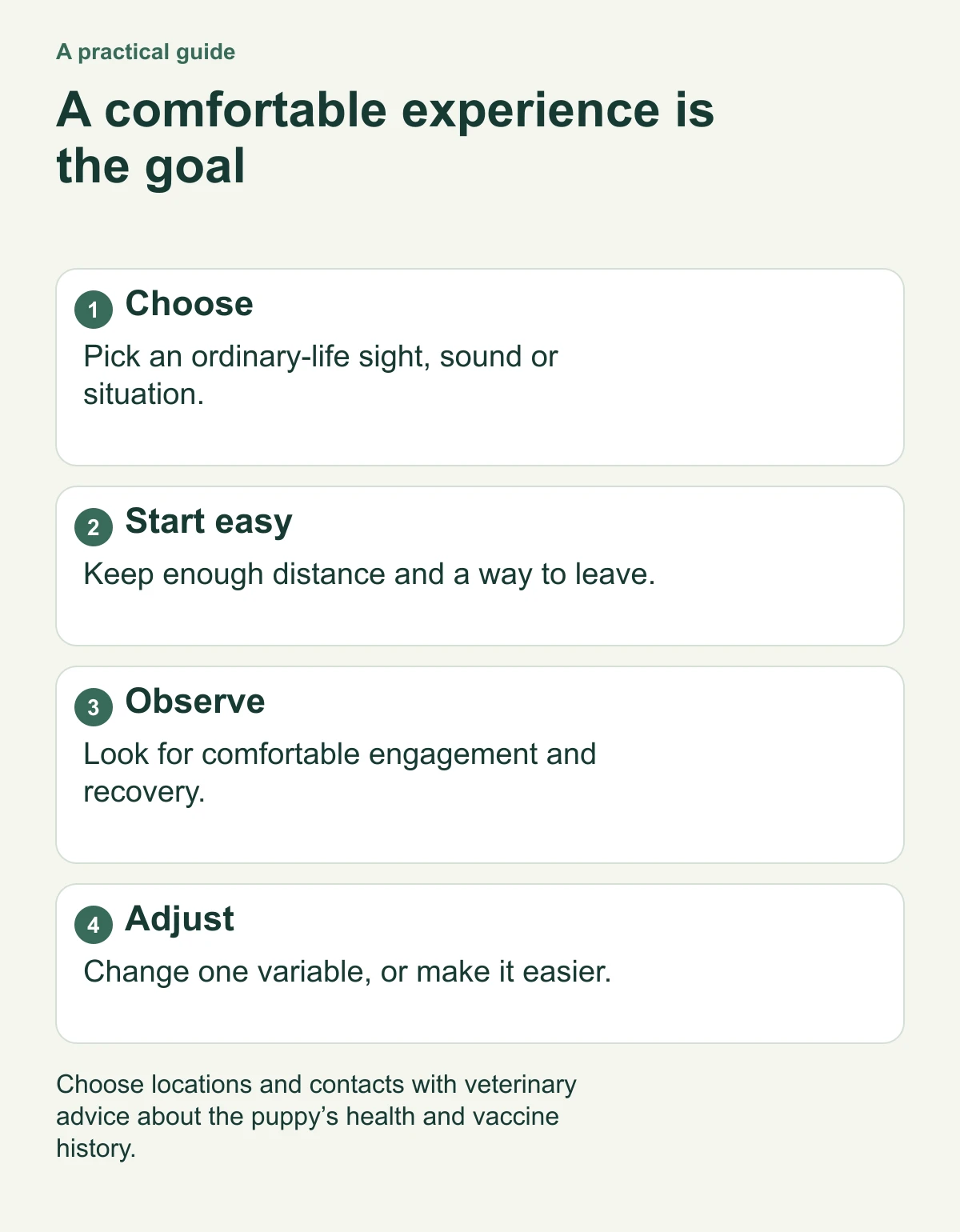
Choose experiences that belong to your real life
Think about an ordinary week in the home your puppy will grow into. A puppy in an apartment may encounter elevators, wheeled bags and people in narrow entrances. A puppy in a quiet house may need gradual experience of traffic, visitors or grooming sounds. Start with the situations they are likely to meet rather than collecting the largest possible number of unfamiliar encounters.
Include quiet household skills: walking on a different safe surface, seeing an umbrella open at a distance, resting while somebody wears a hat, or hearing a low-level everyday sound. Present one manageable change at a time. A vacuum cleaner moving, making noise and approaching the bed combines several challenges, even if you think of it as one item on a checklist.
Build rest into the plan. A busy afternoon does not become better socialization because the puppy stayed awake for all of it. Use the puppy sleep routine guide to protect ordinary opportunities to nap. You want experiences the puppy can process and recover from, not a schedule that measures success by exhaustion.
Find a starting distance before asking for contact
Let the puppy notice the new thing while keeping enough space to move and watch. Look for a loose body, willingness to explore and the ability to turn back toward you or disengage. Food can help create a pleasant association, but it should not be used to lure a worried puppy close enough that they feel trapped once it is gone.
A useful adjustment Food is not permission to move a worried puppy closer. Increase distance or reduce intensity when the body remains tense, even if one treat is accepted.
If the puppy freezes, repeatedly tries to leave, tucks away, startles without recovering or stops engaging, make the experience easier. Increase distance, reduce movement or sound, or finish and try a smaller version another time. A puppy who takes one treat while rigid is not automatically comfortable. Use the whole response and what happens afterward.
For example, watch a quiet street from a sheltered spot before walking beside heavy traffic. If one car passes and the puppy looks, returns to sniffing and moves normally, that is a useful observation. If every passing vehicle produces a growing reaction, move farther away instead of waiting for the puppy to get used to the busiest location.
Let people be present without making greetings compulsory
Ask a calm visitor to sit sideways and allow the puppy to choose whether to approach. The visitor can avoid leaning over, staring or reaching for the head. If the puppy stays near you, they can still learn that a new person is part of a safe scene. An interaction is not a failure because the person leaves without touching the dog.
Introduce differences gradually: a familiar person wearing a hat, somebody carrying an object, or a visitor moving across the room. Keep a clear route away and supervise children closely. A child who runs toward or hugs a puppy can create a difficult encounter, even when the intention is friendly. Adults should manage the setting rather than asking the puppy to tolerate it.
Reward comfortable voluntary engagement and also allow disengagement. If the puppy approaches, sniffs and walks back to their bed, let that be enough. Repeatedly calling them back for another greeting can remove the choice that made the first attempt manageable. Continue ordinary, easy interactions as the puppy grows instead of treating socialization as a task completed once.
Choose dog contact for quality, not quantity
Discuss suitable contacts with your veterinarian. A known, healthy, appropriately vaccinated and socially suitable dog in an appropriate setting may offer a different risk profile from an uncontrolled gathering. Health screening alone is not a guarantee that an individual adult dog will enjoy interacting with a puppy, so watch behavior and have a way to separate them.
Good contact allows pauses and movement away. If one animal repeatedly pursues, pins, corners or overwhelms the other, interrupt calmly and create space. Do not let an unfamiliar dog correct your puppy on the assumption that any frightening experience teaches manners. When you are unsure how to judge the interaction, seek a qualified reward-based professional rather than experimenting in a crowded dog park.
A puppy class should explain its health requirements, cleaning arrangements, group management and training approach. Ask how worried puppies are supported, whether contact is optional, and how the instructor responds to rough play. A class can be useful for calm learning around other dogs; continuous off-lead play is not the only worthwhile activity.
Experience | Easier starting version | A sign to reduce difficulty |
|---|---|---|
A new person | Quiet person seated at a distance | Puppy cannot leave or repeatedly retreats |
Street movement | Observe from a calm, suitable location | Reactions grow with each passing event |
A household sound | Low intensity with an escape route | Freezing, hiding or failure to recover |
Another dog | Suitable, managed contact with pauses | Pursuit, cornering or persistent avoidance |
Adjust one part of the experience at a time
Distance, duration, intensity and the number of things happening can all change difficulty. After an easy experience, repeat it before adding a small challenge. If the puppy was comfortable seeing a visitor sit, try the same visitor standing briefly. Do not simultaneously add loud conversation, a second visitor and handling.
Write a short note that names the conditions: “watched a bicycle across the open space, ate normally, then sniffed,” for example. Next time, start there or slightly easier rather than assuming every bicycle is now familiar. A confident response in one location does not establish comfort with the same object moving quickly beside the puppy's face.
PetMira's care encyclopedia can support everyday questions about behavior and training as you plan these experiences. Keep your own observations somewhere easy to revisit, and check recommendations against the puppy in front of you. An AI explanation cannot clear a public location for disease risk or assess a fearful dog through a generic description.
Take fear seriously without declaring the chance lost
If your puppy has a frightening experience, leave the difficult setting and give them a chance to settle somewhere familiar. Do not immediately repeat the same event at full intensity to finish on a better note. Discuss persistent avoidance, escalating reactions or a change in normal behavior with your veterinarian and an appropriately qualified behavior professional.
An older puppy still benefits from patient learning. Early development matters, but missing a perfect checklist does not mean training is pointless. Start from current comfort and build an individual plan. Our dog language guide supports observation, while AI dog training guidance explains evaluating a plan without confusing a confident app answer with professional assessment.
Build familiarity the puppy can use
Choose ordinary-life experiences, keep them manageable and judge progress by comfortable behavior and recovery. Veterinary advice helps you select appropriate settings, while the puppy's response tells you when to repeat, simplify or move forward.
Everyday care with PetMira
Explore everyday puppy behavior questions
PetMira’s care encyclopedia supports everyday behavior and training topics, helping you organize questions before a manageable new experience.
 Explore care and behavior guidance
- Keep a digital profile as your puppy grows
Ask your veterinarian which contacts and places fit your puppy’s health and vaccine history.
Download iOS App