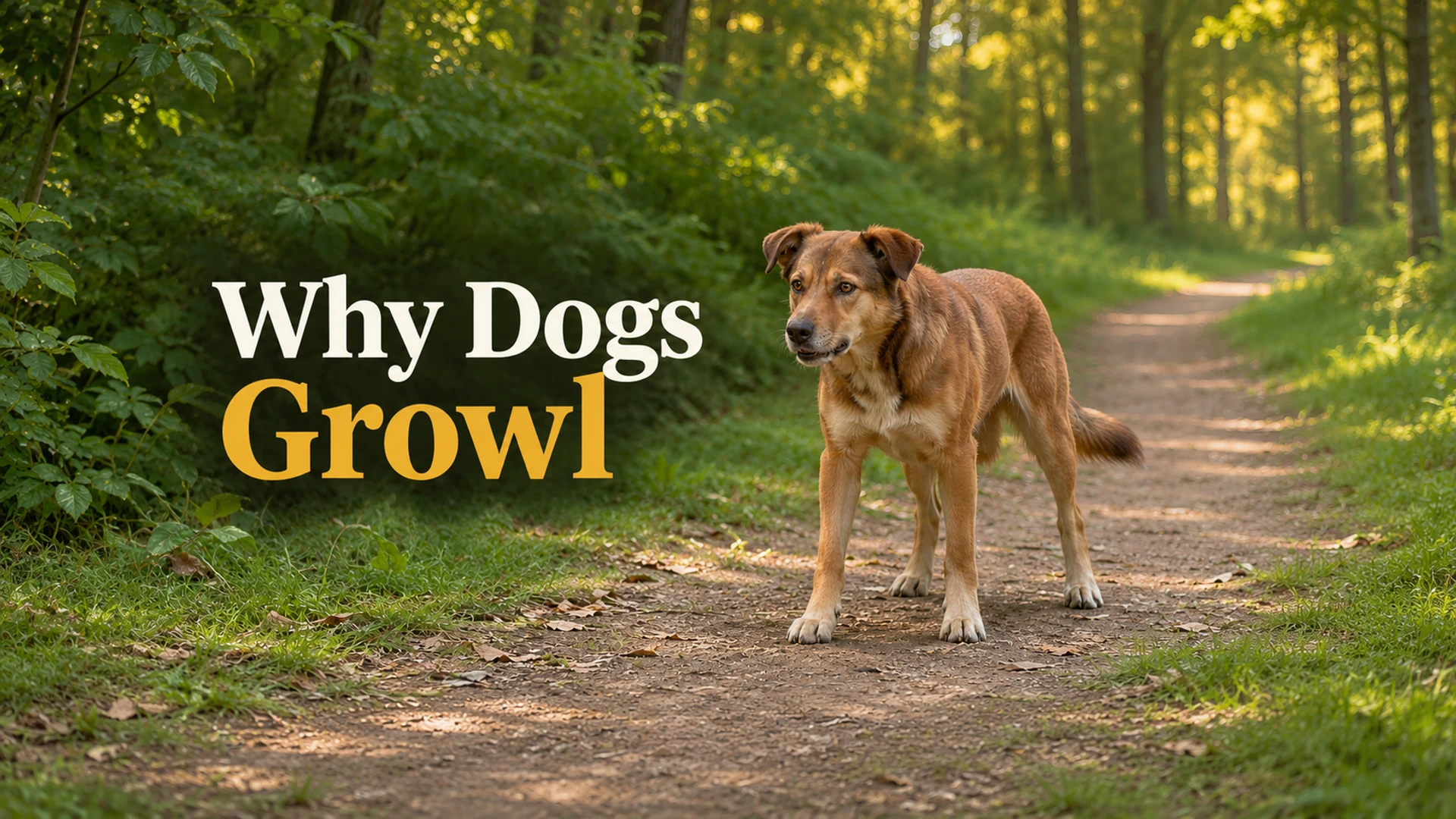
Dogs growl during play, around valued items, when they want more space, and sometimes when they are uncomfortable or in pain. The sound alone cannot tell you which situation applies. If you are unsure, stop approaching or touching the dog and give them room. A growl is information to act on, not something to punish out of the conversation.
When someone could be bitten, the first job is separation and space, not identifying the perfect label. Keep children and other pets away and avoid reaching for the dog's collar or the object beside them. If growling is new or occurs during ordinary movement or handling, contact your veterinarian before starting a behavior exercise.
Give a growling dog room before investigating
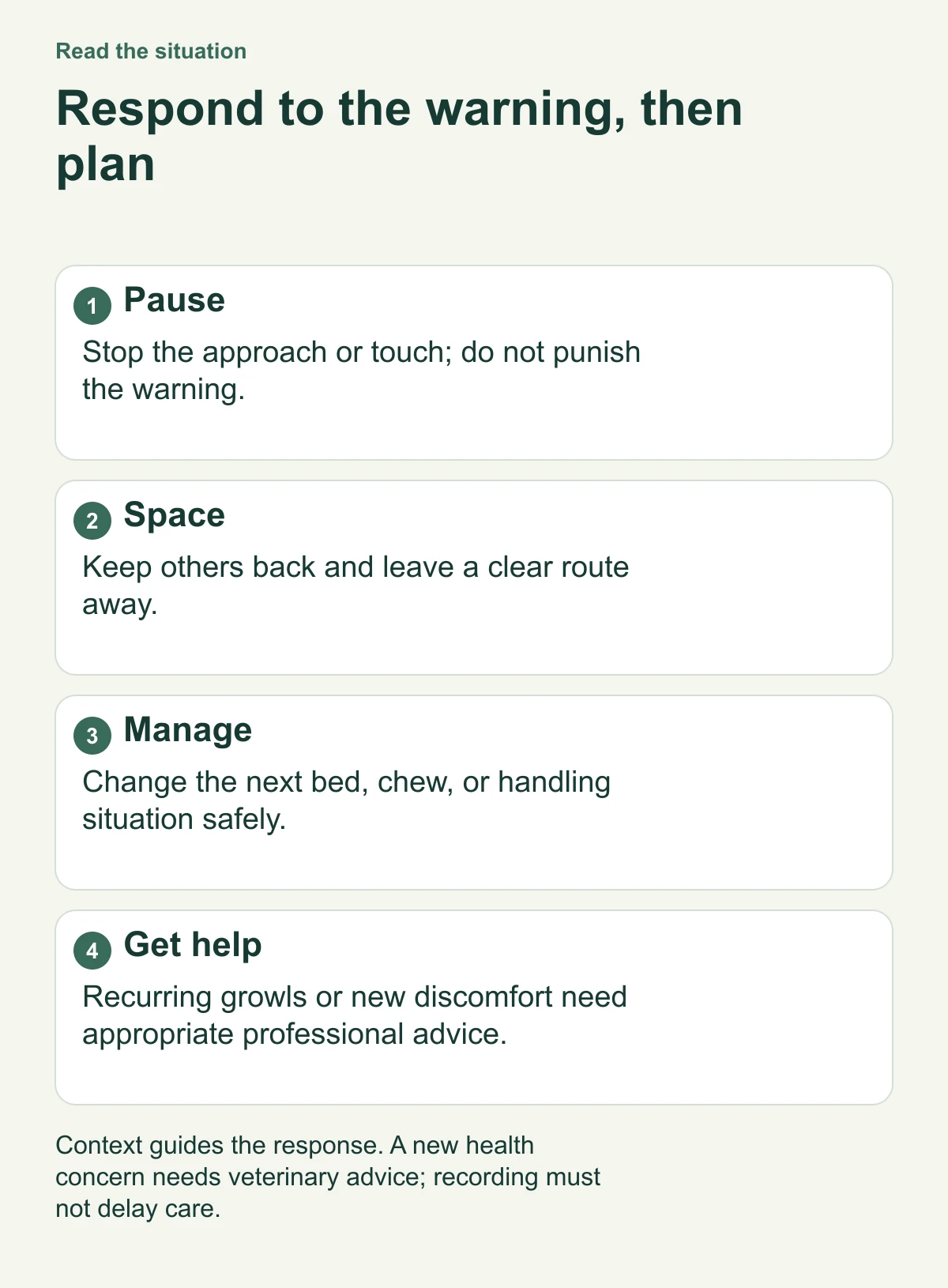
Pause what you were doing. If you were leaning over the dog, reaching toward a chew, or touching their coat, end that pressure without making another approach. Allow a clear route away and move people out of the immediate area calmly. Do not corner the dog while trying to demonstrate that you are in charge.
A dog who growls over an item does not need to surrender it for you to take the warning seriously. Leave the item where it is while you make space. If the item itself presents an immediate danger, call your veterinarian or an appropriate professional for advice rather than trying a risky hand-to-mouth retrieval. Safety for the people and dog comes before finishing a household task.
Once everyone is safe, think about what changed just before the growl. Record the action, distance, and object involved rather than testing whether the dog will do it again. “Growled when I reached across the bed for a blanket” is a useful account. “Doesn't respect me” adds an interpretation without describing the event.
Play growls and warning growls need context
Growling during a familiar game can accompany loose movement, pauses, and voluntary returns to play. A warning may occur with stiffness, a fixed gaze, retreat, or attempts to keep someone away. These combinations help you decide how cautious to be; they do not provide a guarantee that continued contact is safe.
During play, take an easy break and give the dog a choice. If they move away, let the game end. If they return, look at the whole interaction before restarting. With two dogs, watch whether both can leave and whether one keeps pursuing the other through every pause. A dog coming back under pressure is different from freely choosing to reengage.
The dog language guide covers posture and movement more broadly. Here, use those observations to decide whether to end pressure around a growl. Do not rely on pitch, loudness, a wagging tail, or your dog's usual friendliness to overrule a tense interaction.
Context | A detail worth noticing | Safer immediate response |
|---|---|---|
A familiar game | Loose movement and voluntary pauses | Pause and let the dog choose whether to return |
Food, a chew, or a toy | Stiffening as someone comes closer | Leave space and keep others away |
Resting on a bed | Growling when reached over or disturbed | Stop the approach and protect the rest area |
Grooming or handling | A new reaction to touch or movement | Stop handling and discuss the change with your vet |
Common situations that change your next step
For a dog resting in a busy walkway, change the household arrangement before the next rest period. Put a comfortable bed somewhere people do not need to step across, and ask family members to leave the dog alone there. This reduces one predictable conflict. It does not mean the underlying concern has been diagnosed or that the dog can safely be disturbed elsewhere.
Around food or chews, prevent casual approaches from children or other pets. Feed in an appropriate separate space and avoid taking items away to prove the dog will allow it. Repeated growling in these situations deserves a professionally designed plan. A generic suggestion to trade for a treat can be unsafe if it encourages an unprepared person to reach into a tense encounter.
If growling begins during brushing, lifting, putting on equipment, or other familiar handling, stop the procedure. Notice whether the reaction is new and whether movement or comfort has also changed. Arrange veterinary advice rather than assuming the dog has become difficult. Do not press the suspected area, restrain them more firmly, or repeat the handling for a video.
Why stopping the sound does not solve the problem
Scolding, startling, or physically correcting a growl may suppress the warning without changing the situation that produced it. The dog can become quiet while still uncomfortable. You then have less information available the next time someone reaches toward them. A quiet dog is not automatically a comfortable dog.
The American Veterinary Society of Animal Behavior recommends reward-based methods for training and behavior change. For growling, that begins with management and understanding the trigger, followed by an appropriate plan when the setting is safe. It does not mean feeding close to a tense dog until the growl disappears or demanding a sit while continuing the approach they wanted to avoid.
If you need to teach a separate skill, do so away from the conflict. The guide to communicating with clear cues explains simple, voluntary practice. A skill the dog performs in a quiet room does not make a later resource or handling problem safe without a specific plan.
Plan the next ordinary interaction more safely
Choose a concrete management change the household can maintain. That might be separating dogs for chews, moving a bed away from a doorway, or postponing nonessential grooming until you have veterinary guidance. Tell everyone what the change is and why. A note saying “do not reach toward him while he rests here” is more useful than asking people to be careful.
Progress can mean fewer situations in which the dog needs to warn, more comfortable movement, or easier voluntary disengagement. It should not mean demonstrating how close someone can get before the dog growls again. A qualified professional can help determine which exercises are suitable and which safety measures need to remain in place.
Keep the warning useful. End the pressure when a growl occurs. Practise separate skills in comfortable settings; do not use the original conflict as a test of obedience or your relationship.
Record what happened after everyone is safe
Write down who approached, what they were doing, and how the dog responded when the person stopped. Include whether the dog could move away and any changes in everyday comfort. If a safe recording already exists, it may help explain the event. You do not need to recreate it for a clearer angle.
PetMira can record ordinary pet sounds and provide an AI interpretation, but it cannot certify that a growl is playful or that approaching is safe. Use it only for an already comfortable, naturally occurring sound, and keep your own context note separately. It is not a reason to continue a tense game or postpone professional help.
For recurring difficulties, choose a qualified, reward-based professional rather than a generic app instruction. Our AI dog training guide explains why an automated plan needs limits and human judgment. Any sudden behavior change or possible pain should also be discussed with your veterinarian.
Keep the information and reduce the pressure
A safer response to growling begins with space and ends with a plan that changes the difficult situation. Preserve the warning, avoid punishment, and use observations to get appropriate help. The goal is a more comfortable interaction, not a dog who has learned to remain silent while uncomfortable.
PetMira for everyday care
Keep safety ahead of an interpretation
For comfortable ordinary moments only, PetMira can record a pet sound and suggest an interpretation. A phone label cannot establish that a growl is safe to approach.
 Record naturally occurring pet vocalizations
- Keep context separate from interpretation
- Read general care guidance
Do not recreate growling, reach toward a tense dog, or delay qualified help for a clip.
Download iOS App