
Dogs howl to make contact, respond to sounds, attract attention, or communicate in other situations. Howling can also occur when a dog is distressed or unwell. Start with the timing: did it follow a passing siren, happen during a familiar greeting, or begin after someone left? The same long sound can occur for different reasons, so it does not translate into one fixed message.
A new or increasing howling pattern deserves a veterinary check, particularly with changes in comfort, movement, appetite, or rest. If your dog is struggling to breathe, weak, or collapsing, seek emergency care instead of investigating the sound. For an otherwise comfortable dog, the observations below can help you choose a sensible next step.
What the timing of a howl can tell you
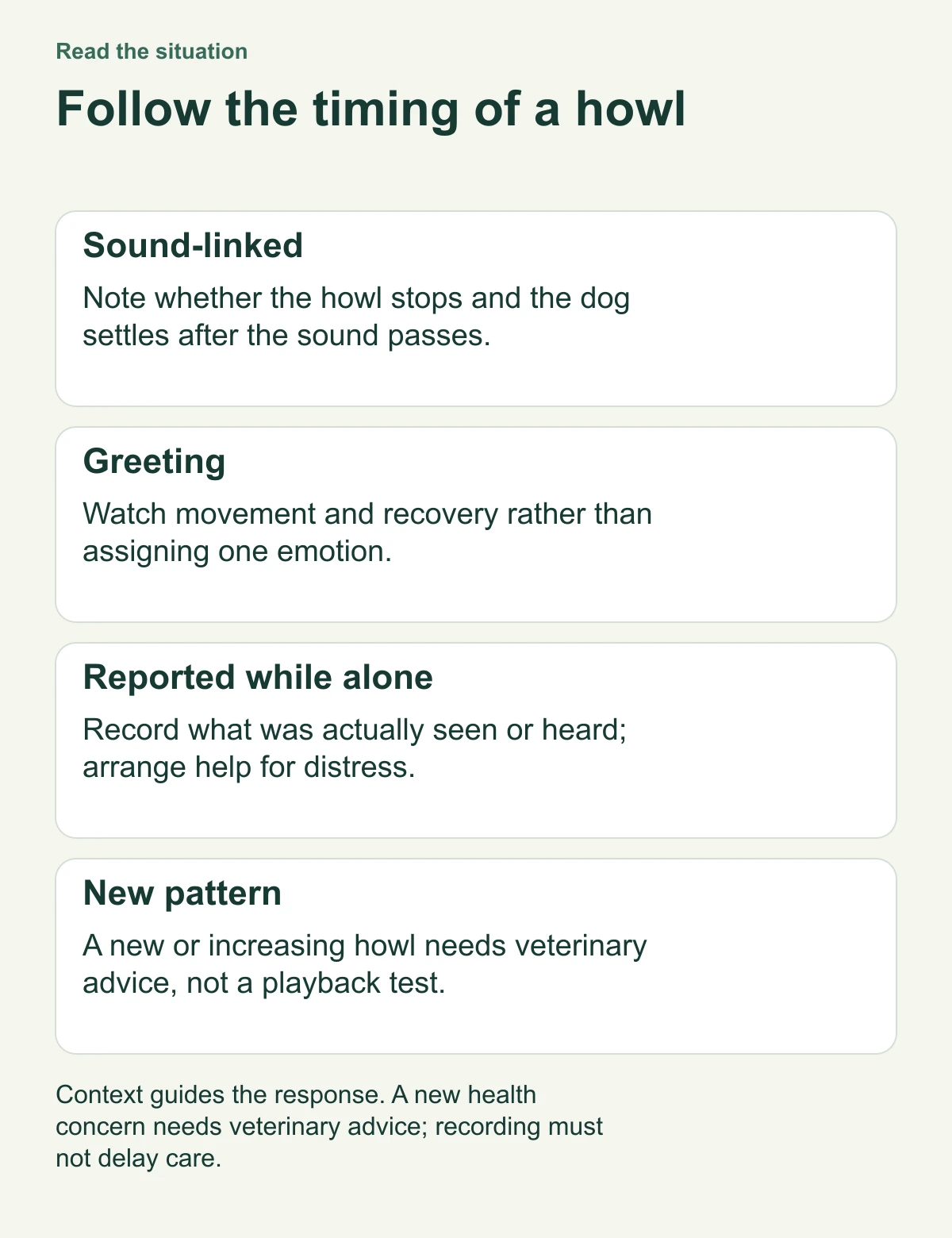
Listen for what happened before the first howl and what happened when it ended. A dog who joins a distant siren briefly, then resumes sniffing, presents a different situation from one who keeps pacing and vocalizing after the street is quiet. Write down the event and the recovery separately. The end of the sound does not necessarily mean the dog has settled.
An ordinary greeting can also include howling. Suppose your dog raises their head and vocalizes when a familiar person returns, then moves loosely around the room and rests. You have a repeatable sequence to recognize. If the same arrival leaves the dog racing between doors and unable to disengage, reduce the intensity of the greeting and consider whether you need help with the pattern.
Our guide to dog language explains the broader combinations of posture, movement, and sound. Here, focus on when a sustained howl starts and stops rather than trying to identify every signal your dog uses.
Timing | Useful extra observation | Possible next step |
|---|---|---|
Follows a passing siren | Settles when it passes or remains distressed | Reduce avoidable exposure and watch recovery |
Happens during a greeting | Loose movement or escalating agitation | Keep the arrival calm and brief |
Reported while alone | When it starts and what else happens | Arrange support and discuss recurring distress |
New without a familiar trigger | Changes in comfort or daily routine | Contact your veterinarian |
Why a siren can start a howl without proving a message
Some dogs respond to high-pitched sounds, including sirens or musical instruments, by howling. Other dogs do not. That response does not establish that the sound hurt, that your dog mistook it for a wolf, or that they are sending a particular sentence. Those are explanations people may attach to a recording, rather than things the recording demonstrates.
Look at your dog's behavior while the real sound passes. Can they move away, return to an ordinary activity, and rest afterward? Or do they keep searching, trembling, or moving frantically? Let them use an available quieter space. Do not hold them near a window or play siren recordings to discover which explanation is correct.
If an unavoidable sound repeatedly causes difficulty, tell a qualified, reward-based behavior professional what you see. Carefully planned gradual exposure and positive associations may be appropriate, but repeatedly playing the sound loudly is a different procedure. A plan should begin at a level the dog can handle and include a clear way to make it easier or stop.
When howling happens while your dog is alone
The first challenge is often knowing what actually happened. A neighbor may hear howling through a wall without seeing the dog. Ask for approximate start and finish times, whether it occurred on more than one occasion, and whether other noises preceded it. Record that this was someone else's report rather than turning it into a confirmed description of your dog's behavior.
If you already have a safe camera setup, a short view of an ordinary departure can add context. Look for the sequence around leaving and returning, not just a total number of vocalizations. Repeated pacing, attempts to get through a doorway, or an inability to settle are reasons to seek advice. A recording alone cannot diagnose separation anxiety or tell you how long the dog can comfortably remain alone.
Where possible, arrange company or other practical support while you discuss a recurring problem with your veterinarian or behavior professional. Do not stage longer absences to prove that the dog will get used to them. A chew or food toy may suit a comfortable dog, but it is not a treatment for a dog who is panicking, and any item must be appropriate for that individual and setting.
For noises that occur after the dog has fully woken and is moving around the house, use the separate nighttime barking guide. A time of day is not enough to explain the behavior; being awake, asleep, alone, or responding to an outside sound changes the question.
Reduce avoidable triggers without testing your dog
Start with an ordinary adjustment that fits what you observed. If the dog howls at neighborhood dogs through an open window, a quieter familiar room or reduced view may make resting easier. Keep access to water and a comfortable bed, and avoid closing the dog into a place that makes them more distressed. Check whether the change helped the dog return to normal activity, not merely whether the room became quieter.
If howling reliably begins while you prepare a familiar activity, review the lead-up. A dog may have learned that vocalizing brings interaction, while also being genuinely excited or frustrated. Offer suitable attention and an easy activity before that predictable moment. Reward a comfortable, quieter way of approaching you rather than waiting for a long howling bout to end before starting the entire exchange again.
Keep household responses simple. One person howling back, another shouting, and another immediately starting a game creates a changing sequence. Agree on checking needs, keeping greetings manageable, and recognizing ordinary quiet approaches. There is no need to demand total silence or prevent every natural vocalization.
Change the setup before repeating the event. If your dog could not settle, make the next ordinary situation easier or arrange support. Do not repeat a siren, departure, or exciting greeting merely to collect another example.
Make a brief record that preserves uncertainty
A useful entry might say, “Howled while the ambulance passed; walked away from the window afterward and lay down.” Another might say, “Neighbor heard howling after departure; exact start unknown.” Both are informative because they separate what was observed from what remains uncertain. Add any recent change in routine without assuming it caused the problem.
For a familiar, non-distressing howl that happens naturally, PetMira can record the sound and offer an AI interpretation. Keep the original situation in a separate note before considering that interpretation. An app cannot tell from a howl whether your dog is lonely, in pain, or responding to a particular outside event, and recording must not delay care.
The dog health monitoring guide can help you summarize associated changes for the clinic. Mention when the howling first became different and how your dog behaves between episodes. A few accurate observations are more useful than a detailed explanation you cannot verify.
In a home with several dogs, note which dog you actually saw vocalizing and whether another dog or a street sound came first. If you only heard the episode from another room, keep the identity uncertain. One dog joining another can look different from the first dog howling alone, but the sequence still does not establish an exact message. Separate observations prevent an account about one dog from becoming a supposed pattern for every dog in the household.
What to take from the next howl
Use the start, surrounding event, and recovery to decide what needs attention. A short response to a passing sound may call for little intervention, while recurring distress or a new pattern needs professional support. PetMira can support an optional sound record; a calmer setup and your dog's ability to settle remain the practical checks.
PetMira for everyday care
Describe the howl without guessing a message
PetMira can support an optional recording of a familiar, non-distressing pet sound. Keep a separate note of the trigger and what happened afterward.
 Capture naturally occurring pet sounds
- Keep AI interpretations provisional
- Refer to everyday care information
Do not replay sirens or extend an upsetting absence to make a recording.
Download iOS App