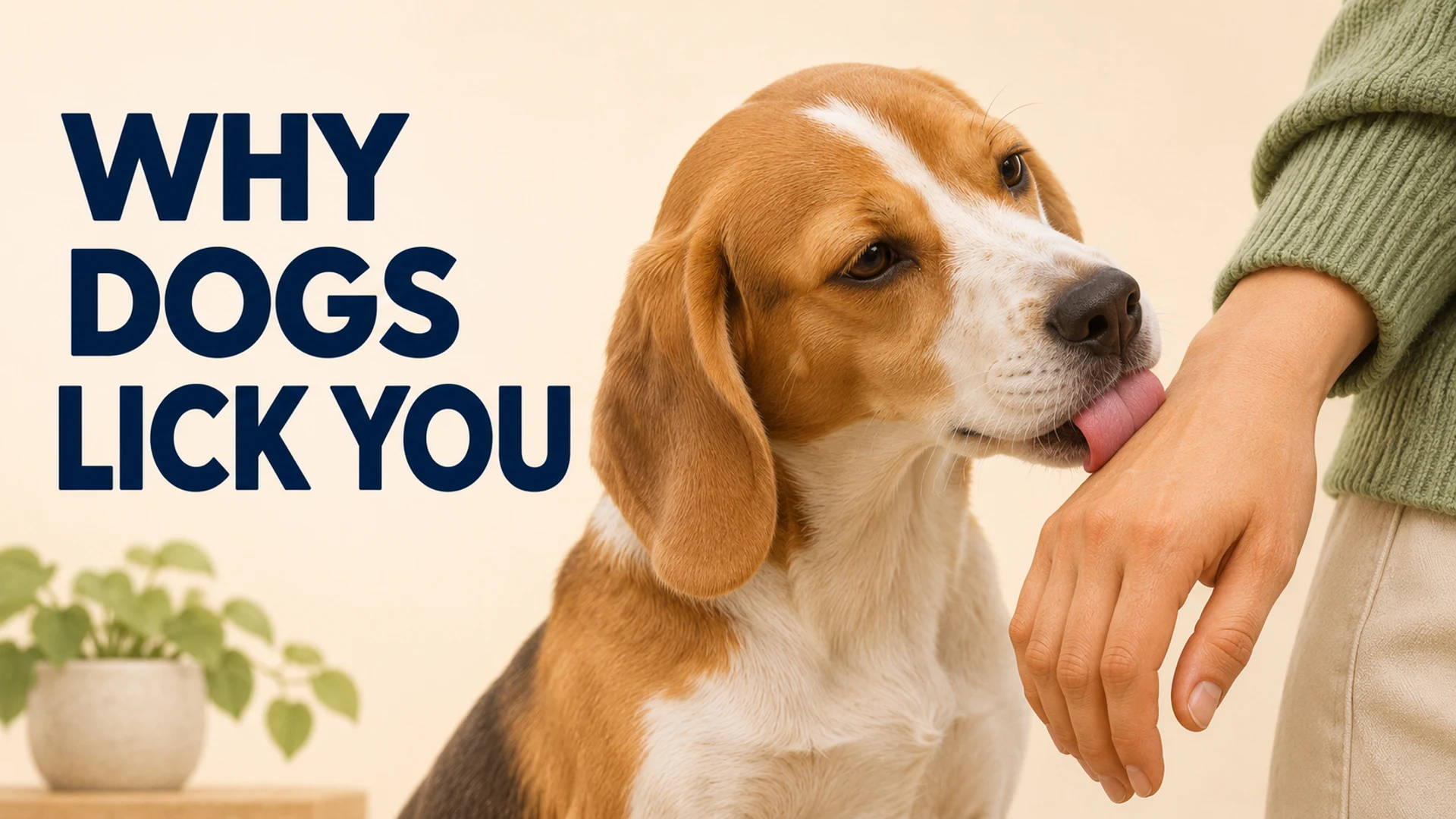
Dogs lick people for several possible reasons, including social contact, interesting tastes, comfort, and attention they have learned to expect. A lick can fit a friendly moment, but it does not establish one exact message. Notice when it starts, where it is directed, and whether your dog remains comfortable when you change the interaction.
You can prefer less licking without punishing your dog. Calmly remove access to the skin, offer a suitable alternative activity, and make the response consistent. Keep saliva away from mouths, eyes, and open wounds. A new repetitive pattern, especially with discomfort or changes to the dog's own skin, deserves veterinary advice.
Licking a person has more than one possible reason
A reunion lick, a lick of a hand that held food, and licking during close handling may look alike at first. They raise different questions. The first may be part of a familiar social routine; the second may involve taste or smell; the third needs you to check whether the dog is trying to make the encounter less demanding.
Several explanations can overlap. A dog can seek your company and also find your salty skin interesting. If you usually laugh, talk, or start a game after a lick, that response may help maintain the habit. None of this makes the dog deceptive or requires you to determine a single motive before choosing a comfortable boundary.
Look at the whole interaction using our guide to dog language. This article focuses on licking people; it does not turn every tongue movement or repeated self-grooming pattern into the same behavior.
Check what happened just before the lick
Consider the nearest observable event. Did you finish cooking, return from a walk, sit down with a laptop, or reach toward the dog's face? Notice what the dog looks at afterward. They may return to sniffing your hand, move toward a toy, settle beside you, or try to leave. Those choices can help you select the next action without inventing a sentence the dog supposedly said.
If licking concentrates on skin with food or another residue, wash the area and prevent access to anything unsafe. Do not let the dog sample lotions, topical medication, or unknown substances. If an exposure may have occurred, ask your veterinarian or an appropriate poison service for instructions. The question is then exposure safety, not whether licking was affectionate.
During handling, notice the dog's freedom to move. A dog who licks while leaning away or becoming still may need the contact to stop. Rest your hands and give room rather than holding the dog close for more “kisses.” If they move away, allow that choice. You can reassess a necessary care task with a safer plan later.
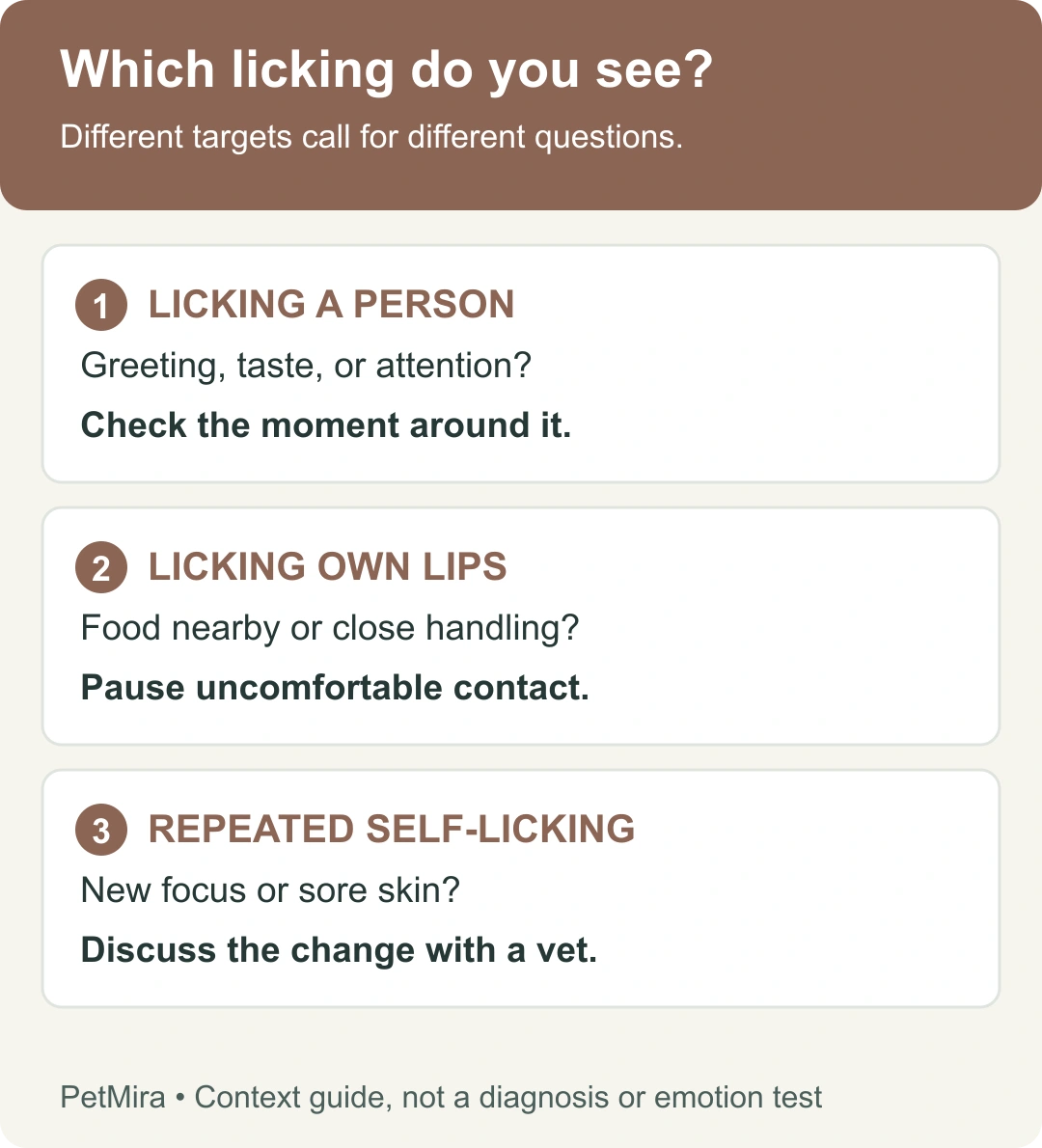
Separate licking you from lip licking or self-licking
Licking a person's hand is different from a dog briefly licking their own lips. Lip movements can occur around food, and they can also appear in demanding interactions. Repeatedly licking one paw or another body area raises a different question about the dog’s own comfort. Treating all three as affection can hide the change you actually need to describe.
Use the target and the sequence in your account. For example, “licked my wrist after I set down a sandwich” preserves more information than “gave kisses.” Likewise, “kept licking the left front paw after the walk” is more useful than “was clingy.” You can use ordinary words; the important part is keeping the observations distinct.
What happens | A useful question | A practical response |
|---|---|---|
Licks a hand after cooking | Is food residue attracting attention? | Wash skin and prevent unsafe residue access. |
Licks during a greeting | Can the dog approach and leave? | Offer contact without face licking. |
Licks when you are busy | What response has followed before? | Offer an acceptable way to ask for attention. |
Licks own body repeatedly | Is the pattern new or affecting skin? | Seek veterinary advice. |
If you are unsure which movement you saw, say so. A clear description of the body area and setting helps a veterinarian or behavior professional ask the next question. It is better than choosing an emotional or medical label from an online list.
Set a boundary your dog can understand
For ordinary unwanted licking, begin before the dog becomes very excited. Sit or stand so your face is out of reach, keep hands relaxed, and gently move the exposed hand away if licking starts. Avoid pushing the dog's muzzle or making a sudden game of pulling your hand back and offering it again. Give your dog a simple acceptable option, such as settling nearby or engaging with an appropriate toy.
Reward that alternative when your dog offers it. If they settle beside you without licking, notice the quiet moment and provide the attention you can comfortably give. You do not need to make affection available only after a perfect performance. The aim is a predictable way to interact that both of you can repeat.
If you want to teach a cue, practise when the dog is comfortable and the situation is easy. Our guide to clear dog cues explains the separate teaching process. Repeating “stop” while continuing the same lively interaction may give the dog little useful information about what to do instead.
Make everyday greetings easier for everyone
Agree on a household routine. One person encouraging face licking while another scolds it creates an inconsistent interaction. Adults can keep faces out of reach, offer calm attention at the dog's level without leaning into them, and end the greeting while the dog can still move away easily. Give children space from the dog's face and supervise contact closely.
When visitors arrive, manage the greeting rather than asking the visitor to fix the dog. A little distance or a suitable barrier can let everyone enter without crowding. A calm greeting later is still a greeting. Avoid making the doorway the place where a dog must absorb several reaching hands at once.
You can also change predictable taste-related situations. Wash hands after preparing food, keep used dishes inaccessible, and put suitable activities nearby before you settle down to work. These changes remove opportunities for a habit without requiring a confrontation every time your dog approaches.
When a new licking pattern needs veterinary advice
Contact your veterinarian if licking becomes unusually persistent, is hard to interrupt during normal activity, affects eating or rest, or accompanies apparent discomfort. Repeated self-licking that produces sore skin, hair changes, or a new focused body area should also be checked. Do not assume the cause is boredom simply because the dog is indoors.
If there is a visible skin or coat change, PetMira's photo-based care log can help you keep comparable images in order after you have arranged any needed care. Record the affected area and when you first noticed it. The log cannot tell you why the dog is licking or rule out a health problem. For a broader observation routine, see dog health monitoring at home.
For a routine behavior question without a concerning change, PetMira's care Q&A can offer background information to discuss alongside your own observations. Keep the question concrete, such as licking after meals or during a reunion. No app answer can establish affection, diagnose anxiety, or decide whether uncomfortable handling should continue.
Keep the connection and choose the contact
Read licking in its setting and keep person-directed licking separate from lip movements or self-licking. Set a calm, consistent boundary and offer another comfortable way to interact. If the pattern changes or the dog appears uncomfortable, investigate the change with your veterinarian rather than assigning a single motive.
Everyday care with PetMira
Plan a calmer response to licking
Read PetMira’s care encyclopedia or ask an everyday question about setting consistent contact boundaries.
 Explore the care encyclopedia
- Ask a focused everyday care question
- Use guidance alongside real-world observation
Available on iPhone. AI-generated information is for educational reference.
Download iOS App