Dogs can make a quick full-body shake to shed water, and they may also shake when dry during changes in activity or an interaction. A dry shake-off does not automatically prove distress, relief, or a particular emotion. First identify the movement, then compare what happened immediately before it and what your dog does afterward.
This article concerns a brief side-to-side rotation, rather than ongoing trembling, repeated head-only shaking, or seizure-like movement. New persistent shaking, apparent pain, ear discomfort, or other concerning changes need veterinary advice. Seek urgent help for collapse, severe weakness, breathing difficulty, or suspected poisoning instead of waiting to interpret the movement.
First identify the movement you are seeing
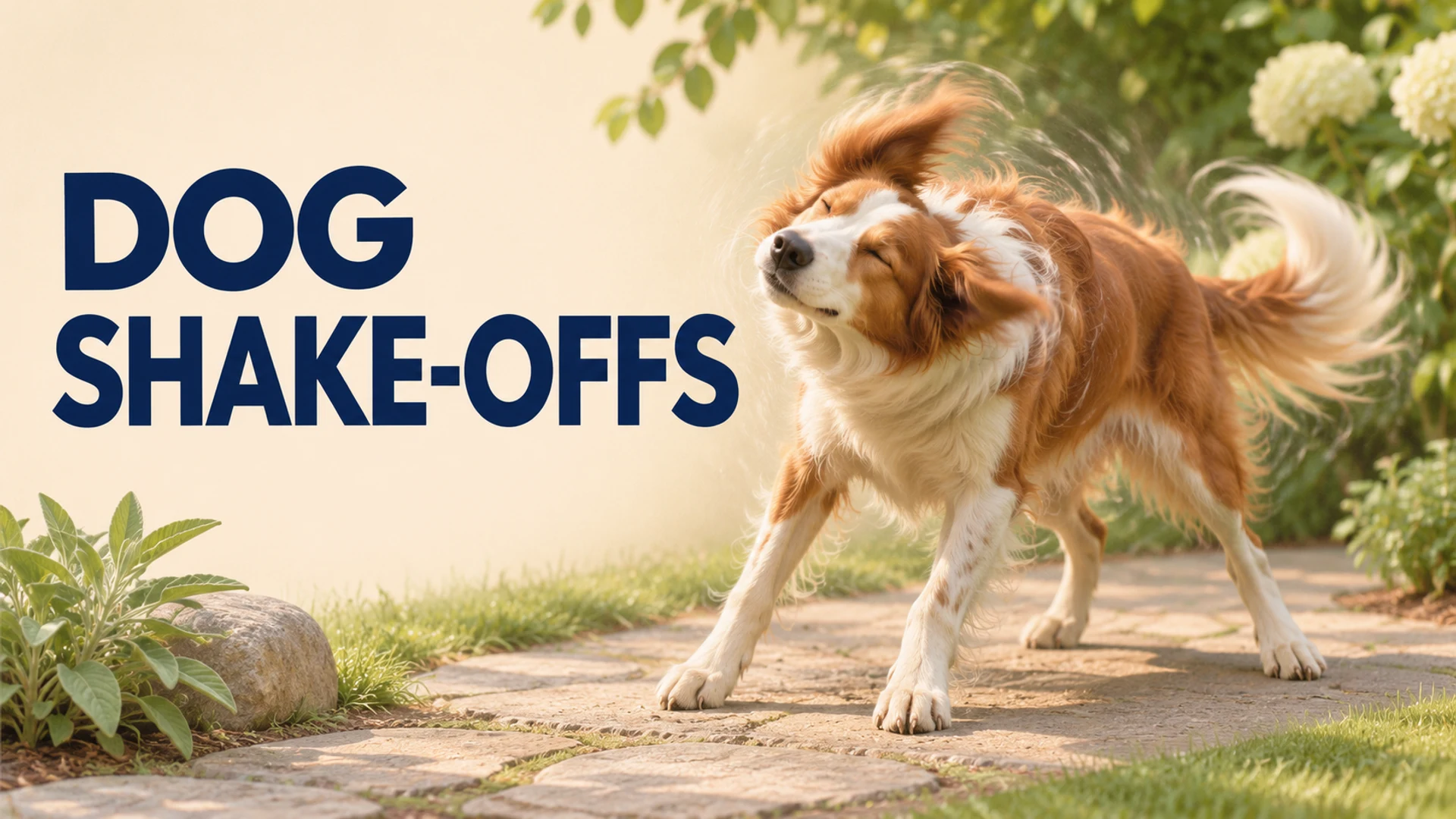
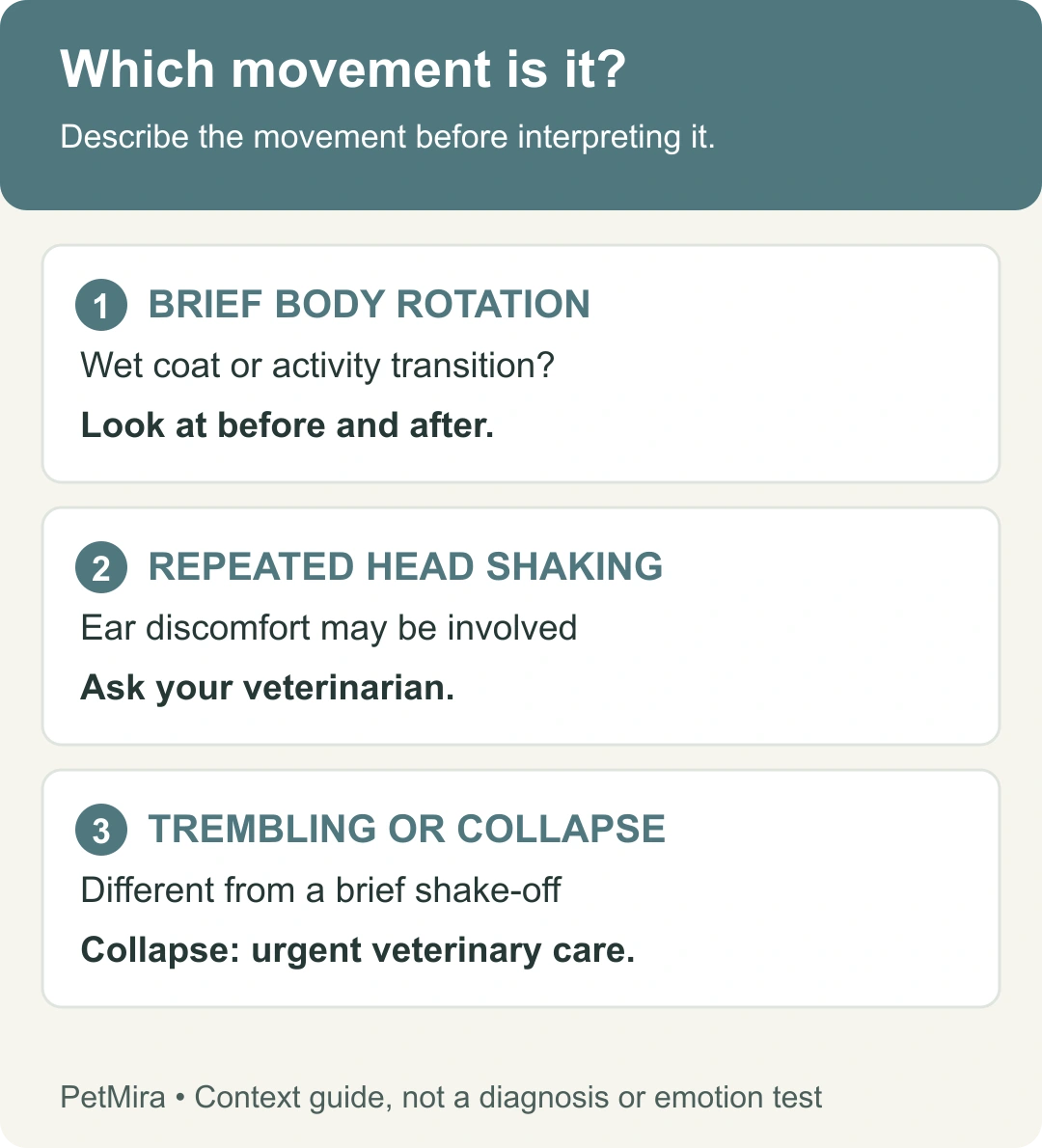
A shake-off is usually recognizable as a quick rotation that travels through the head and body, like the familiar movement after a bath. It ends, and the dog goes on to another activity. You might see fur ripple or ears flap. The coat may be wet, but that is not a requirement for the movement to occur.
Trembling or shivering looks different: the body continues making smaller movements rather than completing one brief rotational event. Repeated head shaking without the same whole-body pattern also deserves a different description, especially if the dog scratches an ear or appears uncomfortable. You do not need a perfect technical label to call the clinic; explain what moved and whether it stopped.
Keep the observation separate from its possible explanation. “Shook once after getting up and then walked to the door” preserves a sequence. “Released all his anxiety” adds an internal change that you have not measured. The first description gives you something concrete to compare next time.
Observed movement | Useful distinction | Next step |
|---|---|---|
One quick whole-body rotation | Wet coat or an activity change | Allow space and observe ordinary behavior. |
Dry shake after contact | Does the dog settle or try to leave? | Let the contact end; do not assume recovery. |
Repeated head-only shaking | Ear scratching, soreness, new tilt | Call your veterinarian. |
New or persistent trembling | Different from a brief shake-off | Contact your veterinarian for advice. |
Collapse | An urgent health change | Seek urgent veterinary care now. |
Dry shake-offs can appear between activities
You may see a dry shake after a dog rises, after physical contact ends, or between play and another activity. Those settings make it useful to consider a transition rather than immediately classifying the movement as either a problem or proof of happiness. What the dog does next still matters.
After play, for example, one dog may shake and walk away to sniff. Allow the break. Another dog may shake, remain tense, and continue trying to avoid an approaching playmate. In that case, create space rather than assuming the shake has resolved the encounter. A pause in movement does not oblige either dog to restart the game.
After a petting session, let the dog decide whether to return. Do not follow them to provide more contact because they have “shaken it off.” You can acknowledge a transition without deciding exactly how the dog felt. Our dog-language guide explains how to include posture, attention, and movement in that wider picture.
What a social-context study found and did not find
A naturalistic study of shaking in dogs observed episodes in a dog run and a daycare. Shaking often occurred between different activities or behavior categories. The recorded postures usually stayed the same before and after the shake. Stress was not measured directly.
That finding supports considering activity transitions, but it does not establish one cause for every shake. It also does not prove that shaking cannot occur in a stressful situation. The study observed particular social settings; it was not a test of every dog, every health condition, or every kind of shaking.
The practical difference is how confidently you explain an episode. Saying that a dog shook after an encounter describes the timing. Saying that the movement removed stress claims an effect. Look for independent signs of comfort, such as easier movement and the ability to disengage, rather than making the shake itself both the evidence of distress and the evidence of recovery.
Read the moments before and after a shake
Begin with the nearest event you could actually see. Was the coat wet? Had the dog just risen from a bed? Did a person release a harness or stop touching? Was another dog close? Then notice where your dog goes, whether their body remains tense, and whether they resume an ordinary activity comfortably.
At a doorway, a dog might shake after the leash is removed and then walk to water. That sequence differs from repeated shaking accompanied by scratching or a new head angle. Do not let a familiar movement hide a change in frequency, body area, or comfort. Equally, one ordinary shake does not require a detailed investigation every time.
If you only saw the end of an encounter, preserve the missing context. You might know the dog shook and moved away but not whether someone had touched them. Asking a household member what happened is more useful than filling the gap with a story about anxiety. A brief account is enough for an ordinary moment.
Choose a calmer transition when the setting is demanding
If the dog is showing other signs of discomfort, reduce the demand that is already present. End close handling, provide distance from another dog, or leave a crowded area by a safe route. Avoid grabbing the collar or restarting the interaction to see whether the shake happens again. Your response can improve the setting without proving the movement's function.
On a walk, a convenient pause might mean waiting in an open area where the dog can sniff and look away. It does not have to mean a sit beside the trigger. If encounters with other dogs are consistently difficult, our guide to barking at other dogs covers a separate passing-and-practice plan. A shake-off is not a substitute for that assessment or evidence that the dog is ready for a closer encounter.
For background questions about an everyday sequence, PetMira's AI care Q&A can help you explore possibilities after the situation is comfortable. Describe the activity before and after the shake. The app cannot measure stress release or certify that an interaction should continue, so keep your own observation and the dog's choices central.
When shaking belongs in a veterinary conversation
Call your veterinarian about new repeated head shaking, ear scratching, a changed head position, persistent trembling, or shaking associated with apparent pain. Mention when it began, whether it occurs at rest or during an activity, and what else has changed. Do not probe an ear or attempt a home treatment to test a suspected cause.
If your dog already has a veterinary plan for a known condition, follow that plan and ask the clinic to clarify any change outside it. A safely captured clip may help describe the movement, but do not provoke another episode or delay urgent care to obtain one. For a broader way to organize changes, see dog health monitoring at home.
Ordinary context and health context can coexist. A dog may shake after rising because they are changing activity, yet a new recurring discomfort still needs attention. The aim is neither to medicalize every movement nor to dismiss a genuine change with a reassuring phrase.
Treat the shake as a clue, not a verdict
Identify the movement, keep the surrounding activity attached to it, and notice what follows. Let a break remain a break and make space when the wider encounter is difficult. A new concerning pattern needs veterinary advice, while one shake alone cannot confirm either distress or recovery.
Everyday care with PetMira
Keep the whole sequence in view
Use PetMira’s AI Q&A for background on everyday behavior, with what happened before and after a shake as the starting point.
 Explore the care encyclopedia
- Ask a focused everyday care question
- Use guidance alongside real-world observation
Available on iPhone. AI-generated information is for educational reference.
Download iOS App