
Dogs can sigh as an ordinary physical breath or while settling, waiting, or responding to something around them. A long exhale after curling up on a bed may fit a relaxed moment, but the same sound does not always mean happiness, boredom, or disappointment. Look at the rest of the dog and what happens next before giving the sigh a human-style explanation.
First, make sure you are seeing comfortable breathing rather than repeated effort to get air. Gasping, visible breathing difficulty, weakness, or collapse needs urgent veterinary attention. A new, recurring sound or a change accompanied by discomfort deserves a call to your veterinarian; an app or an online sound comparison cannot rule out a breathing problem.
A sigh can be an ordinary breath or part of a moment
A sigh is a deeper breath with an audible or noticeable release of air. It is not necessarily a deliberate message directed at a person. Dogs can take deeper breaths during rest, and a sound that catches your attention may simply be more noticeable than the quiet breaths around it. You do not need to invent an emotional cause for every exhale.
Context can still be useful. If your dog lies down easily, loosens their body, and returns to quiet rest, the whole sequence is different from repeatedly getting up and searching for a comfortable position. Describe those observations before deciding whether the dog looks contented or frustrated. Your own dog's familiar resting pattern offers a better comparison than a dramatic clip online.
A sigh may also appear during an interaction. Perhaps you stop throwing a toy and your dog exhales while looking at you. It is reasonable to consider whether they are waiting for more activity, but the sigh does not prove disappointment. They might shortly walk to their bed, bring the toy back, or go to their water bowl. The next action helps you choose what to offer.
Compare these everyday situations
Use the surrounding movement to decide whether anything needs changing. The dog language guide explains how to read posture and interactions as sequences. A sigh adds one observation to that sequence; it should not replace all the others.
Situation | What to notice next | A reasonable response |
|---|---|---|
Curling up after an ordinary day | Easy position change and quiet rest | Let the dog rest |
Waiting near a finished activity | Whether the dog settles or keeps seeking interaction | Review the routine without guessing an emotion |
During close petting or cuddling | Turning away, stiffness, or choosing to stay | Pause contact and allow a choice |
Repeated changes of position | Difficulty settling or other comfort changes | Discuss the change with your veterinarian |
For example, one dog sighs as you put away a book and remains asleep. Another sighs during a tight cuddle, turns their head away, and shifts toward the edge of the sofa. Both episodes include an exhale, but continuing to hold the second dog because “sighing means happy” would ignore the more useful information in front of you.
A practical response during contact is to stop your hands and give space. If the dog chooses to come closer with easy movement, you can consider a brief, familiar interaction. If they leave or remain still, let the pause stand. There is no need to repeat the cuddle to find out whether the same sound happens again.
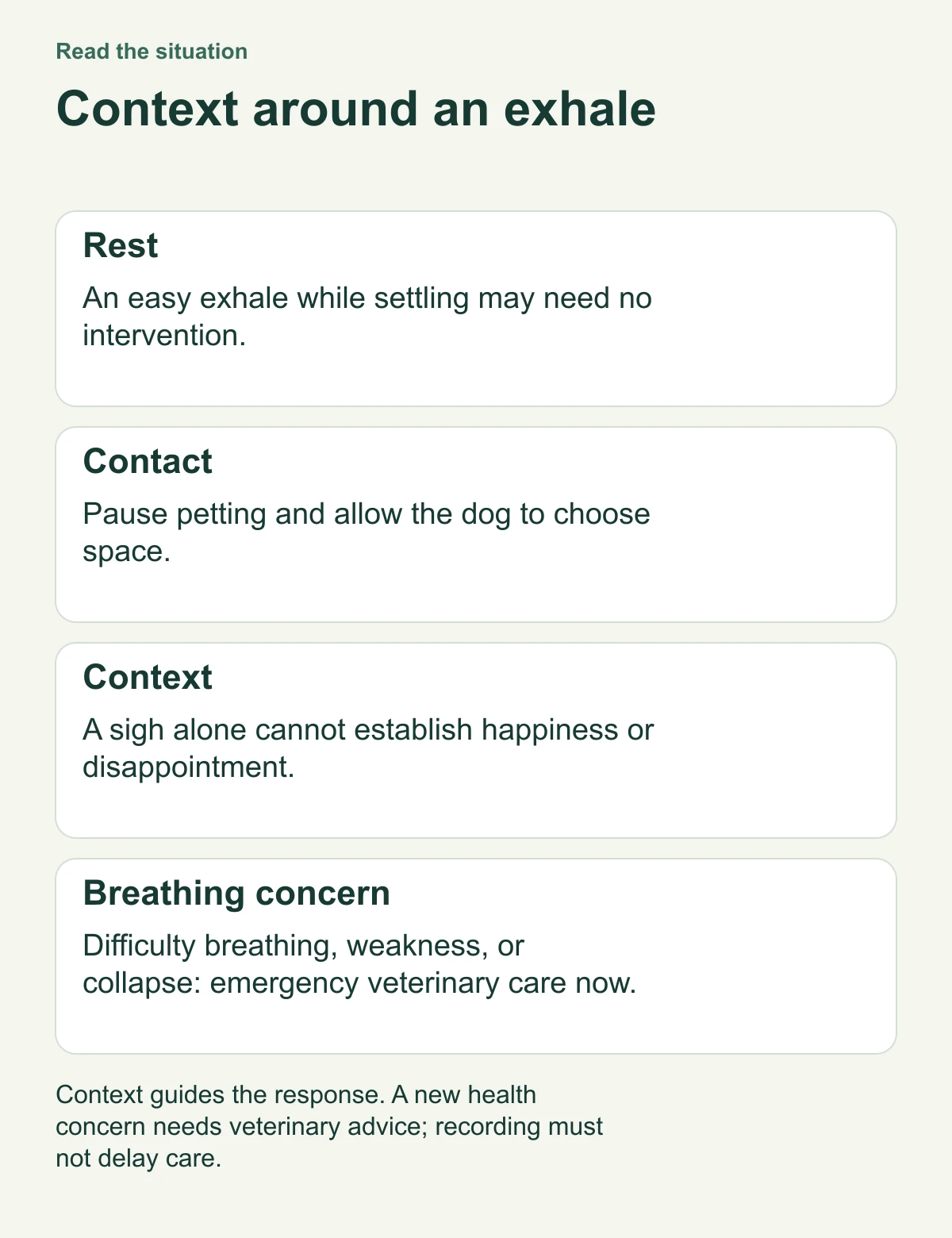
Why a sigh does not prove disappointment
Human descriptions such as “a hard day at work” can make a dog video amusing. They do not establish what a dog was thinking. The same applies to a label that calls an exhale happy, sad, or annoyed without showing what happened before and afterward. A single visible cue cannot confirm the whole story.
Try changing the question from “What emotion did that sigh mean?” to “What was my dog doing, and do they seem comfortable continuing?” If they are resting easily, the answer may be to do nothing. If they keep bringing a familiar toy during a long inactive afternoon, review whether their normal opportunities for activity and company have been met. That is a routine check, not proof that the sigh was a complaint.
Avoid using one detail as a shortcut. Half-closed eyes can occur during rest, but they do not certify contentment in every setting. A louder sigh is not a reliable scale of frustration. Breed, facial shape, recording distance, and background noise can also change what a listener notices. Keep the interpretation modest enough that another observer could disagree without contradicting the facts.
Your response can also become part of a familiar exchange. If every audible sigh brings a lively game, your dog may begin offering the sound during that routine. That does not make the original sound dishonest, and it is not a reason to withdraw companionship. Offer suitable activity at predictable times and notice quiet approaches too. If the dog is already comfortably asleep, starting play because you interpreted an exhale as boredom could interrupt the very rest they were choosing. Use the surrounding behavior to decide whether interaction is welcome.
Observe a change without interrupting rest
For an ordinary, occasional sigh, you usually do not need a monitoring project. Let the dog rest and notice how they act when they naturally get up. Do they move comfortably to a familiar activity? Is the exhale part of the pattern you already recognize? Preserve sleep instead of repeatedly calling their name or moving them for a better view.
If a pattern seems different, note the setting and the accompanying change. “Took several attempts to lie down after the walk, then exhaled” is more useful than “sighing a lot.” Include whether the dog was resting, recently active, being touched, or waiting for something. Do not recreate a strenuous activity or uncomfortable handling to check your theory.
For general background, you can use PetMira’s AI care Q&A to ask which context is useful to describe around an ordinary behavior. Start with the observation, such as an exhale after lying down, rather than asking it to confirm an emotion. Treat the answer as general information, not an assessment of breathing or pain, and keep your factual note separately. Ordinary breathing sounds are not a verified sound-interpretation use here. Skip the phone when care is needed; a resting dog does not need to become more alert for an app.
Our explanation of what dog translators can and cannot show separates a sound record from a claim about its meaning. That distinction matters especially when an app produces an appealing emotional description of something as ambiguous as an exhale.
When to describe the sound to your veterinarian
Call your veterinarian when the sound is new or more frequent, or when it comes with reduced activity, difficulty getting comfortable, changes in appetite, or a new reaction to touch. You do not have to establish that the sigh itself is the problem. The combination of changes is a reasonable reason to ask what should happen next.
Describe the noise in ordinary words if you are unsure what to call it. A cough, whimper, groan, snort, and deep exhale are not interchangeable, but owners may use the same word for several sounds. Explain when it occurs and whether breathing between episodes looks different. Let the veterinary team determine what the sound represents rather than choosing a diagnosis from an online audio comparison.
The health monitoring guide offers a broader way to organize observations. For this question, keep the record short: the event, what was typical, and what changed. Do not wait for several days of notes if your dog seems unwell, and seek emergency care for difficulty breathing or collapse.
The useful question after a sigh
A sigh can be part of an ordinary breath or a familiar interaction, and it does not need a fixed emotional translation. Look at comfort, context, and the next action. Let a resting dog rest, pause contact when they seek space, and get veterinary advice when the overall pattern changes.
PetMira for everyday care
Turn an ordinary observation into a clear question
Use PetMira’s AI care Q&A for general everyday care questions, keeping your factual observations separate from the answer. Breathing concerns need veterinary advice.
 Ask general care questions
- Read everyday care information
- Keep observation and interpretation separate
Ordinary breathing-sound analysis is not a verified use here; do not delay care.
Download iOS App