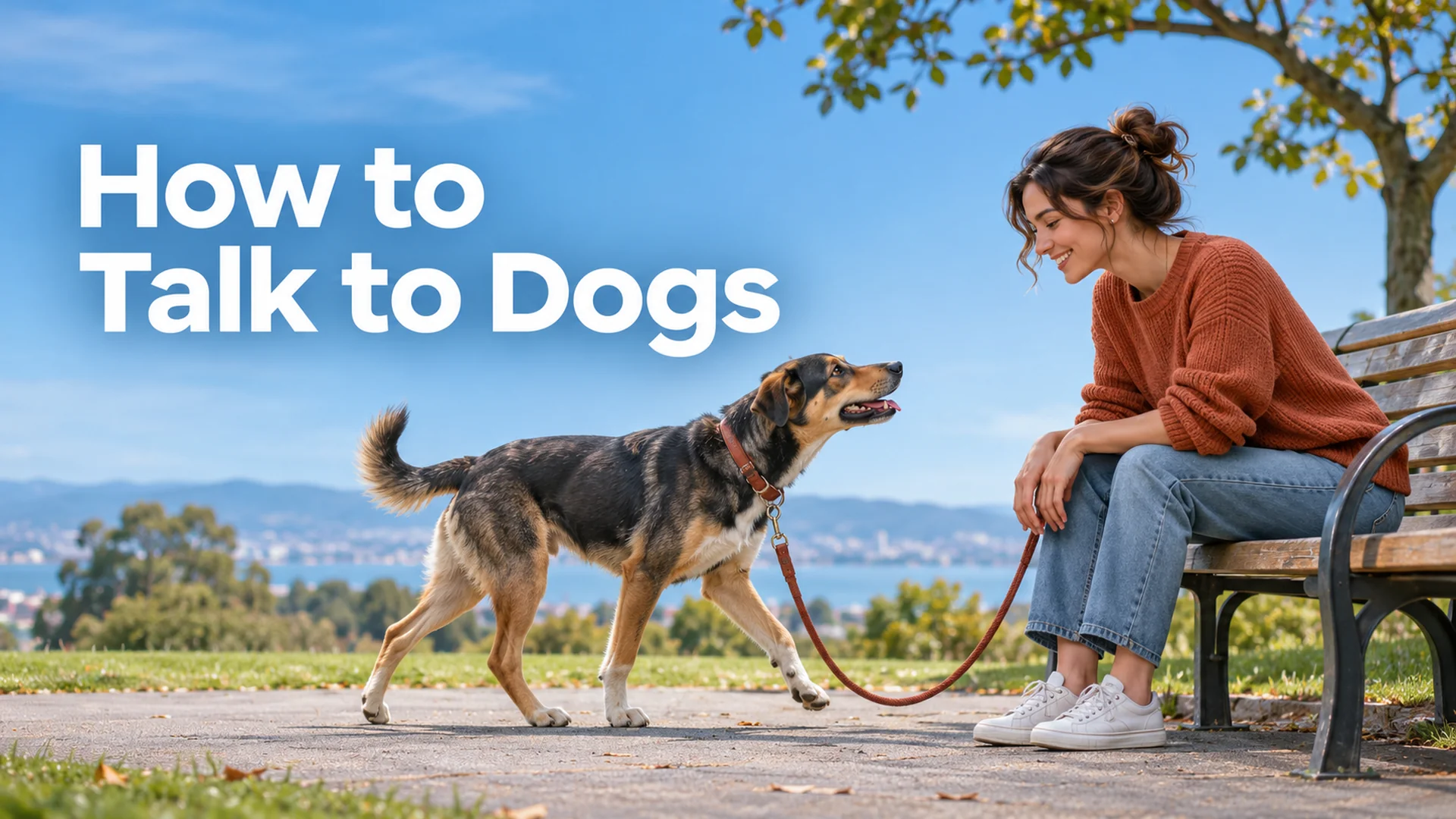
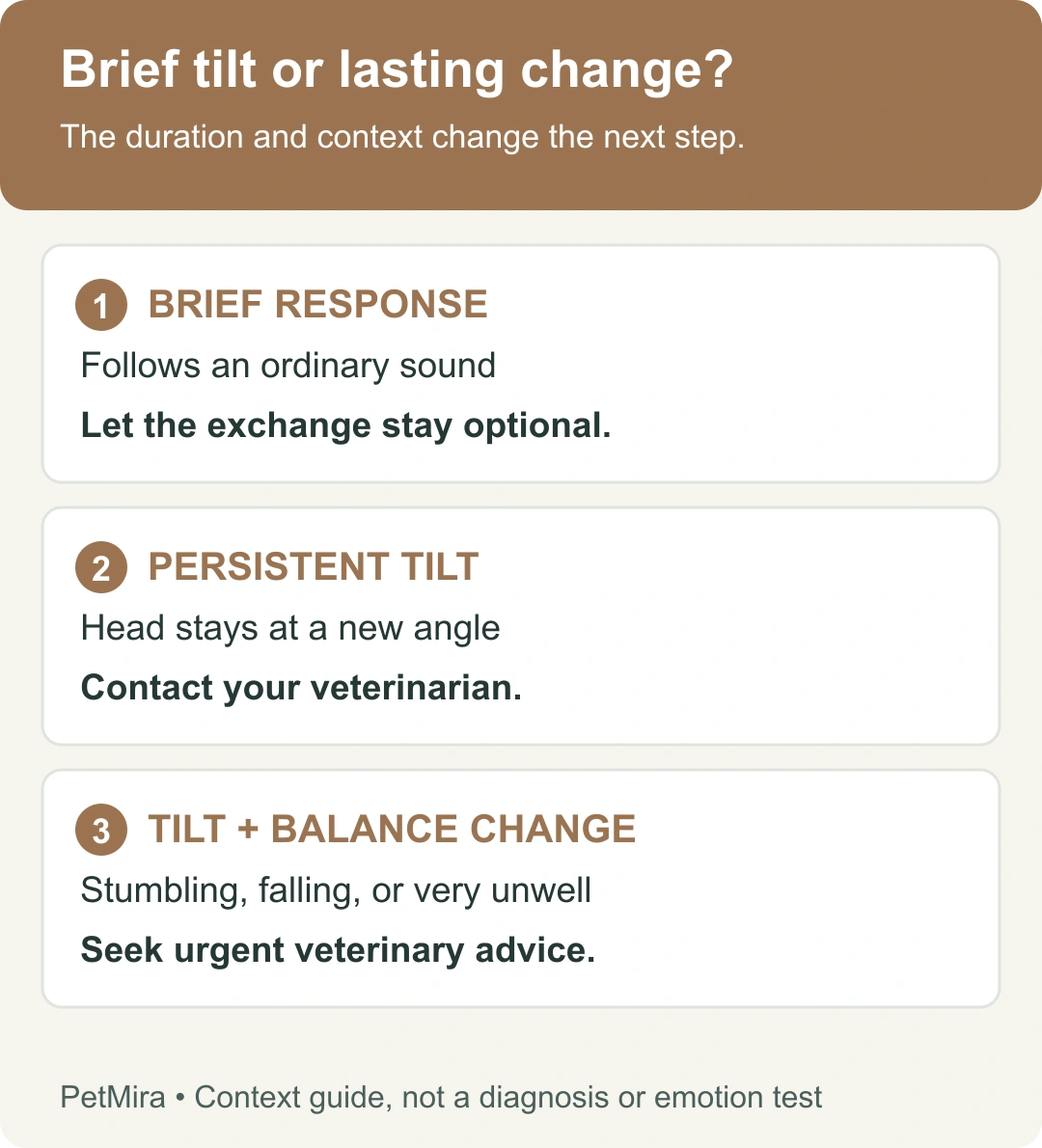
A brief head tilt after a word or sound may be part of a dog gathering or processing information. Hearing, vision, learning history, and the situation may all play a role; there is no single established explanation for every dog. A momentary response that ends with ordinary movement is different from a new head position that remains tilted.
Contact your veterinarian promptly if a tilt persists, appears without an ordinary interaction, or comes with ear discomfort or another change. Seek urgent advice if your dog is struggling to stand, falling, or otherwise seriously unwell. Do not use a cute head-tilt explanation to dismiss a lasting change in posture.
A brief responsive tilt differs from a lasting head position
Notice how the episode begins and ends. You might say a familiar word, see the dog angle their head for a moment, and then watch them return to their normal position as they move away. That sequence gives the response a clear context. It does not tell you exactly what the dog understood.
A dog who continues holding the head at a new angle while walking, eating, or resting presents a different observation. Do not repeatedly call their name or play a sound to see whether they can “straighten it out.” Contact the clinic and explain what changed. A veterinarian can assess possible causes that cannot be sorted out from posture alone.
If you are unsure which description fits, say that uncertainty plainly. “The head looked tilted after breakfast and still looked different on the walk” is a useful account. There is no requirement to identify a cause before asking for advice.
What you see | What it establishes | Next step |
|---|---|---|
Brief tilt after a word | A response occurred; motive remains uncertain | Carry on calmly without repeated tests. |
Often tilts to the same side | An individual pattern, not an intelligence score | Compare with their ordinary movement. |
New head angle that persists | A changed head position | Contact your veterinarian promptly. |
Tilt with trouble standing | A potentially important health change | Seek urgent veterinary advice. |
Hearing, vision, and learning are possible parts of the story
A head movement changes the position of the eyes and ears relative to something being watched or heard. That makes sensory explanations plausible, but plausibility is different from proving the purpose of a particular tilt. A dog facing a speaker may be responding to the sound, the person's expression, a familiar phrase, or several of those details together.
Some explanations suggest that a dog's muzzle affects the view of a person's face. Others focus on listening or attention to familiar information. The AKC discussion of head tilting describes several possibilities and the need for further research. It does not establish one universal hearing or vision trick that every dog is performing.
Your response can also become part of the interaction. If a tilt is often followed by warm attention or an expected activity, that experience may influence what happens again. It still would be too strong to say every dog tilts deliberately to be cute. Keep the observed response and your interpretation separate.
What head-tilt research actually compared
Research involving dogs learning the names of particular toys found an association between head tilting and performance in that specific word-object task. The important condition is the task itself. These were not random head tilts scored from pet videos, and the study did not provide a way to rank any household dog's intelligence from a tilted head.
A dog can respond to familiar cues without tilting. Another dog may tilt while waiting for the activity that usually follows a phrase. The absence or presence of the movement does not show that one dog loves you more, has better hearing, or understands every word in a sentence.
That distinction is useful when you read a headline about “gifted” dogs. A research category describes how participants performed under the study's conditions. It is not a label you need to assign to your pet. Focus on whether your own dog comfortably understands the requests you actually use and whether those requests are consistent.
If a dog suddenly stops responding to familiar sounds or cues in a quiet setting, discuss that change with your veterinarian. Do not interpret it as a change in intelligence or insist on more practice before seeking advice. Familiarity with the dog's usual response matters more than a comparison with another dog's head-tilt frequency.
Enjoy the interaction without testing your dog
Use ordinary conversation at a comfortable volume and let the dog choose whether to stay. There is no need to repeat squeaks, unusual noises, or videos to collect a stronger reaction. If your dog moves away, lowers their body, or looks uncomfortable, end the sound and give them space.
Suppose your dog briefly tilts when you ask about a familiar walk. Carry on with the normal routine if the dog is comfortable. You do not need to delay the walk while repeating the phrase from several angles. The enjoyable part is the interaction you share, not producing a particular pose for a camera.
For an unfamiliar dog, a tilt is not permission to bring your face closer. Ask the handler, leave an exit, and avoid leaning into the dog's space. Our dog-language guide helps place a facial movement beside posture and choice. If your goal is teaching a familiar response, use the separate guide to clear dog cues.
Record a new pattern in useful words
If the movement catches your attention, note the ordinary event before it and what followed. Include whether the head returned to its usual position and whether walking and resting looked normal. “Brief tilt when the food cupboard opened; then walked normally to the bowl” leaves the evidence intact without claiming the dog understood a whole sentence.
If a change is concerning, give the clinic the first time you noticed it and whether it has continued during different activities. Mention any new ear scratching, apparent pain, balance change, or unusual eye movement you have observed. Do not manipulate the head or probe an ear to complete a checklist. The veterinary team can tell you which information is useful and which checks belong in the clinic.
For everyday background questions, PetMira's care encyclopedia and AI care Q&A can help you explore terms such as responsive head tilting. Keep the question tied to the context. These features cannot identify the cause of a persistent tilt, assess balance, or replace an examination, and using them should not delay a call about a worrying change.
When to call about a persistent tilt
Use the changed head position itself as a reason to ask, even if the dog is still interested in food or people. A dog does not need to meet every item in an online symptom list before a new persistent tilt is worth discussing. Your veterinarian will judge the combination of history and examination findings.
If symptoms worsen or the dog cannot move safely, seek urgent advice and follow the clinic's instructions. Prevent access to stairs or other places where an unsteady dog could fall while arranging care, without trying to correct the head position yourself. A safely available observation is helpful; provoking another episode is not.
Keep curiosity separate from a health assessment
A brief tilt during an ordinary exchange can be enjoyed without assigning a precise thought or intelligence score. Watch how the movement ends and let the interaction remain optional. A lasting new tilt or accompanying balance problem needs veterinary attention rather than a more elaborate behavior explanation.
Everyday care with PetMira
Explore everyday behavior questions
PetMira’s care encyclopedia and AI Q&A can help you explore the language around a brief responsive head tilt. A lasting change needs veterinary advice.
 Explore the care encyclopedia
- Ask a focused everyday care question
- Use guidance alongside real-world observation
Available on iPhone. AI-generated information is for educational reference.
Download iOS App