Dogs wag their tails during many kinds of engagement, including friendly greetings, anticipation, uncertainty, and tense encounters. A moving tail does not automatically invite a person or another dog closer. To decide what to do, compare the tail with your dog's usual position, notice whether the rest of the body is loose or stiff, and leave room for the dog to choose the distance.
If a dog freezes, fixes their gaze, or growls as someone approaches, stop closing the gap even if the tail is still moving. Keep children and other pets back. A sudden painful change in tail movement belongs in a veterinary conversation rather than an attempt to test the dog's mood.
A wag can signal engagement without inviting touch
The useful starting question is what has caught the dog's attention. A familiar person opening the front door, a dog beyond a fence, and a hand moving toward a chew are different events. Tail movement may accompany all three. What happens around the wag helps you decide whether to stay still, offer an ordinary activity, or make more space.
Think of the tail as one visible part of an unfolding encounter. You can describe where it is and how it moves without claiming to know the dog's exact thoughts. “Tail moving in short strokes while the legs stayed still” gives someone else something to recognize. “He was definitely happy” closes off other explanations before you have checked them.
Our guide to dog language explains how the face, feet, posture, and voice fit together. Here, the closer task is reading changes in the tail and choosing a response to the interaction in front of you.
Compare the tail with your own dog's resting position
Start with an ordinary moment when your dog is comfortable and free to move. Notice where the tail rests during an easy sniff around a familiar area. A naturally curled tail, a low-carried tail, and a short tail will give you different starting points. Comparing every dog with a drawing of a straight horizontal tail can produce a misleading result.
Look for a change relative to that familiar position. Has the base lifted? Has the tail drawn closer to the body? Is the movement broad or confined to the tip? You do not need to touch or lift the tail to answer these questions. Watch from a place where your presence is not changing the encounter.
If much of the tail is hidden by long hair, clothing, or the angle of view, mark that information as missing. Do the same with a tightly curled or very short tail. You can still use the feet, body tension, face, and freedom to move away. A tail you cannot see is a reason to rely less on that cue, not a reason to approach for a better look.
Read movement, tension, and attention together
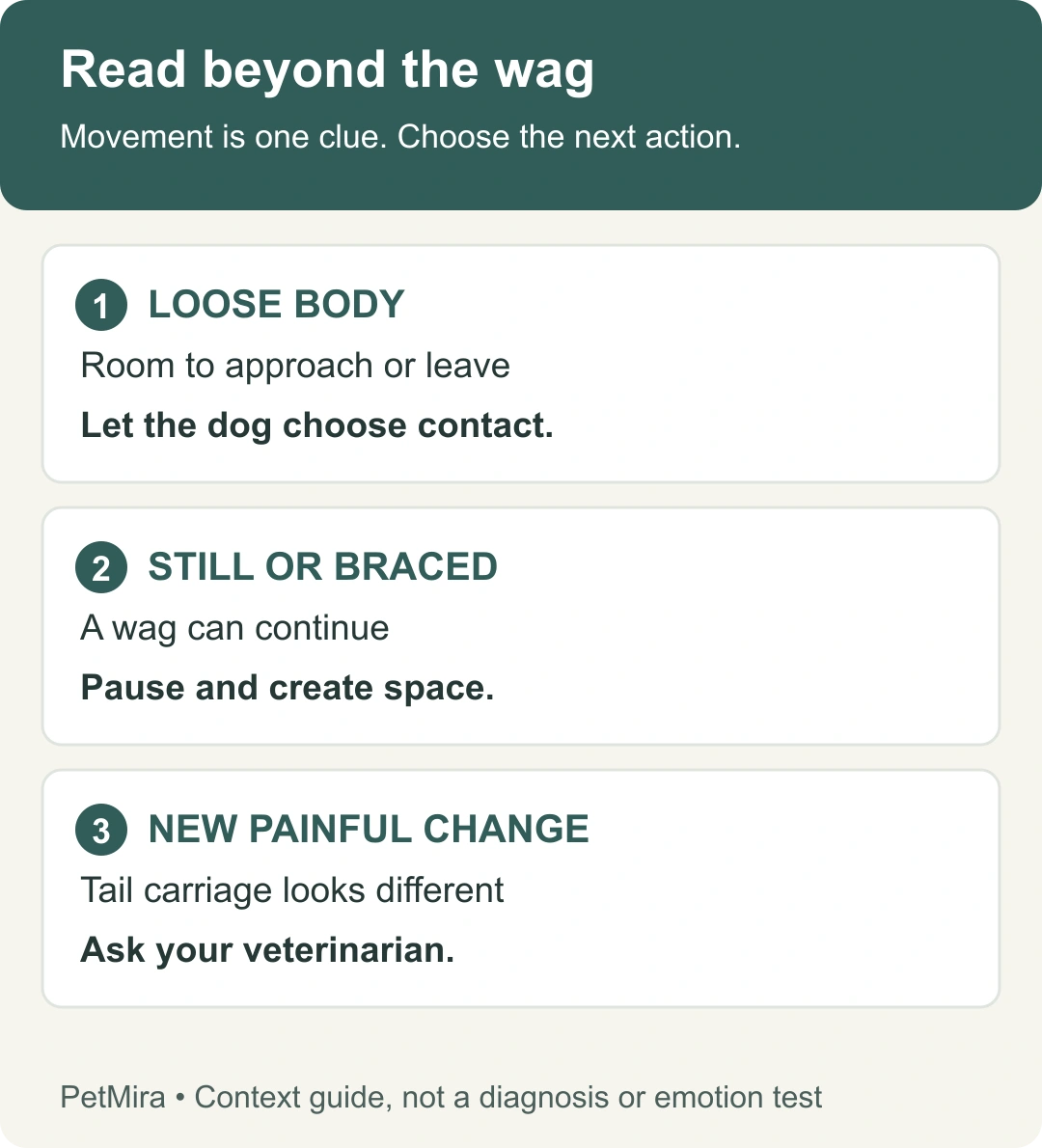
Broad, easy movement accompanied by a loose body can fit a comfortable social moment. Shorter movement above a braced body needs a different response. Speed alone cannot separate those situations. A very active tail can accompany excitement that is pleasant, difficult, or uncertain for the dog.
Notice whether the dog can shift attention. A dog who looks at a visitor, curves away, and resumes sniffing is behaving differently from one whose eyes and feet stay fixed in place. If your dog is watching something intensely, give them room before asking for a greeting or reaching over their head. You can make a safer decision without choosing a precise emotional label.
What you notice | Check alongside it | A useful response |
|---|---|---|
Broad tail movement | Loose body; can move away | Let a familiar greeting stay optional. |
Tail moves over still feet | Fixed attention or stiff body | Stop closing the distance. |
Tail drawn closer to the body | Leaning away or low posture | Give a clear route away. |
Tail suddenly held differently | Pain, injury, movement change | Contact your veterinarian. |
The combinations in the table are prompts for observation, not an emotion chart. A single snapshot misses movement and the order of events. Check what changes when the person pauses or the dog gains distance. Do not repeatedly recreate the encounter to make the tail match an example.
Three everyday encounters with different responses
At home, your dog may wag as someone familiar returns. Suppose the body stays loose, the dog walks in a curve, and they can move past the person. Let the greeting remain optional. The person can stand or sit without leaning over the dog. If contact is already familiar and welcome, a brief interaction followed by a pause gives the dog a chance to continue or leave.
Now picture the same dog at a fence. The tail is moving, but the feet are planted and attention stays on an animal outside. That wag does not tell you to open the gate or introduce the animals. Move away from the boundary using a safe route and reduce the close encounter. If this pattern is recurring or difficult to manage, seek qualified reward-based behavior support.
During petting, pay attention to changes rather than waiting for a dramatic warning. Your dog may begin with easy movement and then close the mouth, turn the head, or become still while the tail continues. Rest your hands and allow space. An absence of growling does not make continued touch necessary. For a fuller explanation of a warning sound, see why dogs growl and how to respond.
These examples share the same observation tool but lead to different actions. The greeting allows choice, the fence encounter calls for distance, and the change during touch calls for a pause. The goal is a more comfortable interaction rather than getting a particular type of wag.
Why left and right are not a home safety test
Researchers have studied differences in the direction of tail movement under particular conditions. A review in Biology Letters describes several dimensions of wagging and important gaps in what is known. This work is more nuanced than a rule that one direction always means a dog is safe to touch.
In daily life, your viewing angle changes, the dog moves, and the tail may be curved or partly hidden. Trying to decide which side wins can distract from a stiff body or a dog who is moving away. Use those clear, whole-body changes for your immediate response. You do not need to score the wag's direction before respecting a request for space.
The same caution applies to online labels such as a “happy wag” or “guilty wag.” A familiar shorthand may help describe an impression, but it does not replace the situation you can actually observe. Do not hold a dog in place, show a threatening stimulus, or take away an item to find out which movement appears.
When a change in tail movement needs a different question
If the tail suddenly hangs differently, the dog seems painful during movement, or there is a visible injury, contact your veterinarian. Avoid bending, pulling, or repeatedly touching the tail to check it yourself. Describe when you first noticed the change and whether ordinary walking, resting, or toileting also looks different.
For an everyday behavior question, PetMira's AI care Q&A and care encyclopedia can help you explore background information after the interaction has settled. Frame the question with what you saw, such as the tail's position, the setting, and what changed when you paused. An app cannot determine whether approaching a particular dog is safe, and it cannot replace veterinary assessment of pain or injury.
If you want to make future interactions clearer, agree on one household response: leave an exit, stop reaching when the body stiffens, and let a greeting end. Our guide on talking to dogs with clear cues covers a separate teaching task when your dog is comfortable and ready to learn.
A better response to the next wag
Read the tail against your dog's normal posture and the encounter around it. When the body becomes still or the dog moves away, give space even if the tail keeps moving. Let the next choice belong to the dog rather than treating a wag as permission.
Everyday care with PetMira
Put the next wag in context
Explore everyday behavior questions in PetMira’s care encyclopedia and AI Q&A, then use what you observe to choose a comfortable interaction.
 Explore the care encyclopedia
- Ask a focused everyday care question
- Use guidance alongside real-world observation
Available on iPhone. AI-generated information is for educational reference.
Download iOS App