
Dogs whine for different reasons: they may be anticipating something, greeting someone, asking for access or attention, or struggling with an uncomfortable situation. Pain can also cause whining. The useful question is what was happening around the sound and whether your dog can move, rest, and interact as usual. A whine by itself does not identify a particular feeling or tell you which response will help.
If whining is new, frequent, or happens during movement or handling, contact your veterinarian before treating it as a training problem. Seek emergency veterinary care for difficulty breathing, weakness, or collapse. You do not need a recording or a complete diary before asking for help.
Check comfort before treating whining as a habit
Start with what you can check without crowding or handling your dog. Notice whether water is available, a toilet trip is due, or their usual resting place is blocked. A dog waiting beside an outside door may need access rather than a lesson in being quiet. Meet that need and watch what happens afterward; do not withhold a toilet trip to test your interpretation.
Also notice how the dog changes position. Whining while repeatedly trying to lie down is a different observation from whining when the familiar walking leash comes out. If the sound accompanies unusual movement, reduced appetite, or difficulty settling, describe those changes to the clinic. Avoid pressing a leg or repeatedly touching a spot to see whether you can reproduce the sound.
For a dog who otherwise appears comfortable, look at the immediate situation. Who arrived, what moved, or what became unavailable? Follow the dog's direction of attention. Looking from a person to a toy offers a possible request to investigate, while moving away from an approaching visitor calls for less social pressure. Neither observation proves a motive, but each suggests a different next step.
Match the whine to what happened around it
The same dog may whine in several settings. Compare the sequence rather than sorting recordings into fixed emotional categories. The whole-dog signals guide explains how posture and direction of movement add information that sound alone cannot provide.
Situation | What else to notice | A useful first response |
|---|---|---|
A familiar person arrives | Loose movement or difficulty settling | Keep the greeting calm and give room |
A toy is out of reach | Looking between the object and a person | Check access, then plan an easier setup |
A person moves away | Following, pacing, or other distress | Reduce the difficulty and seek help if recurring |
The dog changes position | Stiffness, hesitation, or repeated discomfort | Contact the veterinarian about the change |
Imagine your dog whines when you put on walking shoes, then moves easily to the door. Compare that with a dog who whines after a walk and keeps shifting from standing to lying down. Calling both sounds excitement would hide the second dog's comfort change. Keep the description specific enough that another household member could recognize the event.
A tucked posture or repeated attempts to retreat also changes the response. A visitor may interpret whining as an invitation and lean closer, even while the dog moves back. Ask the visitor to pause and leave a clear route away. Whether the dog then relaxes, stays distant, or continues to struggle tells you more than inviting repeated approaches to check.
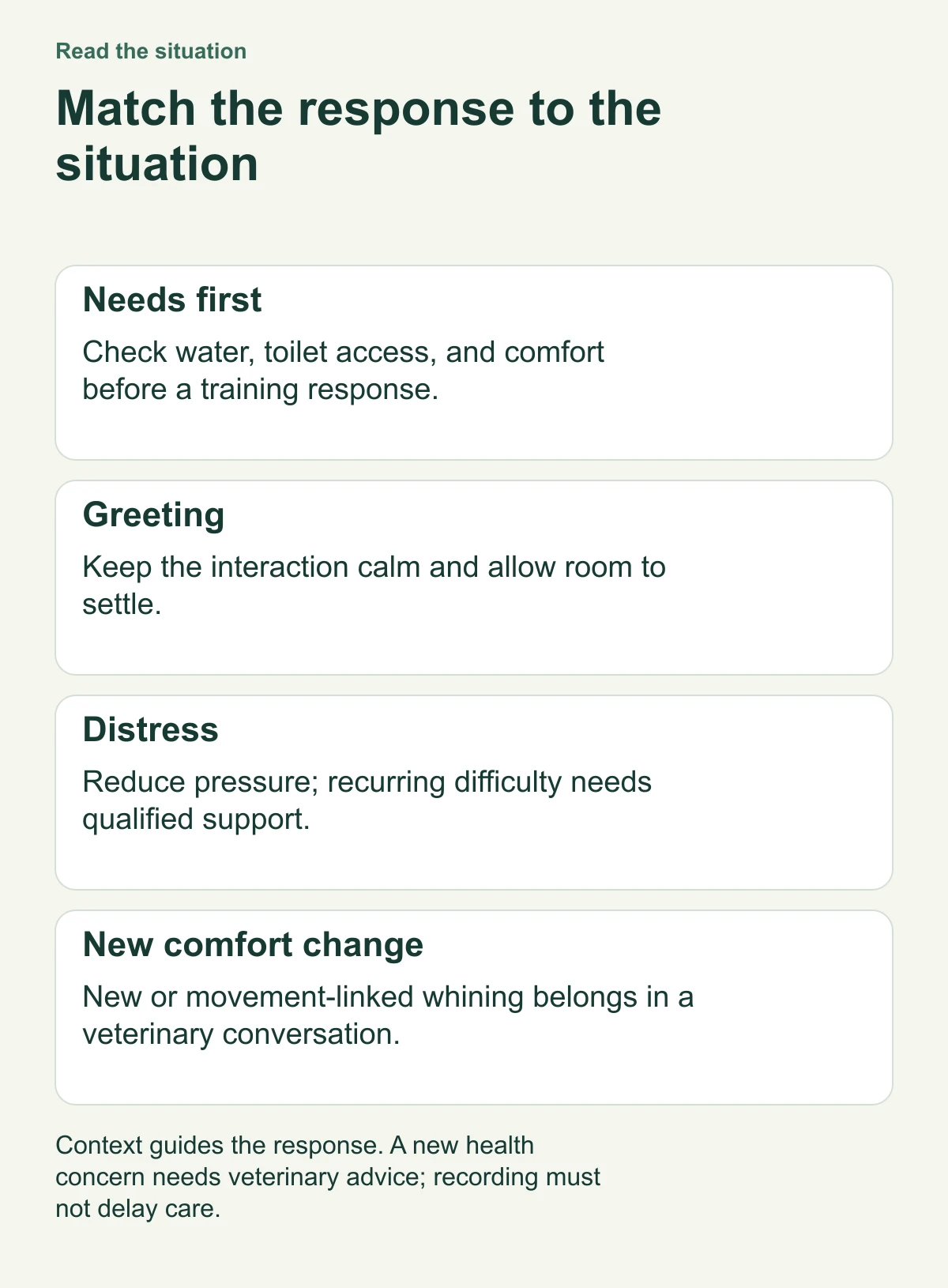
Respond differently to requests, greetings, and distress
During a familiar, comfortable greeting, lower the intensity of your own response. Put bags down without looming over the dog, keep movements easy, and give them time to settle before a lively interaction. If they enjoy carrying a familiar toy, having it available can give the greeting a different focus. Do not push a toy toward a dog who is trying to retreat.
If the dog already knows a simple, voluntary behavior, you can invite it when they are able to respond. A familiar hand target can help organize a greeting, but this is not the moment to teach a new skill while the dog is overwhelmed. Our guide to clear cues and rewards covers that teaching process separately. If your dog cannot engage, simplify the situation instead of repeating the cue louder.
Whining around departure needs another approach. A neighbor's report that your dog cried while alone does not establish separation anxiety, but it deserves attention. Ask when the sound began and whether anyone noticed pacing, scratching at exits, or another change. Arrange support and speak with your veterinarian or a qualified behavior professional if the pattern suggests distress. Leaving the dog longer to see whether they eventually stop is not a useful first experiment.
Notice when a learned request needs a new routine
For an otherwise comfortable dog, a predictable exchange can teach whining as a way to start an activity. Perhaps every work call ends with you retrieving a ball from under the sofa. If the ball becomes stuck repeatedly, block that gap or choose a play area where it stays accessible. Changing the setup can remove the problem without asking the dog to tolerate the same frustration again.
Provide attention and suitable activity before the usual difficult moment. You might have a short play session, allow a toilet break, then offer a familiar resting place while you work. Choose an activity your dog can use safely; a food toy is not appropriate for every dog or every unsupervised setting. This is preparation for one routine, not a promise that more exercise will resolve all whining.
When your dog's needs are met and they can remain comfortable, reward a quiet approach or another simple request before whining starts. If whining has already begun, avoid a loud conversation about stopping it. Check the situation again and make the next attempt easier. A repeated sequence of whine, tiny pause, then immediate play can preserve the original habit rather than teaching a different way to ask.
Keep the goal observable. Look for an easier greeting, a comfortable return to rest, or a quiet approach before a familiar activity. Silence alone does not show that anxiety or discomfort has resolved.
Keep a useful account without provoking another whine
A short note can separate events that otherwise blur together. Write what happened immediately beforehand, where your dog was looking, and what changed after you responded. For example: “Whined beside the gate while the delivery arrived; moved to the kitchen when the gate opened; settled there.” Leave the explanation open rather than writing “jealous” or “stubborn.”
For a familiar, non-distressing sound that occurs naturally, PetMira can record a pet vocalization and provide an AI interpretation. Keep your own context note separately and judge any interpretation against what you actually observed. Do not delay a call about a worrying change, provoke a whine, or keep repeating an upsetting situation to obtain a clearer clip.
If several people care for the dog, use the same basic description. Record when someone already offered food, a walk, or a toilet trip so another person can understand the sequence. The dog health monitoring guide gives a broader method for describing changes in everyday routines without turning a note into a diagnosis.
When whining needs veterinary or behavior support
Ask for veterinary advice when whining starts without an obvious familiar context, increases, or occurs with changes in movement, appetite, toileting, or rest. A dog can still take a treat while uncomfortable, so eating one does not rule out a problem. Describe the first change you noticed and anything that makes the episode better or worse.
Get qualified, reward-based behavior support when greetings or separations remain difficult despite a gentler setup. Tell the professional what your dog can comfortably do now and where the difficulty begins. You do not have to decide whether the cause is fear, frustration, or a learned habit before asking for that help.
A more useful response to the next whine
Check needs and comfort, then use the surrounding event to choose your response. A calmer greeting, easier access, or professional assessment can each be appropriate for a different dog. PetMira may support reviewing an ordinary sound, while your observations and your dog's comfort should guide the next step.
PetMira for everyday care
Keep the situation beside the sound
For a familiar, comfortable moment, use PetMira to record a naturally occurring pet sound. Keep your own context note and treat an AI interpretation as a suggestion.
 Record ordinary pet vocalizations
- Compare interpretations with your observations
- Use general care information for everyday questions
New or worrying whining needs appropriate veterinary advice; recording is optional.
Download iOS App