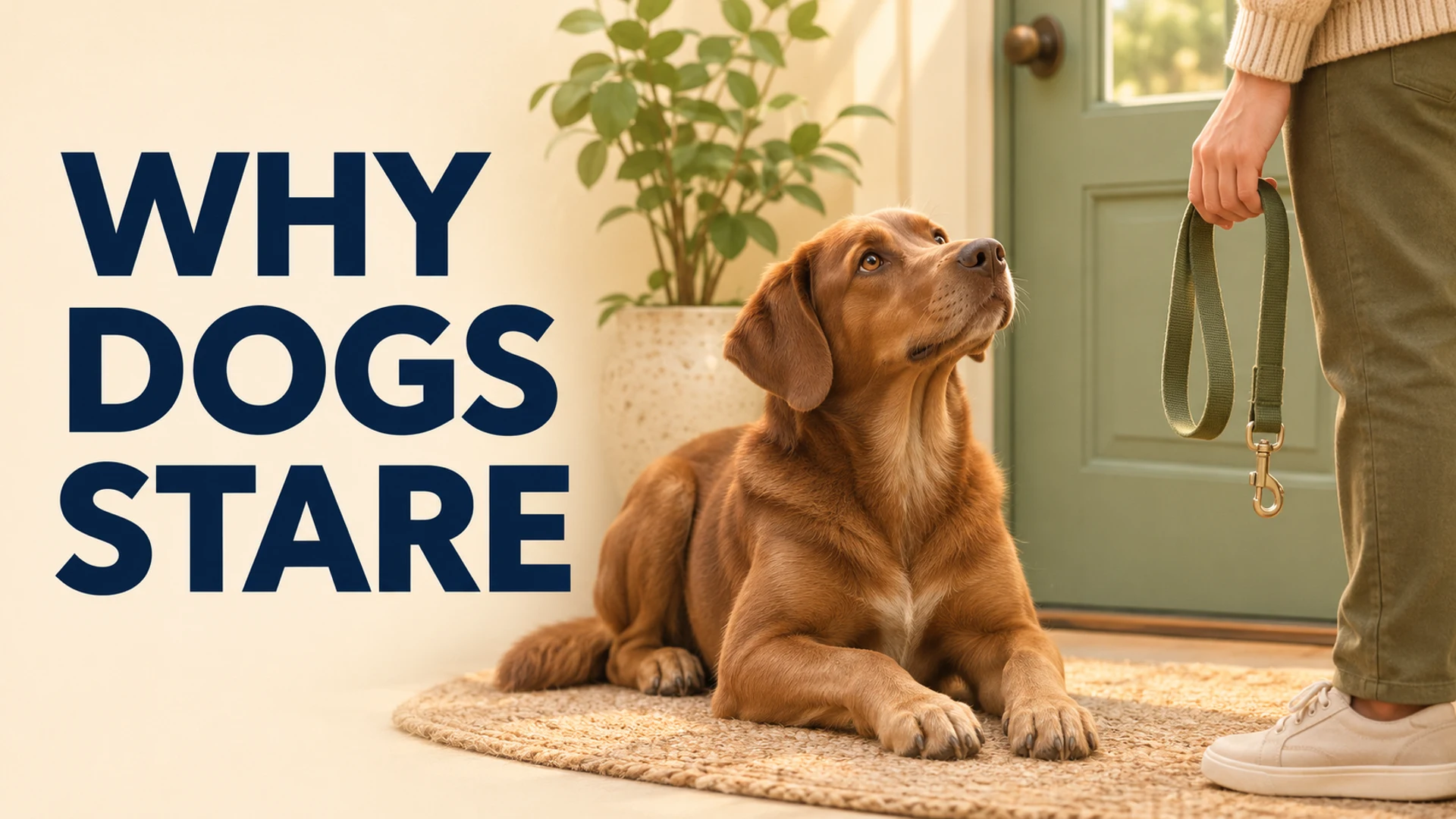
Your dog may stare at you while watching a familiar routine, asking for something, waiting for a cue, or sharing a comfortable social moment. Looking at you can also occur during an uncomfortable encounter. Check the rest of the body and what happened nearby before deciding whether to answer a need, clarify your next action, or make space.
A fixed gaze with a stiff body, especially around food or another valued item, is a reason to stop approaching rather than stare back or take the item. If staring is new and comes with altered awareness, trouble moving, or other signs of illness, contact your veterinarian. That is a different question from an attentive dog watching dinner preparation.
Start with the body and what the dog is watching
Notice where the dog's attention goes. Do their eyes move between you and the door? Are they looking at the hand that normally reaches for the leash? Do they turn their head to keep watching as you move toward a resting place? Describe that sequence before giving it an emotional label.
Then look below the face. A comfortable dog who can change position and look away offers a different picture from one whose body becomes rigid. Being close to you does not establish that a dog wants touch. A dog may be waiting for you to finish something, looking for information, or keeping track of a movement that concerns them.
For the wider posture context, our guide to dog language explains how the eyes, tail, body, and movement work together. Here, the focus is spontaneous looking toward a person, rather than teaching a dog to maintain eye contact on cue.
Everyday reasons your dog keeps looking at you
Dogs can learn the small events that predict an activity. Picking up keys, closing a laptop, or walking toward the food cupboard may become worth watching. If your dog looks at you around a familiar routine, the timing gives you a sensible starting question: what normally happens next? It does not mean the dog understands your entire plan.
A gaze can also be part of a request. Your dog may look from you to an out-of-reach toy or stand near the door around the usual toilet time. Check the practical need before treating the attention as a habit to ignore. If the request is unclear, offer an ordinary appropriate option and notice the response without withholding water, a needed toilet break, or necessary care.
Sometimes a relaxed dog simply watches a familiar person. You can enjoy that company without insisting on an explanation involving love hormones or mind reading. Let looking remain optional. A dog who turns away or changes resting position has not failed a relationship test.
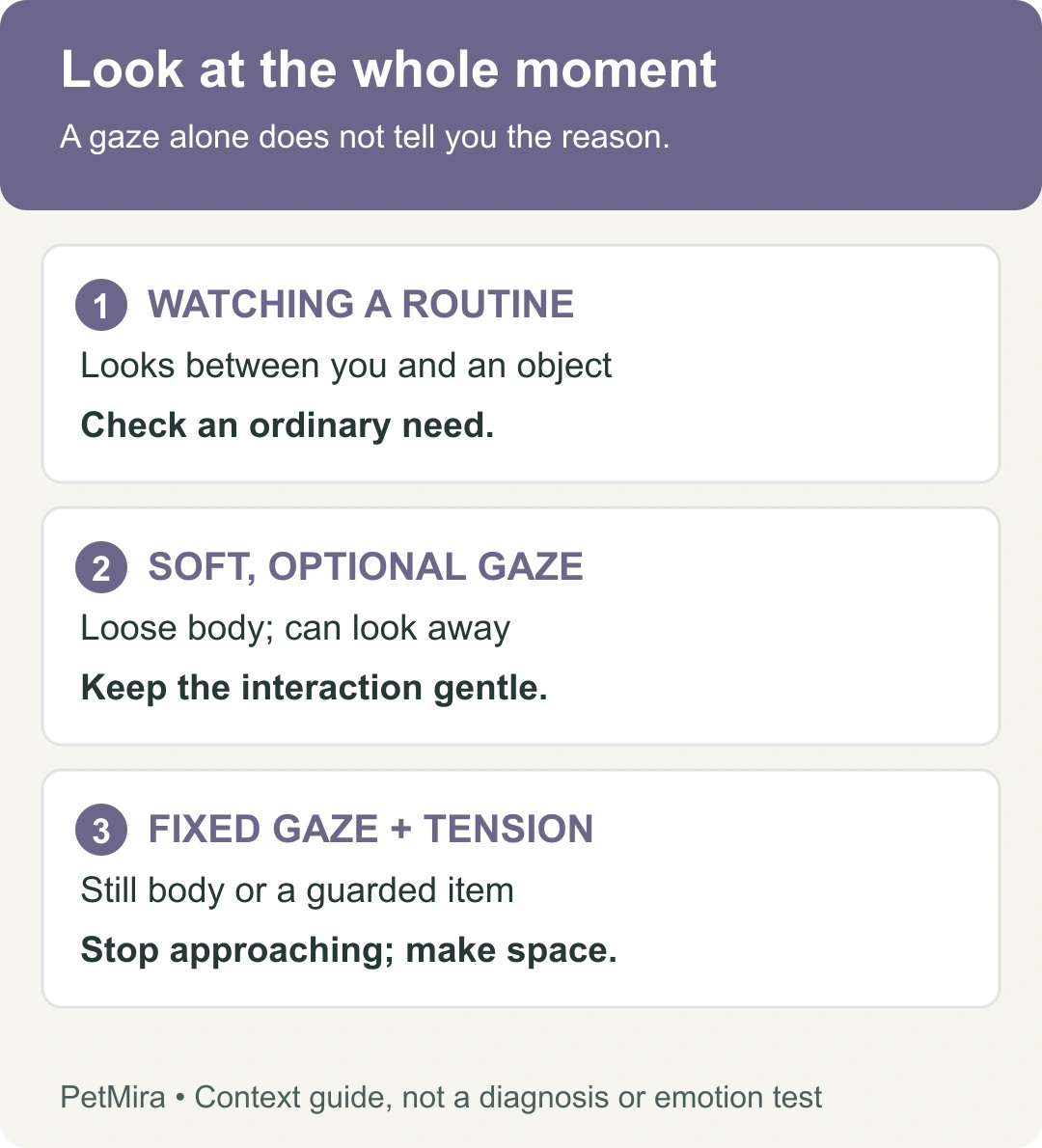
Gaze in context | Check next | Response |
|---|---|---|
Looks from you to the door | Usual toilet routine and movement | Offer an appropriate toilet break. |
Watches while you prepare a walk | Loose body and familiar routine | Give a clear next step. |
Stares while body stiffens | Distance, a valued item, other warnings | Stop approaching; do not take the item. |
New staring with altered awareness | Response and other unusual behavior | Contact your veterinarian. |
The table is a way to choose your next question. It cannot identify the reason for a gaze from a photograph. Keep the setting, body tension, and what the dog does afterward attached to the description.
A soft gaze and a fixed stare need different responses
With a familiar comfortable dog, brief eye contact can fit an easy interaction. You may see loose movement, a relaxed face, and the ability to glance elsewhere. There is no need to hold the dog's face or bring your eyes close to theirs to make the moment more meaningful. Allow the dog to end it.
If a dog becomes very still and watches as you reach toward a bowl, chew, bed, or another valued space, stop the approach. Keep other people and pets away and avoid reaching for the collar or object. You do not need to determine whether the dog is “challenging” you before making the situation safer. A conflict over a resource needs a considered plan, not a contest of will.
Our guide to responding to growling covers the next safety task when a warning sound is involved. Do not wait for a growl before respecting a stiffening body or a dog who is trying to keep distance. If the risk is recurring or exceeds what you can safely manage, seek qualified behavior support with your veterinarian's involvement.
Respond to a request without starting a staring contest
For a routine request, first make your own next step clear. If a walk is about to happen, finish attaching the equipment in your usual calm way instead of repeatedly asking the dog to guess. If you cannot play now, offer a suitable alternative and arrange attention at a time you can provide it. Predictability is more useful than occasionally responding with food because the gaze feels intense.
At your meal, for example, decide on the household routine before the plates arrive. Your dog might have an appropriate nearby resting spot and something suitable to do. Provide normal meals and needed breaks independently of whether the dog stares. Avoid alternating between table scraps and scolding; that changes the rules while leaving the dog to work out which version applies today.
If you want a trained way to ask for attention, teach it separately in an easy setting. Our guide to clear cues explains that process. This article does not require prolonged eye contact as the price of getting a need met. Some dogs are more comfortable looking near a person than directly into their eyes.
Notice a new pattern without testing the dog
Use an event you already see in ordinary life. Write down what the dog was doing, what you were doing, and what happened next. “Watched my hand while I reached for the leash, then walked toward the door” preserves a different sequence from “stood still beside the chew as I moved closer.” The wording helps another household member respond appropriately.
Do not recreate a tense stare by approaching a guarded item or leaning over the dog for a camera. You already have enough information to prevent another close encounter while getting help. A successful change may simply mean the dog can rest where people are not walking through their space.
For a general behavior question, PetMira's AI care Q&A can help you explore possible explanations after you have described the setting. Use observable details rather than asking the app to identify a dog's exact thoughts. An answer can provide background; it cannot tell you that a particular approach is safe or replace an individual behavior assessment.
When staring comes with a change in awareness or comfort
A new vacant-looking episode, difficulty getting the dog's attention in a familiar quiet setting, or an unusual pattern of staring at walls deserves a call to your veterinarian, particularly if other behavior has changed. Describe whether your dog responded normally, how the episode ended, and any changes in movement, appetite, sleep, or comfort. Avoid diagnosing cognitive decline or a neurological condition from an internet description.
Seek urgent veterinary advice if an episode comes with collapse, severe disorientation, seizure-like activity, or breathing difficulty. Do not delay the call to try several cues or collect a more dramatic video. If a clip already exists and was captured safely, ask the clinic how they prefer to receive it.
Keep ordinary requesting separate from these health concerns. A dog watching the snack cupboard is not the same observation as a dog who seems newly disconnected from a familiar activity. Being precise about that difference makes the conversation with your veterinary team more useful.
Answer the situation behind the gaze
Check the dog's body, the nearby routine, and what changes after you respond. Meet an ordinary need, clarify a familiar activity, or create space when the encounter becomes tense. Let eye contact remain a choice, and ask your veterinarian about a new concerning change.
Everyday care with PetMira
Make everyday interactions clearer
Explore care and communication guidance in PetMira, keeping the situation and your dog’s actual response in view.
 Explore the care encyclopedia
- Ask a focused everyday care question
- Use guidance alongside real-world observation
Available on iPhone. AI-generated information is for educational reference.
Download iOS App