

An alley cat is a domestic cat described by where it lives or was found. The phrase does not name a breed. A cat in an alley could be a lost pet, an owned cat that goes out, or a community cat with a familiar outdoor territory. For an adoption profile, domestic shorthair or domestic longhair may be an appropriate description if records do not identify a breed. For a cat you have just found, the more useful question is who already knows it.
Distinguish what the label tells you from what you still need to check. The location tells you where to start asking. A pattern or fur length can distinguish one cat from another. A microchip or confirmed owner can provide history that neither of those details supplies. The order matters because the same gray tabby coat can appear on several cats that use the same courtyard.
What people mean by alley cat
Term | What it usually describes | What to verify |
|---|---|---|
Alley cat | A cat seen or found in an outdoor place | Who has seen or cared for it |
Stray or lost cat | A domestic cat separated from its usual home | Lost-pet notices and chip information |
Community cat | A free-roaming cat living in an area, sometimes with a caretaker | A local rescue or caretaker’s records |
Domestic shorthair | Short-haired household cat category | Hair length and record terminology |
Named breed | A specific registry-defined group | The cat’s documented history |
A community cat and a lost pet can both be wary when approached. Likewise, a cat that accepts food might come from a home or be used to a caretaker. Behavior at one meeting describes that moment. Shelter veterinary guidance notes that a frightening or unfamiliar setting makes socialization hard to assess. Keep your description to observations such as “stayed under a car as people passed” or “walked up to a familiar feeder.” Each observation can help someone who has followed the cat over time.
The label feral generally concerns socialization with people. It is different from living outside. A friendly animal that regularly leaves an owned home may still spend time in the alley. If a shelter or rescue uses the term feral, ask how it was assessed rather than adopting the label from an online photograph. The organization may have prior observations that explain it.
Start with a record someone else can use
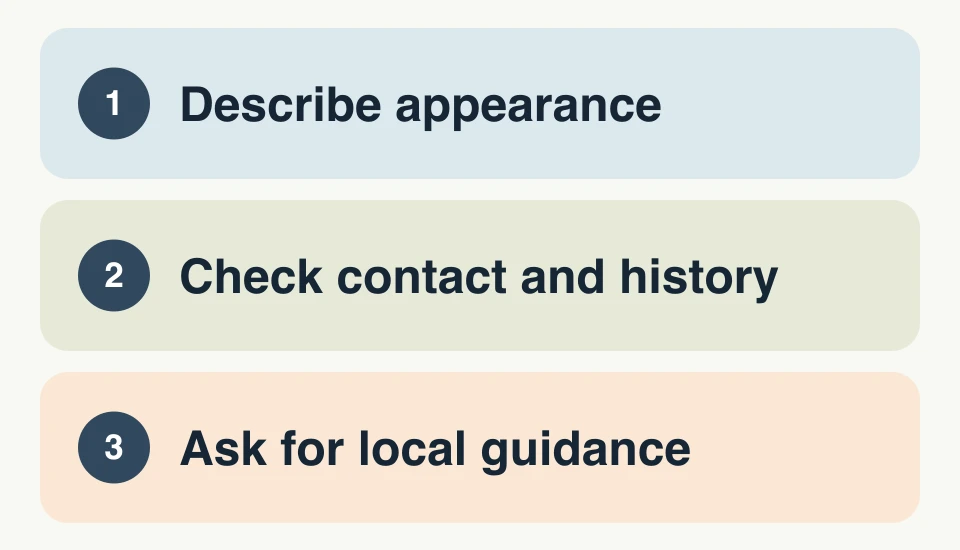
On the first sighting, note where and when you saw the cat, whether it wore a collar, and any features you can describe safely from where you are. A white toe on one front foot, an orange patch over an eye, or a black tail on an otherwise pale cat can help distinguish it. Our guide to describing cat markings can help you choose clear words for these features. Record whether you saw the same markings on both sides. Lighting can make short photos look different from one another.
If the cat is injured, struggling to breathe, or in an unsafe place, contact a local veterinary clinic, animal control, or rescue to ask how to get help safely. An unfamiliar cat can bite or scratch when frightened. Keep your distance, leave an exit open, and let the organization advise on handling. A breed guess adds little in that situation. A precise location and description of what you see are immediately useful.
For a cat that appears well, check local lost-pet listings and ask neighbors or building staff whether they recognize it. A local shelter, rescue, or veterinary clinic can advise on microchip scanning and applicable found-animal steps. A straightforward description or photo can help people match a sighting. When talking to someone claiming a missing pet, ask them to describe identifying marks or share an earlier photo before assuming you have the match.
Photograph a clue from a safe distance If you can see the face, front paws, or tail while the cat stays comfortable, capture those features in one or two clear photos. Skip the picture if you would need to corner the cat.
What an ear tip or collar can tell you
An evenly tipped ear can be a sign of a trap-neuter-return program, where a community cat is sterilized and returned. A jagged edge may instead reflect an injury. Local groups can tell you whether they use ear tipping and know the cat. Keep the exact side and shape in your notes if you can see them. There is no need to handle the cat to inspect the ear.
A collar can suggest a relationship with a household or caretaker, especially when it has readable contact details. Collars can also be lost and may be absent from an owned cat. Treat collar status as a clue. If the cat regularly turns up at the same hour, ask what happens at that time. A nearby caretaker might describe a feeding routine while a neighbor might know the cat’s way home. Both are better sources for tracing an individual than a breed name.
Describe the coat after you check the history
For a rescue or veterinary profile, a useful description could read “adult domestic shorthair, brown tabby with white back feet, found near the loading door on Monday.” If facts emerge later, add the evidence and keep the original observation. Write breed unknown if the record gives you no verified name. If someone prefers to include an estimate, write where it came from and use wording that conveys the uncertainty.
Once the cat is safely in someone’s care, a photo can help compare its appearance with domestic breed profiles. PetMira’s iPhone app offers possible breed suggestions from a cat photo. Leave ownership, socialization, and official identification to the evidence you collect from neighbors, records, and a veterinary or rescue team. For more on the breed side of the question, read how to identify a cat breed using photos and records.
If several cats use the same area, keep one observation per animal instead of adding every sighting to the first record. Two black cats can look similar at dusk. One may have an intact left ear and a thin white mark below the chin, while the other may have a flat ear tip. If you are unsure whether you saw the same cat again, say so in the note. That lets a rescue compare the records without relying on you to make a definitive identification from a single brief glimpse.
For a found kitten, ask a local rescue how to judge the situation before moving a healthy litter from its location. Share the setting and whether you have seen an adult cat nearby. The kittens’ coat patterns can help the rescue keep the litter’s records straight, while age, condition, and the mother’s presence matter more for the immediate decision.
The label to use
Call the cat a domestic cat when you only know how or where it was found. Add visible characteristics and a time and place rather than choosing a breed based on resemblance. If you need to decide how to help, check for a known caretaker or owner and let the local shelter, rescue, or veterinarian guide the next step.
Compare appearance after the cat is safe
Compare breed clues after the cat is safe
Once a found cat is safely in someone’s care, use a clear photo in PetMira for iPhone to compare possible domestic breed matches.
 Compare visible coat and body features
- Keep appearance separate from ownership clues
Follow the shelter’s or veterinarian’s guidance for microchip and ownership checks.
Download iOS App