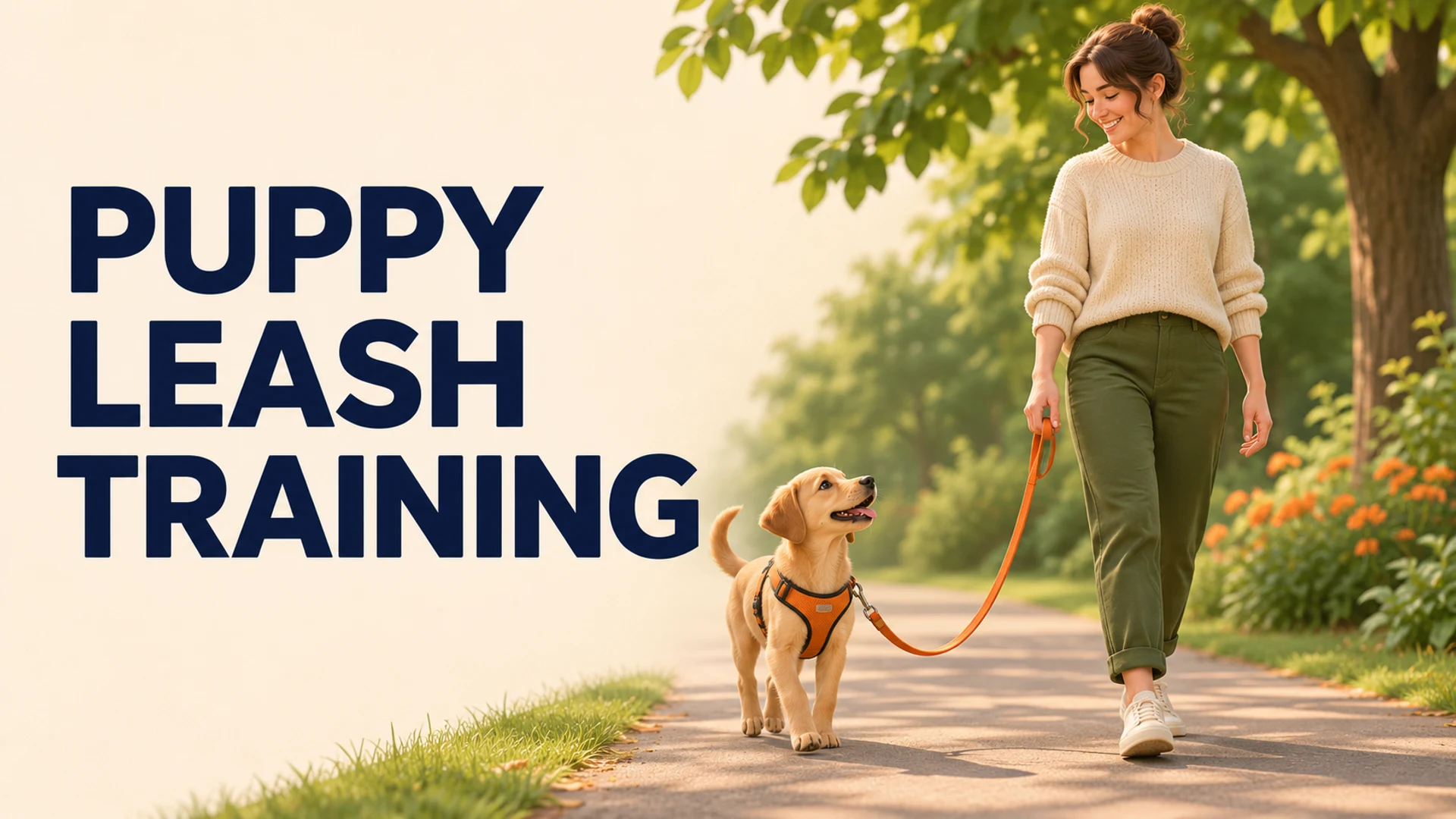
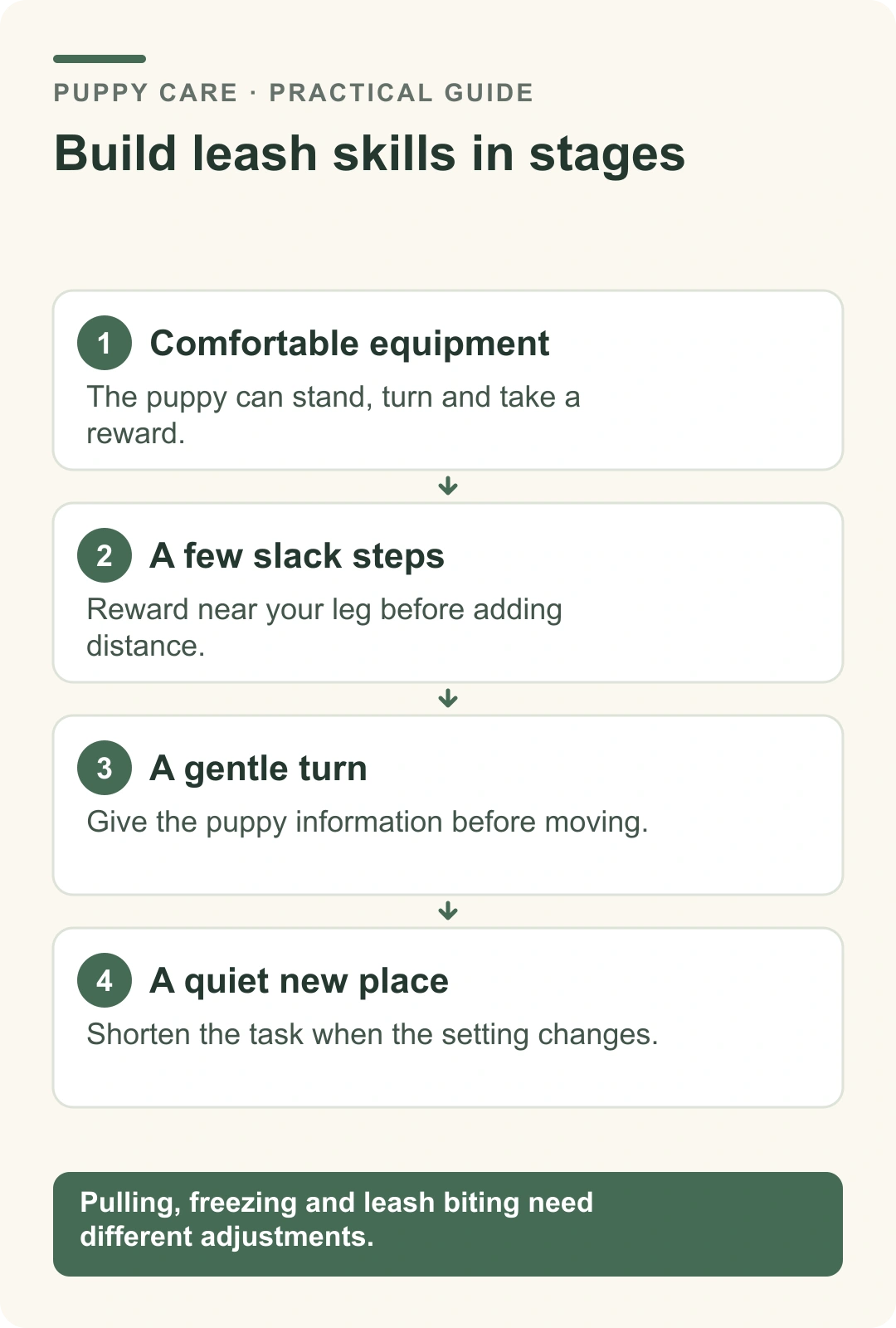
Start puppy leash training with comfortable equipment and a few easy steps in a quiet place. Reward your puppy for moving near you while the leash hangs loosely, then build turns and new locations gradually. A puppy does not need to march beside your knee for the entire outing: the practical goal is moving together without pulling, dragging or constant correction.
This plan is for a puppy who can move comfortably. Stop and seek veterinary advice for a sudden reluctance to walk, limping, breathing difficulty or signs of pain. If the puppy panics, freezes or repeatedly tries to escape the equipment, lower the pressure and get qualified help rather than pulling them through it. Ask your vet which outdoor locations are appropriate for their vaccination status and local disease risk.
Define the first walk you are actually teaching
Separate three milestones: wearing equipment comfortably, following a short slack-leash route, and coping with an outside outing. A puppy can learn the first two at home before they are ready for a busy pavement. This keeps the first lesson from also becoming the first experience of traffic, unfamiliar dogs and a harness all at once.
Choose a clear area with secure boundaries and a surface that is easy to walk on. Put a few suitable rewards within reach, taking them from the puppy’s feeding allowance where appropriate. Decide where you want to deliver them: low and near your leg, without asking the puppy to jump or cross directly under your feet. Keep the route short enough that you can focus on the leash and the puppy together.
Agree on one simple movement cue, such as “let’s go,” and one marker word that predicts a reward. If cues are new to the household, our guide to talking to dogs explains how to keep their meaning consistent. Here, the cue belongs to walking together; it is not a demand to stop looking at the environment.
Make the equipment comfortable before moving
Use equipment that fits securely without restricting normal movement. A suitable harness can avoid pressure on the neck if the puppy reaches the end of the leash, but no design replaces checking the fit. Ask the veterinary team or a qualified trainer for help if you are unsure. Recheck as the puppy grows instead of assuming last month’s adjustment still works.
Let the puppy investigate the equipment, then introduce wearing it in manageable steps. Reward a relaxed response to a small part of the process and pause before adding another. A puppy who avoids putting their head through an opening may need a different introduction or harness style. Do not trap them in the equipment and wait for the struggle to stop.
Attach a lightweight, ordinary fixed-length leash and supervise closely. Hold it so it cannot catch furniture, wrap around legs or become a dangling toy. Never leave a puppy unattended with a trailing leash. Before asking for movement, check that they can stand, turn and take a reward comfortably while the equipment is present.
Reward a few steps with a slack leash
Begin beside the puppy. Mark and reward a voluntary glance or movement toward you, then take one or two unhurried steps. When the puppy follows and the leash remains loose, mark that moment and deliver the reward near your leg. Stop briefly, let them finish eating, and begin another tiny stretch. At first, a successful journey may be across only part of a room.
Keep your reward hand predictable. If you wave food high above the nose, the puppy may bounce; if you reach across your body, they may weave into your path. Adjust the delivery position before assuming the puppy is deliberately getting in the way. Reward while they are where you want them, then reset with enough space to move safely.
Gradually join a few steps together when the puppy is moving easily. Give the movement cue just before you set off, rather than repeating it continuously during the walk. End while the puppy can still participate. The AKC’s puppy leash-training guide also distinguishes ordinary loose-leash walking from a formal heel; you are teaching a useful everyday skill, not a competition position.
Introduce a turn before the leash tightens
On an easy stretch, make a small direction change while the puppy is still near you. Get their attention, give your chosen turn cue if you use one, and move in a gentle curve. Reward them for following. This gives the puppy information about your movement before a tight leash abruptly supplies it.
Choose space for the turn instead of spinning over the puppy or sweeping the leash around their body. If they stop, pause and invite an easier movement rather than pulling. Practice both your own footwork and their response: a handler who walks too quickly or changes direction without warning can make the same route needlessly difficult.
Treat pulling, stopping and leash biting as different problems
If the puppy pulls toward something, stop advancing when it is safe to do so. Invite them back to an easier position or take a calm route away from the distraction, then reward the loose-leash movement you can achieve. Avoid repeatedly letting tension carry them to the object and then correcting them for it. Plan more distance before the next attempt.
A puppy who plants their feet or crouches may need time, a quieter location or help with the equipment. Check what changed: a new surface, a loud vehicle or a strap rubbing the skin. Do not turn every refusal into a contest to complete the route. A sudden or persistent change in movement belongs with your veterinarian, and fear that repeatedly prevents outings deserves individual training support.
For leash biting, reduce the swinging length near the puppy’s mouth without making the leash tight. Offer a suitable separate activity and simplify the session; do not start a tug game with the lead. If the puppy is already too excited to move calmly, finish in a safe area. Keep the broader puppy mouthing plan separate from the mechanics of holding a leash.
Use distance before repeated cues If your puppy cannot turn away from a distraction, move to a safer, quieter starting point. Repeating the walking cue beside the same trigger does not make the setting easier to learn in.
Take the skill outside without changing everything
Choose a quiet, appropriate place and begin again with the version your puppy found easy indoors. Reward a few nearby steps, allow a pause and notice whether they can take food and move freely. Outside, familiar smells and sounds can be a large change even when the route seems boring to you. Shorten the walking task rather than expecting the indoor distance immediately.
Give safe opportunities to sniff and explore without requiring eye contact throughout. You can invite a short “walk with me” stretch and then allow a sniffing break. Our puppy socialization guide handles positive exposure to people, animals and places; the walking lesson does not require greetings or approaching something that worries the puppy.
PetMira’s care encyclopedia can help you prepare a small everyday training question, such as how to make equipment introduction more manageable. Use that reading to plan one change for the next session, then judge it against the puppy you observe. An AI answer cannot check harness fit, evaluate pain or provide the individual feedback needed when a puppy is frightened or a handler feels unsafe.
Finish with a next session you can repeat
Choose the next easy milestone: a comfortable harness, a few slack steps or a quiet turn. Keep that goal small enough to reward clearly, and use PetMira’s everyday care guidance for preparation when useful. Progress comes from a manageable setup and a puppy who can participate, not from finishing a route through tension.
Everyday care with PetMira
Prepare the next easy walking lesson
Read PetMira’s care encyclopedia and ask a focused everyday training question before choosing one manageable change for your next session.
 Explore the care encyclopedia
- Ask a focused everyday care question
- Use guidance alongside real-world observation
Available on iPhone. AI-generated information is for educational reference.
Download iOS App