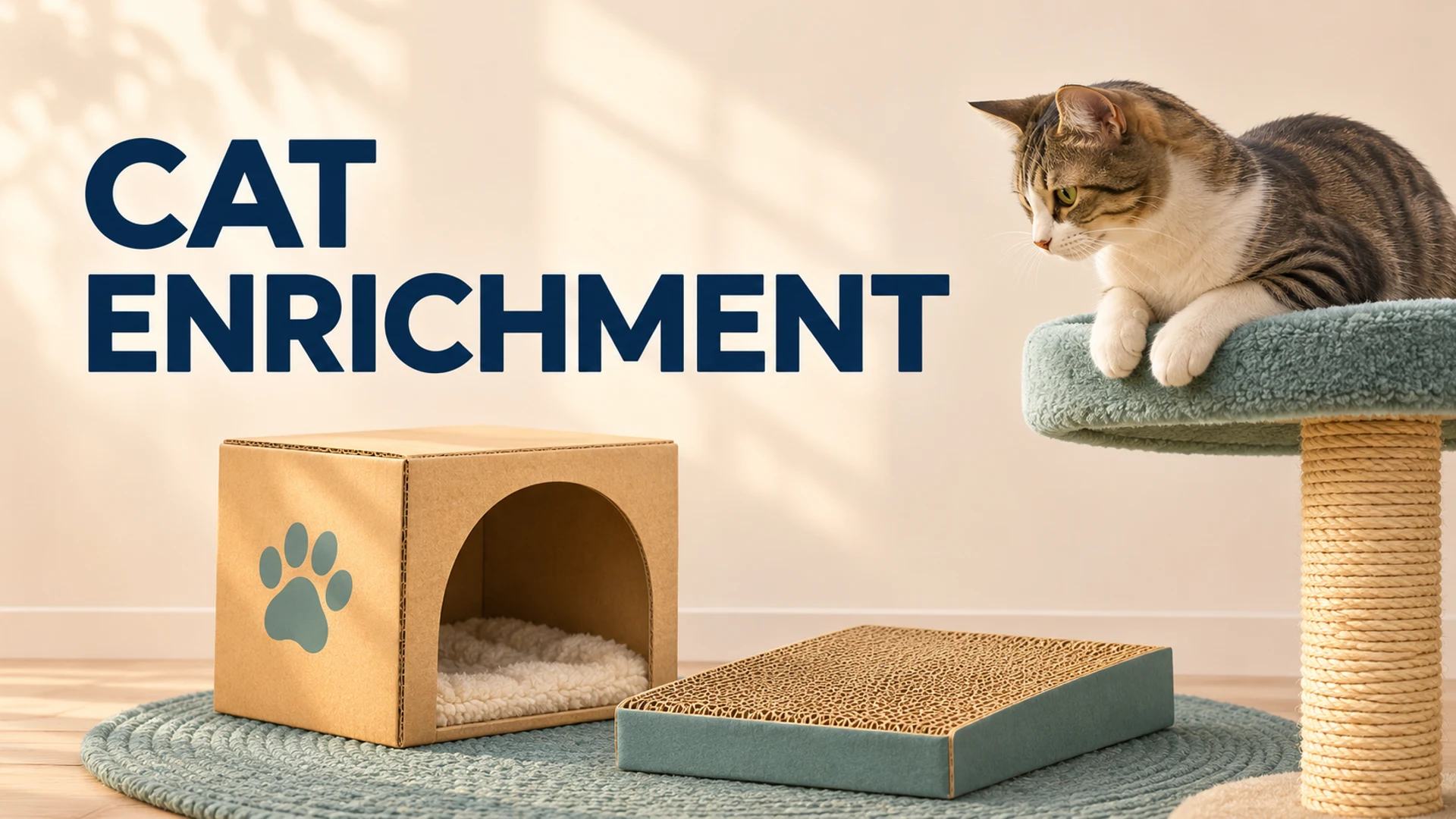
Cat enrichment means giving your cat usable opportunities to explore, scratch, rest, play and work for food in ways that suit the individual. Start by checking whether they can comfortably reach the resources already at home. Then add one manageable choice, such as an easy food puzzle or a stable resting place with a view, and watch whether the cat actually uses it.
More equipment does not automatically create a better environment. A room can contain an impressive cat tree and still offer no quiet route to water. This guide is an audit of everyday access and variety for an indoor home; it is not a shopping list or a promise that enrichment alone will resolve illness, fear or conflict.
Start with access before adding entertainment
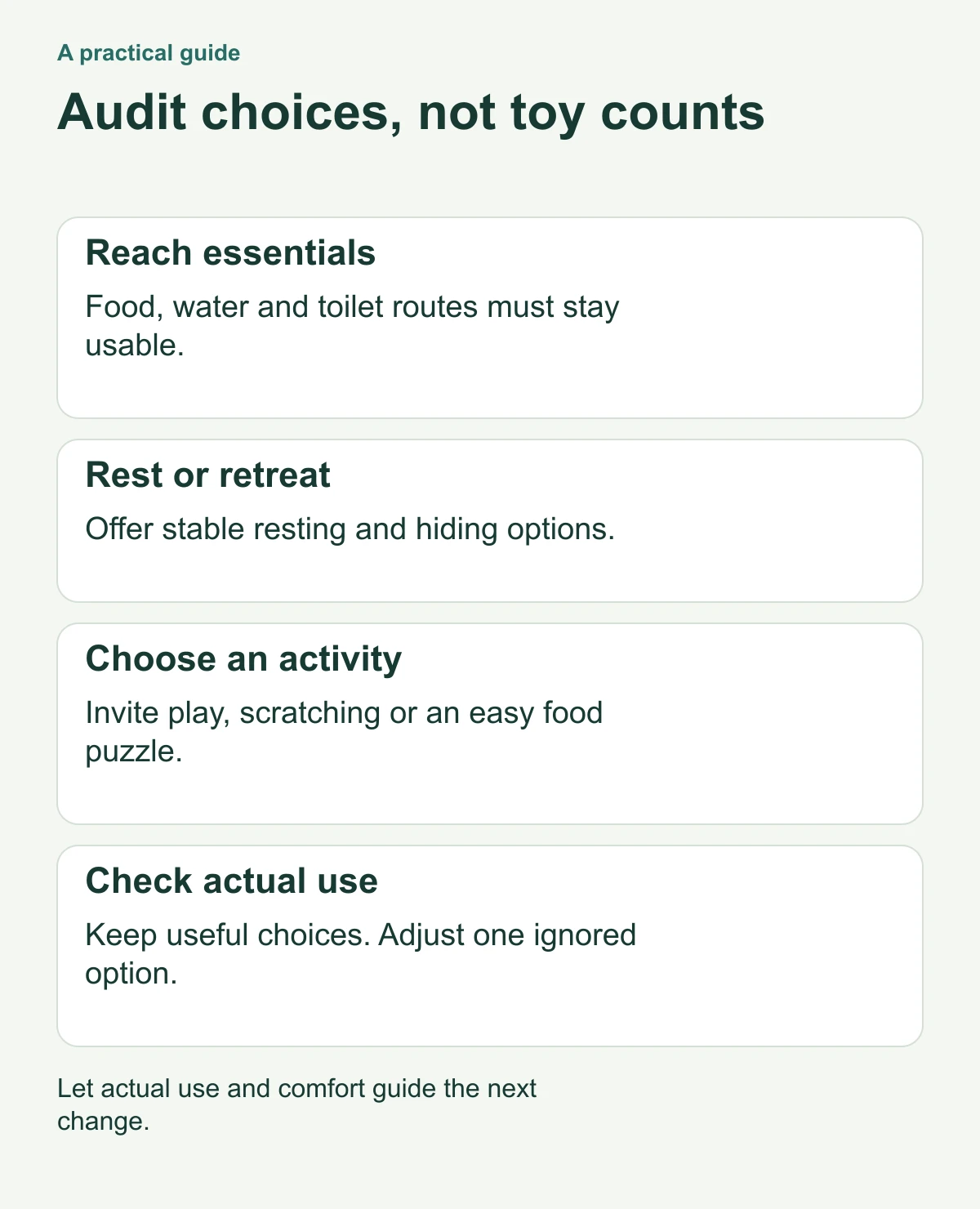
Walk through the home from your cat's height. Notice the routes between resting places, food, water and litter boxes. Is a door regularly shut across a necessary path? Does another animal settle in the only doorway? Is a surface slippery where your cat needs to jump? Fixing an obstacle can change what the cat is able to choose before you buy anything new.
Look for actual use rather than presence. A bowl may be available on paper while one cat waits until another leaves the kitchen to drink. A high perch may exist but require a jump your older cat no longer attempts. Offer accessible alternatives and discuss a new reluctance to move or jump with your veterinarian. An environmental adjustment can support access without establishing why movement changed.
For a newcomer, keep familiar essentials predictable while they learn the space. Open more of the home when the individual is ready rather than presenting every room and activity at once. Our first-week kitten care guide covers the younger newcomer's basic setup. An established adult needs their own assessment of what already works and what has recently become difficult.
Give rest and observation different places
A hiding place and a lookout serve different moments. An open box on its side can provide cover; a stable perch can let a cat observe without joining activity on the floor. Offer options the cat can approach and leave. Keep the entrance of a hide clear, and avoid repeatedly reaching inside to check whether the cat likes it.
Choose height around access and stability, not the tallest item you can fit. A secure lower platform with an easy approach can be more useful than a high shelf with a difficult landing. Check the route down as carefully as the route up. Do not place a resting area where a door swing, wobbling furniture or a passing dog makes it unreliable.
A window can provide interest, but watch what happens at that particular view. One cat rests comfortably; another repeatedly becomes tense when an outdoor cat appears. Move or partly screen the view if it is making the setting harder to use, and seek help for persistent distress. Windows and screens must remain secure; an interesting view does not require an open escape route.
Home feature | Check actual access | First adjustment |
|---|---|---|
Rest and cover | Can this cat enter and leave without being blocked? | Offer a stable alternative with a clear route |
Food puzzle | Does the cat succeed and still eat enough? | Reduce difficulty and preserve normal feeding |
Scratch and play | Does placement match a route or active period? | Move one optional invitation, not all essentials |
Shared space | Does one animal wait for another to leave? | Spread usable options across separate areas |
Make food puzzles easy enough to use
Begin with a small part of the cat's usual food allowance in an easy, cleanable puzzle suited to that food. Show that food is available without making access difficult. The cat should be able to succeed while learning how the object works. Continue the normal feeding plan and check that enough food is actually eaten, particularly when more than one animal shares the room.
A homemade idea needs the same scrutiny as a purchased toy. Remove staples, loose tape, sharp edges and pieces that could be swallowed. Supervise the first attempts and put the object away if your cat chews or dismantles it. A simple safe arrangement that stays intact is more useful than an elaborate puzzle requiring constant rescue or presenting a swallowing risk.
If your cat has a prescribed diet, appetite concerns or difficulty handling the food, ask your veterinary team before changing delivery. Do not make meals dependent on solving a puzzle the cat avoids. Keep a familiar route to food while you try a separate low-pressure invitation. The result you want is voluntary investigation with appropriate intake, not hunger overcoming reluctance.
Rotate the invitation, not the entire home
Try one small change at a time. Offer a different suitable toy, move an optional play object into a quieter area, or introduce a clean box with an easy entrance. Leave valued beds, essential resources and familiar routes available. Variety becomes less useful when every comfortable place disappears whenever you decide to refresh the room.
Match activities to how your cat engages. A floor-level chase, a scratching surface and a food-search opportunity use different actions. Interactive play is one part of enrichment, not its whole definition. If you try a toy game, let your cat watch and catch rather than expecting continuous running. Put string and wand toys away afterward, and inspect any independent-play items for damage.
Notice when no extra activity is the better choice. A cat sleeping in a favored spot does not need to be interrupted each time a new toy arrives. Offer the option later and observe whether the animal returns to it. If apparent disinterest is new across normal activities, contact your vet rather than labeling it boredom and escalating novelty.
Build a plan for one cat in a shared household
List where each cat rests and which paths they use, rather than assuming shared ownership means shared access. A second sleeping place beside the first may still leave both in the same guarded corner. Spread usable options so an individual can move away without having to pass the other animal. Watch ordinary transitions such as somebody preparing food or opening the bedroom door.
Keep social interaction optional too. Some cats enjoy brief company and then leave; others prefer sitting nearby without touch. Children and visitors can help by leaving hide entrances and travel routes clear. The cat language guide explains how a pause or withdrawal can change your next move. Offering a choice only works when people allow the cat to decline.
If the household is introducing a new kitten, use a staged relationship plan rather than expecting more toys to solve tension. Our kitten-to-cat introduction guide covers separation and gradual contact. Resources support that process, but they do not make a forced meeting comfortable or guarantee that the cats will become close companions.
Choose the first change and check what happened
Pick a practical target: one cat using an accessible resting place, investigating an easy puzzle, or reaching a scratcher beside a usual route. Compare what happens before and after one adjustment under ordinary conditions. If the cat ignores the object, check placement, difficulty and competing activity. Do not assume the solution must be a more expensive version.
PetMira's care encyclopedia and AI Q&A can help you turn a vague request for enrichment into a specific planning question, such as arranging low-level choices in a small room. Keep the answer separate from your observations of actual use. The app does not verify that a home is suitable or diagnose the cause of avoidance; persistent withdrawal, appetite changes or uncomfortable movement need veterinary advice.
Keep the home interesting without making it unpredictable
Start with clear access, then offer a choice your cat can use or ignore. Preserve comfortable familiar places while you test one new activity, and judge it by voluntary use and the wider daily routine. A smaller set of accessible, well-used options is a sounder plan than a crowded room with no easy route through it.
Everyday care with PetMira
Plan usable choices at home
Use PetMira’s care encyclopedia and AI Q&A to explore an everyday enrichment question, from an accessible resting place to an easy activity.
 Explore the care encyclopedia
- Ask a focused everyday care question
- Use guidance alongside real-world observation
Available on iPhone. AI-generated information is for educational reference.
Download iOS App