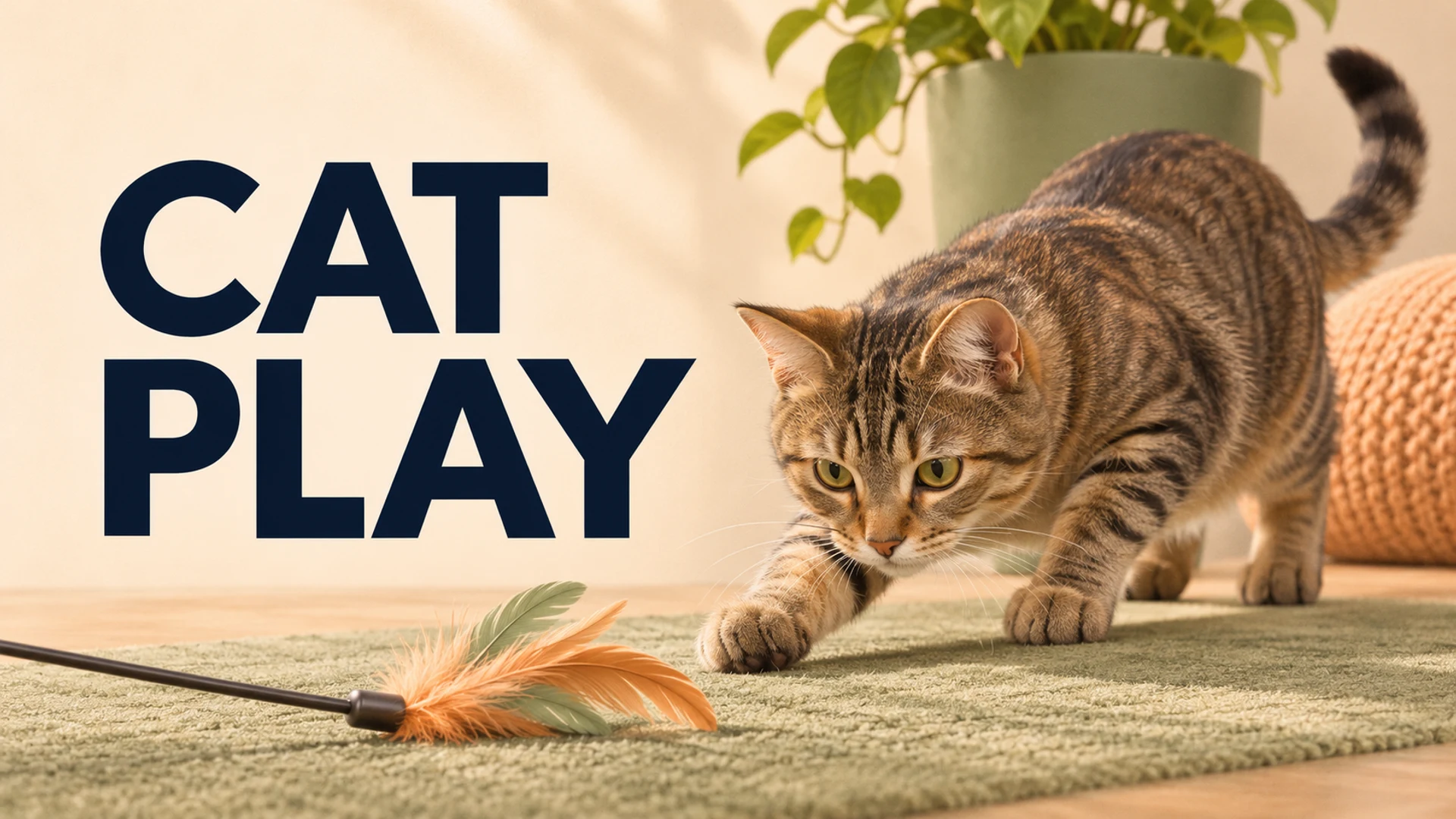
To play with a cat, move a suitable toy like something they can watch, stalk and catch, keeping your hands out of the target. Pause often enough for your cat to make a choice, allow real catches, and end while the game is still manageable. A successful session can include plenty of watching and very little running; the aim is engaged, comfortable play rather than exhaustion.
Start with a cat who is comfortable moving around normally. A sudden loss of interest, a new reaction to movement or touch, or a change in appetite deserves veterinary advice. Stop activity and seek urgent veterinary care for breathing difficulty or collapse. A play routine cannot explain away a cat who seems unwell.
Choose a safe target and an easy playing space
A wand toy gives you distance between your fingers and the object your cat catches. A larger soft toy can suit a cat who likes to hold and kick, while a rolling toy may appeal to one who follows movement along the floor. Inspect the whole item before use. Loose eyes, damaged seams, exposed wire and fraying attachments change an ordinary toy into something you should put away.
Clear enough floor space that your cat can turn without colliding with furniture or landing on clutter. Choose a surface where they have traction. Keep the game away from a busy doorway, hot drinks and another animal's resting spot. A quiet strip of floor can offer a better first attempt than the biggest room if the larger room is full of distractions.
Let the cat approach or watch from a familiar position. Do not wave the toy directly into their face or pull them from a resting place to begin. If you are teaching children to take part, an adult should control the toy and show them how far away to keep hands. The cat needs a route out of the game as well as a route toward the target.
Move the toy so your cat can make a plan
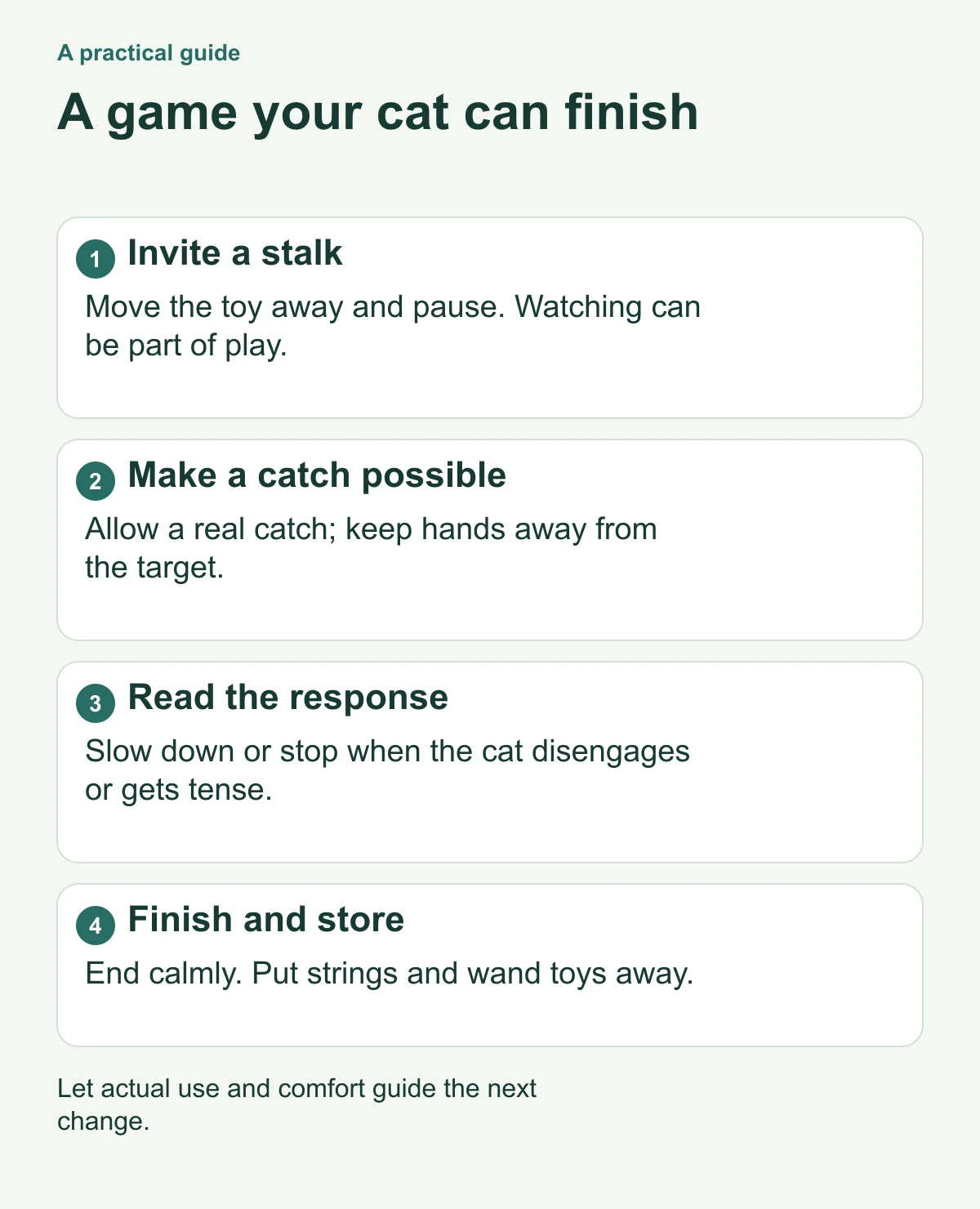
Try sliding the target away from your cat, pausing beside an open box or just beyond a piece of furniture. Watch for a turn of the head, focused attention or a slow approach. Those actions can be the beginning of play. Constantly flicking the toy faster may remove the moment in which the cat was preparing to pounce.
Make the first catch easy. After the cat reaches the toy, stop pulling long enough for them to hold it. Reset when they release or move away rather than tugging it through their mouth. Some cats enjoy several small bursts; others spend most of the game tracking one slow movement. Change the speed in response to the animal you are watching, rather than completing a routine of your own.
Compare two attempts. In one, the toy circles high above the cat and never comes within reach. In the other, it crosses the floor, stops and can be caught. If the second produces more comfortable engagement, keep that feature. You have learned something about the available game, not proved that your cat is lazy or incapable of playing.
What happens | Change for the next attempt | A useful result |
|---|---|---|
Watches without moving | Slow the toy and add a pause | The cat can track or approach voluntarily |
Fingers become the target | Increase distance from hand to toy | Paws and teeth follow the object |
One cat takes every turn | Offer separate quiet sessions | Each cat has an opportunity to engage |
Interest fades or movement gets tense | End sooner and reduce intensity | The cat can leave and settle |
Change the game when your cat only watches
Before buying another toy, change one part of the presentation. A cat who ignores a dangling target may follow it on the ground. One who loses interest on an open floor may watch when the target briefly disappears behind a box. Keep the object visible again soon enough to follow; the purpose of cover is to create an invitation, not a frustrating search.
Offer play when your cat is naturally awake and interested. A cat who has just settled for sleep may decline without anything being wrong. Try again at another ordinary active period and compare the response. If movement is difficult, ask your veterinarian what activity is suitable. Keep any approved game low and accessible instead of expecting repeated jumps to demonstrate enthusiasm.
Do not keep raising the intensity to get a reaction. A cat who looks away, leaves or becomes tense has given you a reason to pause. Our cat language guide explains reading the whole sequence rather than one expression. Quietly ending an invitation can be the right response even when the toy is new and you hoped for more.
Keep teeth and paws on the toy
Hands under blankets and moving toes make memorable targets, but they create a confusing rule when you later want skin left alone. Keep the exciting movement on an appropriate object from the start. Hold the wand so your hand stays well away from the catch, and move your feet out of a likely pounce path before the cat commits.
If the game shifts toward fingers or ankles, stop the movement you can safely stop and give the cat space to disengage. Avoid wrestling, spraying water or deliberately startling them. Arrange a calmer next attempt with more distance between you and the toy. For a young cat who repeatedly targets skin, the kitten biting guide covers that separate problem in more depth.
Reset before the next grab If your cat repeatedly catches your hand beside the toy, change the distance and target before restarting. Do not turn each nip into an immediate, more exciting chase.
Finish before the game becomes frantic
Allow a final manageable catch, then slow and end the interaction. Avoid suddenly snatching the toy from a cat who is gripping it. Wait for a safe release or disengagement, keeping your hands out of the mouth and paws. A cat who becomes tense over the object needs space and a different setup next time, not a contest to show who controls the toy.
Put string, ribbon and wand toys away after supervised use. Keep any toy left out appropriate for independent play, and check it again after wear. Take the cleanup seriously in a shared home: a visitor who finds the wand on the sofa may assume it is safe to leave with the cat. Choose a storage place everyone can use after the game.
There is no need to extend the session until your cat is panting or cannot continue. Finish earlier if the movement becomes poorly controlled, the cat repeatedly misses the toy, or either of you is no longer enjoying the interaction. Count a calm ending as part of the game you are teaching, rather than an interruption of its most exciting moment.
Fit play to the cat in front of you
In a multi-cat home, check who actually gets to follow the toy. One confident cat may take every turn while another watches from an exit. Offer separate opportunities when needed and avoid making both animals compete for a single catch. A cat who plays willingly in a quieter room has shown that the social setting mattered.
Use PetMira's care encyclopedia or AI Q&A to organize a specific everyday question, such as how to offer a lower-intensity toy game in a small apartment. Compare the suggestion with your cat's actual response. An AI answer cannot assess pain, breathing changes or the safety of an escalating interaction, so those concerns belong with your veterinary team or a qualified feline behavior professional.
Make the next session easier to repeat
Keep the useful parts: a suitable target, room to move, a chance to catch and a finish your cat can manage. Change one feature when interest fades, and let watching or walking away count as information. A repeatable, comfortable game gives you a stronger starting point than trying to make every session longer or faster.
Everyday care with PetMira
Plan a game your cat can join
Explore PetMira’s care encyclopedia and AI Q&A for everyday play ideas, then adjust them to the cat in front of you.
 Explore the care encyclopedia
- Ask a focused everyday care question
- Use guidance alongside real-world observation
Available on iPhone. AI-generated information is for educational reference.
Download iOS App