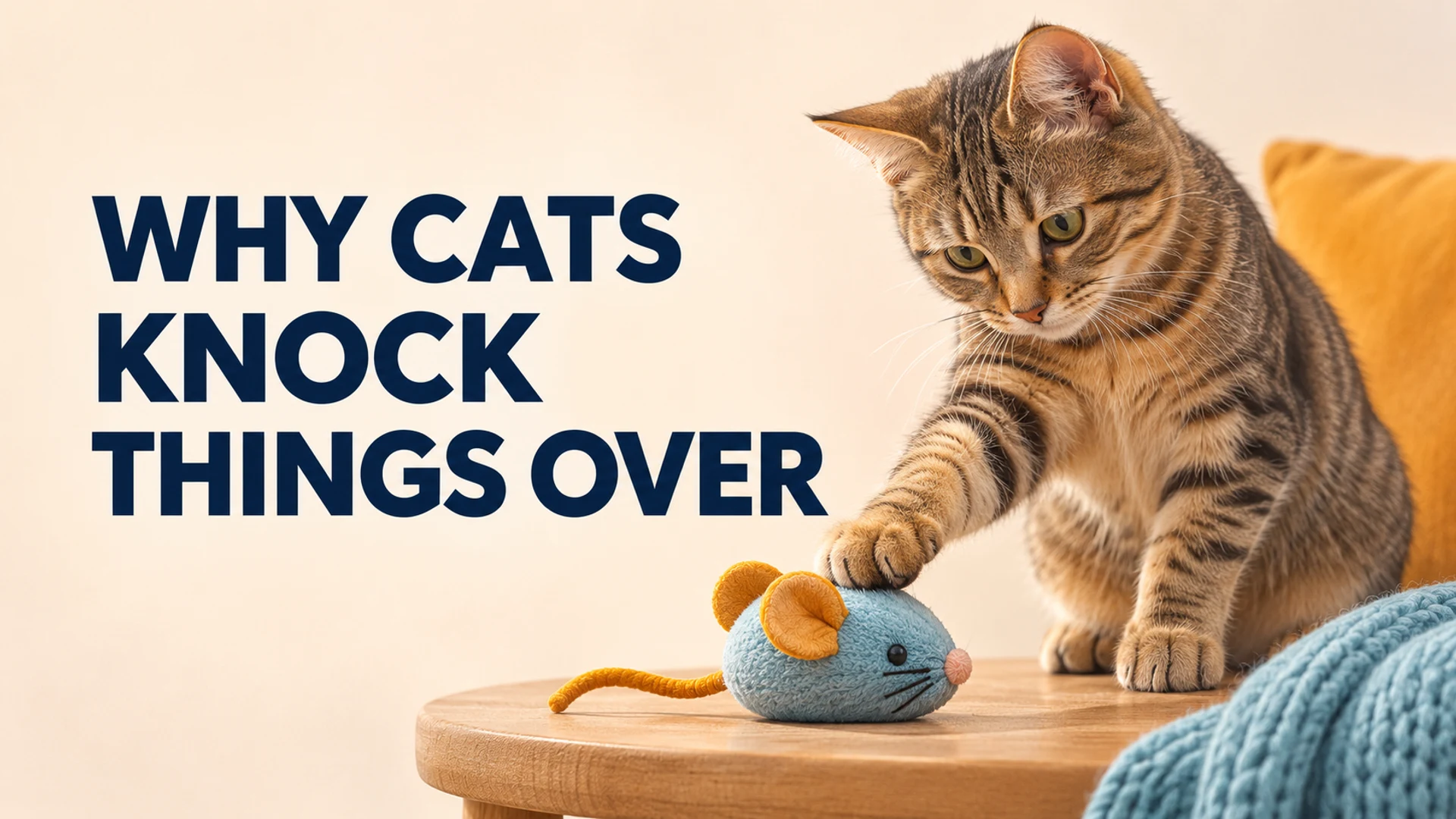
Cats may knock things over while investigating with a paw, following a moving object, seeking an interaction they have learned to expect, or simply navigating a crowded surface. A deliberate swipe does not prove spite. Remove fragile or hazardous objects first, then look at the sequence and provide a safer activity before the usual incident happens.
Deal with consequences before analyzing motivation. Keep the cat away from broken glass, hot spills or dangerous materials, and contact your veterinarian promptly if injury, poisoning or swallowing an object is possible. Do not wait for symptoms or an app answer when you suspect an exposure. For ordinary safe incidents, the useful work usually happens in the setup before the next swipe.
Separate the paw swipe from a crowded route
Watch what you actually saw. Did a paw reach toward an object, did the object move after a nudge, or did the cat's body bump it while passing? Those are different observations. A shelf full of ornaments may provide too little space for a cat to turn, while an otherwise clear desk can offer a movable item that attracts repeated attention.
Notice what changed just before the incident. A newly placed object, a moving cable or an open route to a familiar high spot may explain why the area became interesting. That timing does not tell you exactly what the cat intended. Keep curiosity, play and a learned response as possibilities rather than assigning one motive to every fallen item.
Compare a low-risk example without setting a trap. If a cat bats an appropriate toy on the floor and follows it when it rolls, you can offer that kind of movement in a safer place. There is no need to leave a glass on an edge to discover whether they will push it. Prevention should not require another breakage as a demonstration.
Remove the consequence that can hurt someone
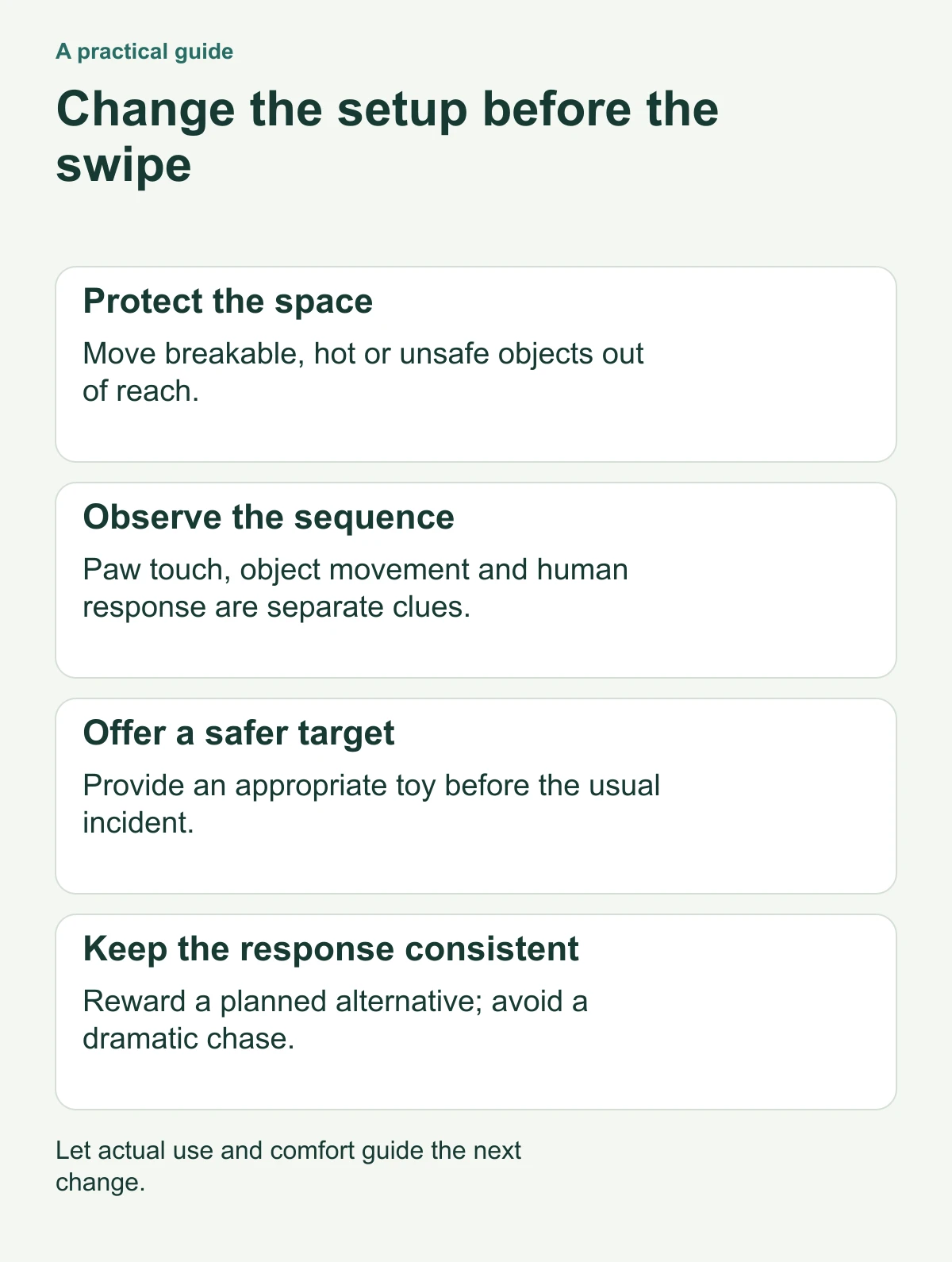
Move breakables into secure storage and keep hot drinks, medications, cleaners and unsuitable plants out of accessible areas. Shifting an object slightly back from an edge may reduce an accidental bump but will not make it unreachable to a determined paw. Choose protection based on the consequence if the object falls, not only the chance that it will happen.
Check the landing area too. An item can spill onto electrical equipment, hit another pet or leave sharp fragments along a route people use barefoot. If something dangerous falls, calmly separate animals from the area before cleaning. Deal with possible injury or exposure using professional advice; avoiding attention for the behavior never takes priority over an immediate hazard.
Where practical, offer a stable alternative route or perch so that moving through the room does not require stepping among ornaments. Secure the structure and inspect how the cat gets down. A cat-designated area is only an alternative if it is accessible and interesting enough to use. Simply placing a tree in a remote corner may leave the original route unchanged.
Observed sequence | What remains uncertain | First change |
|---|---|---|
Paw touches a new object, then follows it | Curiosity does not prove one motive | Offer a safe toy away from fragile items |
Body bumps objects on a narrow shelf | It may be a crowded route, not a deliberate swipe | Clear or replace the route |
Swiping repeats during desk work | Attention may be part of a learned sequence | Arrange an alternative before working |
Hot, toxic, sharp or swallowed material | Consequences can require urgent care | Separate safely and contact appropriate help |
Give the paws a safer object to investigate
Offer a suitable toy that moves when touched, with no loose pieces the cat can swallow. Begin on the floor or another safe, clear surface. Some cats prefer a rolling object, while others like following a target you move away from them. Supervise a new item and remove it if chewing, dismantling or damage changes its safety.
Keep the useful part of the action while changing its consequences. A cat who likes testing an object's movement can investigate an appropriate toy without needing access to a mug. You do not have to reproduce the crash or provide a fragile household object to make the alternative interesting. Watch what the cat chooses rather than assuming a purchased toy is automatically a match.
Use planned interactive play as another opportunity, keeping human fingers away from the target. For a kitten who also grabs hands or feet, the kitten biting guide covers the additional training task. Object pushing itself is not proof of aggression, and a plan for biting should not become the explanation for every desk incident.
Change the attention pattern before the usual moment
If swiping repeatedly happens when you work at a desk, consider the whole routine. You sit down, stop interacting, the cat approaches an object, and somebody gets up quickly. Your response may have become part of a sequence worth repeating. That possibility does not mean ignoring every need; check ordinary care and arrange appropriate interaction before the predictable moment.
Choose an alternative the cat can actually perform, such as settling on a nearby stable bed or engaging with a suitable independent-play item. Make that option rewarding before you begin the busy period. If the cat uses it while you work, acknowledge the behavior in a way they enjoy. It is easier to support an established alternative than invent one after something has already fallen.
For a safe, non-urgent incident, avoid an exciting chase or dramatic confrontation. Reset the surface and return to prevention. If each swipe immediately produces the most energetic toy game of the day, move that activity earlier next time. The aim is a predictable opportunity that does not depend on knocking an object down first.
Make your desk or shelf plan realistic
Change the environment in ways you can maintain. A desk used for work may need closed storage for small objects, a drink placed elsewhere and a separate resting option beside the room's activity. An evening ornament display may need a cabinet rather than repeated supervision. A rule that requires somebody to watch every surface all day is unlikely to last.
Agree on the response with other caregivers. If one person laughs and begins a chase while another scolds, the household is providing different events after the same action. Name the practical plan: store the vulnerable objects, offer an appropriate activity before desk work and reinforce the alternative place. Specific actions give people something consistent to repeat.
Use your cat's wider behavior to judge whether the arrangement is comfortable. A cat repeatedly leaving the alternative spot when another animal approaches may need a different location. The cat language guide helps you notice that sequence. If incidents occur alongside overnight calling, check the calling routine separately with the nighttime meowing guide.
Notice a change that is more than object play
An established cat suddenly stumbling into objects, misjudging familiar movement or behaving very differently needs veterinary advice. Describe the action and timing rather than assuming they have become destructive. A new mobility or coordination concern is not a reason to test a more difficult climbing route or repeatedly reproduce the incident for a video.
PetMira's care encyclopedia and AI Q&A can help you formulate an everyday behavior question from a clear sequence: where the object was, what the paw did and how people responded. Use the suggestion to refine a safer setup. It cannot establish your cat's intention or resolve a possible medical change, injury or ingestion.
Keep the interesting part and remove the hazard
Separate exploration, accidental bumps and the human response instead of treating every fallen object as a deliberate insult. Secure vulnerable items, provide an appropriate activity before the usual moment and keep the household plan consistent. A safer surface and a workable alternative give the next encounter a better ending.
Everyday care with PetMira
Prepare a safer everyday setup
Use PetMira’s care encyclopedia and AI Q&A to explore suitable activities while you protect shelves and keep household responses consistent.
 Explore the care encyclopedia
- Ask a focused everyday care question
- Use guidance alongside real-world observation
Available on iPhone. AI-generated information is for educational reference.
Download iOS App